Brown Bear Anatomy Reference for 3D Sculptors | Ursus arctos

Most brown bear sculpts fail in the same three places: the hump is built as fat instead of bone and muscle, the claws are twice as long as any real bear’s, and the rump is sculpted level with the shoulder when on a living animal it sits visibly lower. This page is the reference set that fixes those — measured skull and skeleton plates, every major subspecies, body mass tables with the study behind each number, and the fossil ancestors that explain why the skull is shaped the way it is.

On this page
- How to use this reference
- The numbers, at a glance
- Taxonomy: where the brown bear sits
- Ancestors and fossil relatives
- Subspecies, and which differences matter
- Measured dimensions by population and sex
- The skull and dentition
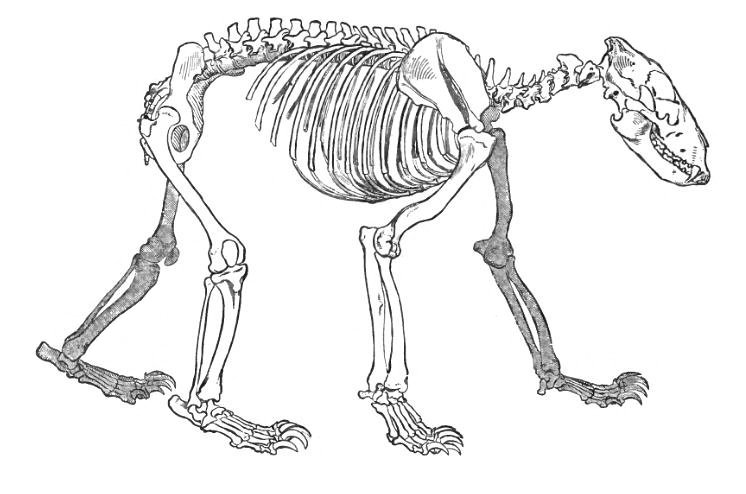
- The skeleton, and the truth about the hump
- Muscle and surface form
- Paws, claws and tracks
- Fur: colour, length and season
- Cubs and growth
- Locomotion and posing
- Software and brushes for sculpting a bear
- The sculptor’s checklist
- Frequently asked questions
- Sources
- Image credits and licences
How to use this reference
Reference images are not all doing the same job, and mixing them up is how proportions drift. Sort what follows into three piles before you start blocking out:
- Measured plates — trust the proportions. Orthographic skull renders, Blainville’s comparative osteology plates and museum mounts are dimensionally honest. Use these to set your scale and your silhouette.
- Photographs — trust the surface, not the proportions. Lens compression lies about muzzle length and limb thickness. Use photos for fur direction, skin folds, fat distribution and how light behaves in dense guard hair.
- Period engravings — trust the observation, not the anatomy. The 19th-century plates below are beautifully observed on things like scapula shape and pad structure, and quietly wrong about limb length. They are inspiration, not a blueprint.
Every figure in the tables below carries the source it came from. Where a value is an agency estimate rather than a measured mean, it says so. Brown bear mass swings up to 40 % between spring emergence and autumn hyperphagia, so a single number without a season attached is close to meaningless — all masses here are autumn, pre‑denning unless noted.
The numbers, at a glance
Taxonomy: where the brown bear sits
Ursus arctos Linnaeus, 1758 sits in the family Ursidae, subfamily Ursinae — the group containing every living bear except the giant panda and the Andean bear. Its closest living relative is the polar bear, and the two are close enough that they still produce fertile hybrids.
Chromosome-scale genomes published in 2025 put the common ancestor of all bears at about 18.7 Ma, the Ursinae radiation at about 4.34 Ma, and the brown–polar split at roughly 0.40 Ma. All six ursine species share a karyotype of 2N = 74. The tidy tree below hides something worth knowing: bear evolution is full of gene flow across species boundaries, including a major ancient hybridisation that pushed roughly a third of the northern group’s ancestry in from the Asiatic black bear lineage.
| Rank | Name | Note for reference work |
|---|---|---|
| Kingdom | Animalia | — |
| Class | Mammalia | — |
| Order | Carnivora | Keeps the full carnivoran dentition, but re-purposed |
| Suborder | Caniformia | Dog-line, not cat-line — non-retractile claws |
| Family | Ursidae | Plantigrade, short tail, 2N = 74 in Ursinae |
| Subfamily | Ursinae | Excludes giant panda and Andean bear |
| Genus | Ursus | With U. maritimus, U. americanus, U. thibetanus |
| Species | Ursus arctos Linnaeus, 1758 | ~15–16 named subspecies; far fewer are genetically distinct |
Scroll the table sideways →
The classic list follows Wozencraft’s 2005 Mammal Species of the World and runs to about 15 named subspecies. Most of those were erected on skull measurements and fur colour from small samples, and genetic work has since collapsed many of them — the Cantabrian pyrenaicus, for instance, is now generally folded into the nominate arctos. Treat subspecies as regional phenotypes worth sculpting, not as hard biological units.
Ancestors and fossil relatives
The brown bear’s skull did not appear from nowhere. Every feature you sculpt — the dished face, the blunted carnassials, the wide molar grinding surface — is a step on a sequence you can actually see in fossils, and sculpting the ancestors is the fastest way to understand why the modern animal is shaped as it is.
| Taxon | Age | Relationship | What changed |
|---|---|---|---|
| Ursavus | ~20–10 Ma | Stem ursine (“dawn bear”) | Roughly raccoon-sized; molars start broadening |
| Ursus minimus | ~5–2 Ma | Early Ursus | Small, near the root of the modern genus |
| Ursus etruscus | ~2.5–1 Ma | Direct stem form | The ancestor shared by brown bears and cave bears |
| Ursus deningeri | ~1.8–0.1 Ma | Cave bear lineage | Forehead steepens, dentition turns herbivorous |
| Ursus spelaeus | ~0.3–0.024 Ma | Cave bear, side branch | Domed forehead, massive limbs, near-herbivore |
| Arctodus simus | ~2.5–0.011 Ma | Tremarctine cousin | Short face, long limbs — not an ancestor |
| Agriotherium | ~10–2 Ma | Off-lineage giant | Huge, heavily carnivorous; leaves no descendants |
Scroll the table sideways →


Arctodus, the short-faced bear, is a tremarctine — the group whose only survivor is the Andean bear. It is a cousin on a different branch, not a brown bear ancestor. If you are building a Pleistocene scene, the two coexisted; do not treat one as the other’s grandfather.
Subspecies, and which differences matter
For a sculptor, only four axes of variation really change the model: overall mass, skull proportion, coat colour and length, and limb length relative to body depth. Everything else is a range-map footnote. The gallery below is ordered so those four axes read against each other.


| Subspecies | Range | Build | Coat | Sculpting cue |
|---|---|---|---|---|
| U. a. arctos Eurasian | Europe, W Russia, Caucasus | Medium, balanced | Mid to dark brown, sometimes silvered | The default proportions; everything else is a deviation |
| U. a. horribilis Grizzly | Interior N America | Leaner, longer-legged | Dark with pale guard-hair tips | Largest hump relative to body; dished face |
| U. a. middendorffi Kodiak | Kodiak Archipelago | Heaviest; deep barrel | Uniform mid-brown | Broad skull, short-looking legs under bulk |
| U. a. beringianus Kamchatkan | Kamchatka, Okhotsk coast | Very heavy, long-furred | Dark brown, often violet-tinged | Longest coat of the large subspecies |
| U. a. lasiotus Ussuri / Ezo | Amur, Sakhalin, Hokkaido | Variable; Hokkaido small | Darkest — often near-black | Value, not form: it reads as a black bear at distance |
| U. a. isabellinus Himalayan | Himalaya, Karakoram | Small, high-altitude | Sandy, reddish, pale | Short muzzle, dense woolly underfur |
| U. a. syriacus Syrian | Caucasus to Iran | Small, light-boned | Palest of all — cream to straw | Pale claws too, unlike every other subspecies |
| U. a. gobiensis Gobi | Mongolian Gobi | Smallest; gaunt | Pale sandy brown | Visible ribs and hips — sculpt it lean, not plump |
| U. a. collaris East Siberian | Yenisei to Bering Strait | Medium-large | Dark with a pale shoulder collar | The collar is the whole identity; keep it |
| U. a. marsicanus Marsican | Central Apennines | Medium, compact | Warm brown | Rounder skull, notably short muzzle |
Scroll the table sideways →
Measured dimensions by population and sex
This is the section the old version of this page got wrong, so it is worth being precise. Brown bear size tracks food, not subspecies. A Kodiak bear and a Gobi bear are genetically close; the threefold mass difference between them is salmon. Sculpt to a population, and state which one.
Body mass
| Population | Adult male | Adult female | Source |
|---|---|---|---|
| Kodiak Archipelago | Mature males avg 312–389 kg; up to ~680 kg | 120–318 kg | Troyer & Hensel 1969; Alaska Dept. of Fish & Game |
| Kamchatka | Mature males 350–450 kg; >600 kg after hyperphagia | ~200 kg | Revenko; Marciszak et al. 2015 |
| Hokkaido (captive) | Mean 257 kg (120–440) | Mean 151 kg (75–221) | Hokkaido captive series |
| Scandinavia | Asymptotic 245 kg | Asymptotic 114 kg | Swenson et al. 2007 |
| Greater Yellowstone | Mean 187 kg; max 324 kg | Mean 122 kg; max 198 kg | Interagency Grizzly Bear Study Team, via NPS |
| Himalaya (Pakistan) | ~135 kg | ~70 kg | Nawaz et al. 2008 |
| Gobi Desert | 96–138 kg | 51–78 kg | Gobi bear research review |
| Syria / Caucasus | 100–160 kg, sexes not separated in the literature | Regional survey data | |
Scroll the table sideways →
Linear dimensions
| Population | Head–body length | Shoulder height | Standing height |
|---|---|---|---|
| Kodiak | ~2.44 m total length | 1.33 m | Over 3.0 m for a large male |
| Grizzly (Yellowstone) | 1.8–2.13 m | 95.2 cm (mean) | ~2.2–2.4 m |
| Eurasian | 1.7–2.1 m | ~90–110 cm | ~2.0–2.5 m |
| Himalayan | ~1.4 m | ~70–80 cm | ~1.8 m |
| Gobi | ~1.0–1.5 m | ~65–75 cm | ~1.6 m |
Scroll the table sideways →
Across four Alaskan ecosystems, body-frame size — skull and body length — is complete at 8 to 14 years, but lean mass keeps increasing for the rest of the animal’s life. Within a single population, adult females vary about two-fold in lean mass and adult males three- to four-fold. So an “old male” is not a bigger skeleton than a prime male; it is the same skeleton carrying far more meat. Scale the muscle, not the frame.
Sexual dimorphism
| Trait | Adult male | Adult female | Sculpting note |
|---|---|---|---|
| Mass ratio | Males run roughly 1.6–2.2× female mass, population-dependent | Widest in coastal, narrowest in desert populations | |
| Skull | Deeper sagittal crest, wider zygomatic arch | Shallower crest, narrower arch | Crest depth is the single clearest sex marker |
| Neck | Thick, merges into the hump | Distinct from the shoulder | Read the neck–hump junction, not the body |
| Forehead | Broader, flatter between the ears | Narrower, more domed | Females keep a slightly more juvenile head |
| Vertebrae | Males significantly larger across cervical, thoracic and lumbar regions | Scale the whole column, not just the shoulder | |
Scroll the table sideways →
The skull and dentition
The brown bear skull is a compromise: a carnivore’s tooth count doing a herbivore’s job. The full carnivoran formula survives — I 3/3, C 1/1, P 4/4, M 2/3 = 42 teeth — but the carnassial blade is reduced and the molars are broadened into grinding platforms. The premolars between canine and carnassial are small, peg-like and frequently missing altogether in older animals, which is worth knowing before you model a perfect row.


Orthographic scan renders — measurable reference
The six plates below are orthographic renders of a photogrammetry-scanned brown bear skull, made for this reference. Because the camera is orthographic rather than perspective, you can measure directly off them and drop them straight into a reference plane in ZBrush or Blender without correcting for lens distortion.


| Measurement | This specimen | Context |
|---|---|---|
| Greatest skull length | 407.6 mm | Within the large-male range for Kamchatka (403–436 mm) |
| Zygomatic width | 255.6 mm | Male range 258–277 mm; this sits just below it |
| Skull height | 213 mm | Dorso-ventral, at the crest |
| Condylar (TMJ) width | 149.5 mm | Use this as the jaw pivot axis when rigging |
| Cranium volume | 3 070 cm³ | Watertight solid volume, not braincase capacity |
| Mandible volume | 472 cm³ | Both rami, watertight |
Scroll the table sideways →
Female skulls are not simply scaled-down male skulls. The sagittal crest is proportionally shallower and the zygomatic arches flare less, so a uniformly scaled male skull gives you a female with a male’s bite muscles. If you are sculpting a sow, pull the crest down and the arches in independently of overall size.
The skeleton, and the truth about the hump
Three things in the brown bear skeleton drive the silhouette, and all three are routinely got wrong.
- The thoracic spinous processes ramp upward. The dorsal spines of the forward thoracic vertebrae are long, and they are what the hump is built on. The hump is bone plus the rhomboideus and trapezius complex that anchors to it — it is never a fat deposit, and it does not vanish in spring when the animal is lean.
- The rump sits lower than the shoulder. On a standing brown bear the highest point of the back is the hump, and the line falls away toward the hips. Sculpt it level and the animal immediately reads as a black bear, whose rump is the high point.
- The hind foot is plantigrade and long. The whole sole, heel included, contacts the ground. This is the single biggest difference from any canid or felid you have sculpted before and it changes every pose from the ankle up.



Vertebral formula for rigging
| Region | Count | Rigging note |
|---|---|---|
| Cervical | 7 | Short and massive; far less mobile than a felid neck |
| Thoracic | 14 | Long dorsal spines at the front build the hump |
| Lumbar | 6 | Main flexion for the gallop — but limited travel |
| Thoracolumbar total | 20 (constant) | Holds even when a T15/L5 variant appears |
| Sacral | 5, fused | Rigid; treat as one bone |
| Caudal | ~8–10 | The tail is short and barely articulates — do not over-rig it |
Scroll the table sideways →

Comparison with related species
Comparative plates are the fastest way to see what is specific to Ursus arctos rather than generic to bears. The polar bear is the control: same genus, split 0.40 Ma, but a longer neck, a narrower skull and almost no hump because it stalks seals instead of digging roots.


Muscle and surface form
Bear musculature reads through the coat far less than a horse’s or a big cat’s does — dense underfur plus long guard hair smooths almost everything below the level of a major group. That is a licence to simplify, but only in the right places.
| Group | Reads through the coat? | What to do |
|---|---|---|
| Rhomboideus / trapezius (hump) | Strongly | Sculpt it fully. It is the animal’s signature. |
| Deltoid & triceps | Yes, when the limb is loaded | Show them in a charge or a dig, soften them at rest |
| Latissimus dorsi | As a broad plane, not a shape | A wide soft transition, no defined border |
| Gluteals / quadriceps | Only in motion | Mass over definition; the rump is a rounded block |
| Epaxials along the spine | Rarely | They set the back’s curve, not its surface |
| Masseter & temporalis | Yes — on the head | Drives the cheek; the head is where definition lives |
| Abdominals | No | Belly hangs; in autumn it swings visibly when walking |
Scroll the table sideways →
Put your anatomical detail in the head, the forelimbs below the elbow and the paws — the three places where hair is short enough for form to read. Everywhere else, sculpt mass and let the groom do the talking. Sculpts that fail usually have the opposite distribution: a heavily defined ribcage and a vague, under-observed muzzle.
Paws, claws and tracks
The forefoot and hindfoot are genuinely different structures and this is where period diagrams earn their place: Pocock’s pad plates below show the arrangement more clearly than any photograph. The front pad is a wide transverse bar; the hind is a long plantigrade sole running back to the heel.


| Feature | Measured value | Note |
|---|---|---|
| Front claw, mean | 45 mm along the curve | Greater Yellowstone grizzlies |
| Front claw, record | 150 mm | An outlier — do not use as a default |
| Hind claw | Roughly half the front | Hind feet do not dig |
| Retractile? | No | Always extended, always blunted by ground contact |
| Claw colour | Dark horn | Except Syrian bears, which have pale claws |
| Toes | 5 front, 5 hind | Toe pads sit in a nearly straight line — a curve reads as a black bear |
Scroll the table sideways →

Fur: colour, length and season
“Brown” bear is a bad name for an animal that ranges from cream to black. Colour is not a reliable subspecies marker, but coat structure is consistent everywhere: a dense woolly underfur carrying the insulation, and long guard hairs over it carrying the colour and the silhouette.
| Region | Guard hair length | Groom note |
|---|---|---|
| Hump & withers | Longest — up to ~15 cm winter | Exaggerates the hump further; comb back and slightly out |
| Neck ruff | Long | Breaks the head–shoulder transition; heaviest in Kamchatkan bears |
| Flanks | Medium | Flows down and back; shows the spring moult first |
| Belly | Long but sparse | Hangs; reads as fringe in profile |
| Legs, lower | Short | Form reads here — sculpt, don’t groom |
| Face & muzzle | Shortest | Where all facial anatomy has to be sculpted properly |
Scroll the table sideways →


The two photographs above are the same individual — bear 284 at Katmai, photographed fat and lean. That is not a different animal and it is not a different shader: it is a different mesh. A bear can shift up to 40 % in mass between spring emergence and autumn hyperphagia, and it shows in the depth of the barrel, the height of the belly line and whether the neck reads separately from the shoulders at all. Decide the season before you block out.
Cubs and growth
Cub proportions are not adult proportions scaled down, and the numbers here are unusually well-measured because much of the data comes from captive breeding programmes.


| Stage | Measurement | Source |
|---|---|---|
| Birth mass | 419 ± 40 g, no sex difference | Tsubota et al. 1994 (Hokkaido, 192 cubs) |
| Birth date | 91 % born 17 Jan – 5 Feb | Tsubota et al. 1994 (107 litters) |
| Litter size | Mean 1.82 (captive) / 2.04 (Yellowstone), range 1–4 | Tsubota et al. 1994; IGBST via NPS |
| Daily gain | 0.018–0.130 kg/day, slower in large litters | Tsubota et al. 1994 |
| Den emergence | 7–9 kg by May–June | Alaska Dept. of Fish & Game |
| Independence | 2–3 years with the sow | — |
| Female first breeding | 5.8 years (Yellowstone) | IGBST via NPS |
Scroll the table sideways →
- No hump. It is built by years of digging. A cub’s back line is almost level.
- Domed forehead, stubby muzzle. The face lengthens dramatically between years one and three.
- Oversized paws. Feet reach adult proportion long before the body does.
- Pale natal collar. Common across subspecies; usually gone by the second year.
- Proportionally longer legs. Cubs are leggy; bulk arrives later.
Locomotion and posing
Four poses cover almost every brief, and each has a specific anatomical trap.


| Pose | What is really happening | The trap |
|---|---|---|
| Walk | Lumbering pace; the whole sole lands | Animating a digitigrade footfall — the heel must touch |
| Gallop | 56–64 km/h with limited spinal flexion | Borrowing a felid’s spine bend; bears are far stiffer |
| Standing bipedal | Scenting and seeing, not threatening | Posing it as aggression; the body reads relaxed |
| Swimming | Only muzzle, eyes and hump above water | Floating the whole back — bears sit low |
Scroll the table sideways →
Software and brushes for sculpting a bear
The bear-specific requirement is not the sculpt — any of these will sculpt a bear. It is what happens after: a body this large covered in 15 cm guard hair needs a groom, and the right choice is usually the package whose hair system you already know.
| Software | Best for | Fur workflow | Verdict for a bear |
|---|---|---|---|
| ZBrush | Production creature work | FiberMesh for look-dev; groom in XGen / Ornatrix / Yeti | Still the benchmark. Unbeatable at high-density detail and posing with Transpose. |
| Blender | Everything, free | Hair Curves natively, with sculptable curve brushes | The best single-package answer: sculpt, retopo, groom, rig and render without leaving it. |
| 3D‑Coat | Blockout and silhouette | External | Voxel sculpting means you can fight for the silhouette without ever thinking about topology. |
| Mudbox | Layer-based detail passes | External (XGen) | Niche now, but its layer system is still pleasant for skin passes. |
| Nomad Sculpt | iPad / on the move | Limited | Genuinely capable for blockouts and studies; not where you finish a hero bear. |
Scroll the table sideways →
Brushes, in the order you actually use them
| Stage | ZBrush | Blender | What it is for on a bear |
|---|---|---|---|
| 1. Gesture | Move, Move Topological | Elastic Deform, Grab | Find the back line and the hump-to-rump fall before anything else |
| 2. Mass | Clay Buildup | Clay Strips | The workhorse. Build the hump, the barrel and the haunches in broad strokes |
| 3. Big forms | Clay, Inflate | Clay, Inflate | Rounding the rump and the ribcage into single readable masses |
| 4. Transitions | Smooth (low intensity), hPolish | Smooth, Flatten | Softening muscle borders so they read through fur, not like a flayed model |
| 5. Creases | Dam Standard | Crease | Lip line, eyelids, nostril wings, the fold behind the shoulder |
| 6. Sharpening | Pinch | Pinch | Tightening claw edges and the rim of the rhinarium |
| 7. Fur clumps | Slash3 / Slash2, Standard + alpha | Draw Sharp, Scrape + alpha | Sculpted guard-hair clumps for silhouette-critical areas |
| 8. Long hair | Snake Hook | Snake Hook | Pulling neck-ruff and hump strands where a groom cannot reach |
| 9. Skin detail | Standard + alpha, Orb Cracks | Draw + texture brush | Nose pad, foot pads, the bare skin inside the ear |
| 10. Pose | Transpose, ZModeler | Pose brush, armature | Final weight shift — always check the plantigrade heel |
Scroll the table sideways →
Drop Clay Buildup’s Z Intensity to around 10–15 and build the hump in many light passes instead of a few heavy ones. Bears are made of soft, overlapping volumes with almost no hard edges; a high-intensity clay stroke gives you facets that no amount of later smoothing fully removes. The same applies to Blender’s Clay Strips — halve the default strength.
The sculptor’s checklist
Run this before you call a brown bear finished.
- Is the hump the highest point of the back, with the line falling toward the hips?
- Is the hump built on bone — a visible ramp of thoracic spines — rather than modelled as a fat pad?
- Do the hind feet sit flat, heel and all, in every contact pose?
- Are the front claws around 45–60 mm at the model’s scale, not 150 mm?
- Do the toe pads sit in a straight line rather than an arc?
- Is the muzzle short and deep, with a broad flat rhinarium rather than a domed canine nose?
- Does the facial profile dish between the eyes, if you are sculpting a grizzly?
- Is the sagittal crest appropriate to the sex, not simply scaled with the body?
- Is the neck short and thick, merging into the hump rather than reading separately?
- Is there a season — spring lean with a ragged coat, or autumn heavy with an even one?
- Is the detail concentrated in head, lower forelimbs and paws, with mass elsewhere?
- Have you named the population you are sculpting, and matched its mass and limb proportion?
Frequently asked questions
How many bones does a brown bear have?
There is no reliable published total, and the figure of 206 that circulates online is simply the human bone count copied across. What is actually measured and citable is the vertebral formula. A 2026 morphometric study of eight adult brown bears found the typical formula to be C7 – T14 – L6, with the thoracolumbar total held constant at 20 even in the one female that showed a T15/L5 arrangement. Add 5 fused sacral and roughly 8–10 caudal vertebrae. For rigging, that constant of 20 thoracolumbar joints is the number you actually need.
How long are a brown bear’s claws?
Shorter than most sculpts assume. Front claws on Greater Yellowstone grizzlies average 45 mm measured along the curve; the longest on record there is 150 mm. Anything past about 100 mm is an outlier, not a default. Hind claws are roughly half the length of the front ones, because they do not dig.
What is the shoulder hump actually made of?
Muscle and bone, never fat. The thoracic vertebrae carry unusually long dorsal spinous processes, and the rhomboideus and trapezius complex that anchors to them drives the forelimb during digging. That is why the hump is largest on digging-heavy interior grizzlies, why it is small on cubs, and why polar bears — who dig far less — barely have one. Sculpt the bone ramp first and let the muscle sit on it.
Which brown bear subspecies is the largest?
The Kodiak bear (U. a. middendorffi) and the Kamchatkan brown bear (U. a. beringianus) are the heaviest, both averaging well over 300 kg for mature males. The difference is diet, not lineage: both have unlimited salmon. The Gobi bear, genetically a brown bear too, averages under 140 kg because it does not.
How different are male and female brown bears?
Substantially, and it shows in the skull before it shows in the body. Males run roughly 1.6–2.2× female mass depending on population, carry a deeper sagittal crest, a broader zygomatic arch and a heavier neck, and keep growing lean mass for years after the skeleton has stopped growing. Body-frame size is reached at 8–14 years, but lean mass keeps climbing for life.
Is a grizzly the same thing as a brown bear?
A grizzly is a brown bear — Ursus arctos horribilis, the interior North American subspecies. Coastal Alaskan bears of the same species are usually called brown bears rather than grizzlies, and are far heavier on the same genes. For a sculptor the practical distinction is condition, not taxonomy: interior bears are leaner and longer-legged, coastal bears are deeper through the barrel.
What is the best software for sculpting a bear?
ZBrush if you already own it, Blender if you do not. The bear-specific requirement is a good fur workflow on top of the sculpt, and both handle it — ZBrush via FiberMesh into an external groom, Blender via Hair Curves natively. 3D‑Coat is the strongest option if you want to block out in voxels and never think about topology while you find the silhouette.
Sources
- Wooldridge, T. B. et al. (2025). Chromosome-scale genomes show rapid diversification and ancient gene flow among bear species. Genome Biology and Evolution 17(11):evaf188. — Divergence times and karyotype.
- Kumar, V. et al. (2017). The evolutionary history of bears is characterized by gene flow across species. Scientific Reports 7:46487. — Ursidae topology and introgression.
- Ruzhanova-Gospodinova, I. (2026). Morphometric characteristics of the cervical, thoracic and lumbar vertebrae of the brown bear (Ursus arctos): sexual dimorphism and size variation. — Vertebral formula C7–T14–L6 and the constant thoracolumbar total of 20.
- Hilderbrand, G. V. et al. (2018). Body size and lean mass of brown bears across and within four diverse ecosystems. Journal of Zoology 305(1):53–62. — Frame size complete at 8–14 years; lean mass continues increasing.
- Swenson, J. E. et al. (2007). Brown bear body mass and growth in northern and southern Europe. Oecologia 153:37–47. — Scandinavian asymptotic masses, 245 kg / 114 kg.
- Tsubota, T., Maeda, N. & Kanagawa, H. (1994). Parturition and postnatal development in the captive Hokkaido brown bear. Journal of the Mammalogical Society of Japan 19(2):75–82. — Cub birth mass, litter size and growth rates.
- Sacco, T. & Van Valkenburgh, B. (2004). Ecomorphological indicators of feeding behaviour in the bears. Journal of Zoology 263:41–54. — Reduced carnassial blade and molar grinding area.
- Interagency Grizzly Bear Study Team, via the U.S. National Park Service, Yellowstone Grizzly Bear Facts. — Mass, claw length, speed, litter size and denning duration.
- Alaska Department of Fish & Game, Kodiak brown bear fact sheet. — Kodiak mass, height, cub emergence mass.
- Troyer, W. & Hensel, R. (1969) and Nawaz, M. A. et al. (2008). — Kodiak and Himalayan population dimensions.
- Wozencraft, W. C. (2005). Order Carnivora, in Mammal Species of the World, 3rd ed. — The subspecies list this article follows.
Image credits and licences
Every photograph and plate on this page comes from Wikimedia Commons under a free licence, or is an original render made for this article. Full attribution below, as each licence requires.
| Image | Author | Licence | Source |
|---|---|---|---|
| brown-bear-ursus-arctos-kodiak-adult-male | Marshmallow | CC BY 2.0 | Alaska Brown Bear.jpg |
| brown-bear-eurasian-ursus-arctos-arctos | Charles J. Sharp | CC BY-SA 4.0 | Eurasian brown bear (Ursus arctos arctos) 14 months 2.jpg |
| grizzly-bear-ursus-arctos-horribilis-yellowstone | Betty Wills (Atsme on Wikipedia) | CC BY-SA 4.0 | Grizzly half upright.png |
| kodiak-bear-ursus-arctos-middendorffi | Alaska Region U.S. Fish & Wildlife Service from Anchorage, United States | Public domain | Kodiak brown bear (23503323660).jpg |
| kamchatka-brown-bear-ursus-arctos-beringianus | Kandukuru Nagarjun from Bangalore, India | CC BY 2.0 | Massive beast (53169058678).jpg |
| ussuri-brown-bear-ursus-arctos-lasiotus | Calistemon | CC BY-SA 4.0 | Taxidermied Ussuri brown bear (Ursus arctos lasiotus) on d… |
| himalayan-brown-bear-ursus-arctos-isabellinus | Zoo Hluboka | CC BY-SA 4.0 | Medvěd plavý (Ursus arctos isabellinus).jpg |
| syrian-brown-bear-ursus-arctos-syriacus | מתניה | CC BY-SA 3.0 | Ursus arctos syriacus in Jerusalem Biblical Zoo alone.JPG |
| gobi-bear-ursus-arctos-gobiensis | Hunter J. Causey | CC BY-SA 1.0 | Ursus arctos gobiensis.jpg |
| east-siberian-brown-bear-ursus-arctos-collaris | Unknown author Unknown author | Public domain | Ours mâle de Sibérie (Ursus collaris)- Histoire naturelle … |
| marsican-brown-bear-ursus-arctos-marsicanus | Alastar 07 | CC BY-SA 4.0 | Orso marsicano – Parco Nazionale della Majella.jpg |
| brown-bear-cub-kodiak-snow | Alaska Region U.S. Fish & Wildlife Service from Anchorage, United States | Public domain | Kodiak brown bear cub in the snow (51942617571).jpg |
| brown-bear-cubs-play-fighting-bipedal | Steve Hillebrand, U.S. Fish and Wildlife Service | Public domain | Two grizzly bear cubs playing on their hind legs.jpg |
| brown-bear-mother-with-spring-cubs | USFWSAlaska | Public domain | Kodiak brown bear with cubs (17622757303).jpg |
| brown-bear-skull-lateral-ursus-arctos | Ta-Ntalas | Public domain | Ursus arctos skull.JPG |
| grizzly-bear-skull-ursus-arctos-horribilis | thedemonhog | CC BY-SA 4.0 | Grizzly skull.jpg |
| brown-bear-skull-museum-specimen-mwnh | Klaus Rassinger und Gerhard Cammerer , Museum Wiesbaden | CC BY-SA 3.0 | Ursus arctos 01 MWNH 145.JPG |
| bear-skull-profile-outlines-comparison | Zbigniew Ryziewicz | Public domain | Schemat zarysu profili u niedźwiedzi JStach.jpg |
| brown-bear-dentition-ursus-arctos | Charles Knight | Public domain | Animaldentition ursusarctos.png |
| himalayan-brown-bear-skull-lithograph | Joseph Smit | Public domain | UrsusSkullSmit.jpg |
| ussuri-brown-bear-skull-lithograph | Joseph Smit | Public domain | UssuriBearSkull.jpg |
| brown-bear-skeleton-lydekker-lineart | Richard Lydekker | Public domain | BearSkeletonLyd.jpg |
| brown-bear-skeleton-museum-bologna | Marco Vinci | CC BY-SA 3.0 | Scheletro di Orso, Bear skeleton, museo di Anatomia Compar… |
| brown-bear-skeleton-iconographia-zoologica | Unknown | Public domain | Ursus arctos – skelet – 1700-1880 – Print – Iconographia Z… |
| bear-artistic-anatomy-cuyer-plate | Cuyer, Édouard; Haywood, George. | Public domain | Artistic anatomy of animals (Page 50) BHL22847443.jpg |
| brown-bear-skeleton-blainville-plate | Blainville, H.-M. Ducrotay de (Henri-Marie Ducrotay) | Public domain | Description iconographique comparée du squelette et du sys… |
| brown-bear-viscera-internal-anatomy-plate | Unknown | Public domain | Ursus arctos – ingewanden – 1700-1880 – Print – Iconograph… |
| brown-bear-paws-fore-and-hind-pads | Reginald Pocock (4 March 1863 – 9 August 1947) | Public domain | Brownbearpaws.jpg |
| brown-bear-front-paw-claws-detail | NPS/Kaiti Critz | Public domain | Brown Bear Paws.jpg |
| grizzly-bear-claw-close-up | Jim Chapman | CC BY 2.0 | Bearclaw.jpg |
| brown-bear-track-footprint-snow | Walter Inspruckner | CC0 | Baerenspur Shafat Valley.jpg |
| brown-bear-nose-rhinarium-ears-diagram | Reginald Pocock (4 March 1863 – 9 August 1947) | Public domain | Brownbearnose&ears.jpg |
| brown-bear-running-gallop-reference | Malene Thyssen | CC BY 2.5 | Brown bear (Ursus arctos arctos) running.jpg |
| brown-bear-standing-bipedal-hind-legs | David Menke | Public domain | Kodiak Bear standing on hind legs, USFWS 11394.jpg |
| brown-bear-swimming-reference | Eric Kilby from Somerville, MA, USA | CC BY-SA 2.0 | Swimming Brown Bear (54257257142).jpg |
| brown-bear-fishing-salmon-brooks-falls | Wilker Greg, U.S. Fish and Wildlife Service | Public domain | Brown bear sow with salmon ursus arctos.jpg |
| ursus-etruscus-skull-ancestor | Ghedoghedo | CC BY-SA 3.0 | Ursus etruscus skull.JPG |
| ursus-minimus-fossil-skull | Ghedoghedo | CC BY-SA 3.0 | Ursus minimus 1.JPG |
| ursus-deningeri-skull | HJunghans | CC BY-SA 4.0 | Ursus deningeri skull.JPG |
| cave-bear-ursus-spelaeus-skeleton | Unknown | CC BY-SA 3.0 | Ursus spelaeus skeleton – MUSE.JPG |
| short-faced-bear-arctodus-simus | Sergiodlarosa (Sergio De La Rosa) | CC BY-SA 3.0 | Arctodus on a white background Sergiodlarosa.png |
| agriotherium-fossil-bear | Ghedoghedo | CC BY-SA 3.0 | Agriotherium insignis plio montpellier.JPG |
| ursavus-early-bear-fossil | Skye McDavid | CC BY-SA 4.0 | Ursavus tedforti.jpg |
| brown-bear-vs-giant-panda-skull-comparison | Emőke Dénes | CC BY-SA 4.0 | Em – Ailuropoda melanoleuca and Ursus arctos – 1.jpg |
| polar-bear-skeleton-blainville-plate | Blainville, H.-M. Ducrotay de (Henri-Marie Ducrotay) | Public domain | Description iconographique comparée du squelette et du sys… |
| spectacled-bear-skeleton-blainville-plate | Blainville, H.-M. Ducrotay de (Henri-Marie Ducrotay) | Public domain | Description iconographique comparée du squelette et du sys… |
| bear-skull-comparison-cambridge-natural-history | Frank E. Beddard | Public domain | Cambridge Natural History Mammalia Fig 212.png |
| brown-bear-skull-scan-lateral | animalanimator.com | Original work | Original render for this article |
| brown-bear-skull-scan-dorsal | animalanimator.com | Original work | Original render for this article |
| brown-bear-skull-scan-palate | animalanimator.com | Original work | Original render for this article |
| brown-bear-skull-scan-frontal | animalanimator.com | Original work | Original render for this article |
| brown-bear-mandible-scan-lateral | animalanimator.com | Original work | Original render for this article |
| brown-bear-mandible-scan-occlusal | animalanimator.com | Original work | Original render for this article |
| brown-bear-silhouette-white-background | lwolfartist | CC BY 2.0 | Brown bear on a white background.png |
| brown-bear-skull-frontal-mwnh | Klaus Rassinger und Gerhard Cammerer , Museum Wiesbaden | CC BY-SA 3.0 | Ursus arctos 02 MWNH 145.JPG |
| brown-bear-fat-autumn-hyperphagia | KatmaiNPS | Public domain | 284 (Fat) (53222164871).jpg |
| brown-bear-lean-spring-condition | KatmaiNPS | Public domain | 284 (Skinny) (53229069877).jpg |