Nine Things That Make a Horse’s Lower Jaw
Drag to turn the jaw. Each glowing point marks a structure that does real work — three parts of the dentition, six of the bone. Tap a point to pin its note, tap again to clear it.
Tap a glowing point to read it
Four Ways to Read a Horse’s Lower Jaw
Each plate is rendered from the same photogrammetric scan, lit once and labelled from measured points — not traced by hand. Tap any plate to open it full-screen, then pinch or double-tap to zoom into the enamel.
Rendered in Blender (Cycles) from a photogrammetric scan. Warm key, teal rim, labels placed from projected 3D coordinates.
A horse is a machine for turning grass into distance
Everything awkward about animating one comes from that sentence. The legs are long because distance is cheap when your limbs are levers. The neck swings because a 50 kg head on a stick needs a spring to carry it. The teeth grow for life because grass is full of silica and files them flat. Get those three facts into your rig and the animation stops looking like a large dog.
- Gait choiceU-shaped Oxygen cost per metre bottoms out at one speed per gait. Horses pick the gait that sits at the bottom — they do not accelerate through a trot the way we imagine.1
- Neck spring55% Share of the work of moving the head and neck at walk that comes from elastic recoil in the nuchal ligament, not muscle. 33% at trot, 31% at canter.2
- Dentition2–4 mm Worn off the cheek teeth every year, and replaced from a reserve crown buried in the jaw. The tooth is a slowly extruding column.3
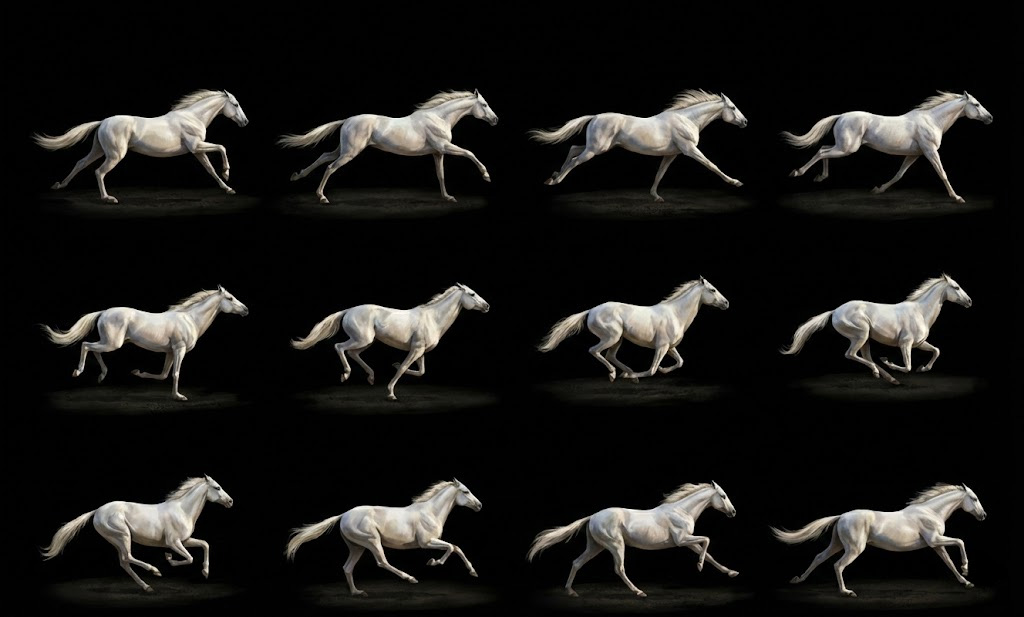
Horse animation cycles are the backbone of believable equine characters in film, games and simulation. The five gaits below — idle, walk, trot, canter and gallop — are not stylistic choices. They are distinct, measurable patterns of footfall, each with its own energetic sweet spot, and an audience notices when one is wrong long before it can say why.
The five gaits, as footfall patterns
Beat count is the thing to animate. Everything else — head carriage, tail, muscle jiggle — hangs off getting these contacts in the right order and the right spacing.
| Gait | Beats | Footfall order | Suspension | Typical speed | What animators get wrong |
|---|---|---|---|---|---|
| Idle | — | Weight shifts, one hind resting | None | 0 | Perfect stillness. A standing horse never stops moving: ears, tail, skin twitches, a cocked hind that swaps every minute or so. |
| Walk | 4 | LH → LF → RH → RF | None — always 2 or 3 feet down | 1.4–1.7 m/s | Adding float. There is no airborne phase in a walk, ever. |
| Trot | 2 | (LF+RH) → (RF+LH) | Yes, between diagonal pairs | 3–4 m/s | Breaking the diagonal. The pair lands and lifts together; even a frame of offset reads as lameness. |
| Canter | 3 | RH → (LH+RF) → LF (left lead) | Yes, after the leading fore | 5–8 m/s | Ignoring lead. A canter is asymmetric; the lead fore reaches further forward and the whole body is subtly bent that way. |
| Gallop | 4 | RH → LH → RF → LF (left lead) | Yes, when fully gathered | 9–17 m/s | Putting suspension at full extension. The airborne phase happens collected, legs tucked under, not spread like a hobby horse. |
Hoyt and Taylor put horses on a treadmill and measured oxygen consumption across speeds. For each gait the cost-per-metre curve is U-shaped, and the three curves bottom out at different speeds. Given a free choice, the horses moved at the speed near each gait's minimum and switched gait rather than pushing one past its efficient range.1 For a game locomotion blend tree that means the honest solution is three tuned cycles with transitions, not one cycle time-scaled across the whole speed range.
1. Idle: the foundation of rest and subtlety
An idling horse is never still. It rests a hind leg — locking the stifle with the passive stay apparatus so the limb holds weight with almost no muscular effort — and swaps which hind is resting every minute or two. Ears track sound independently through roughly 180°. The tail swings at flies. In War Horse or Breath of the Wild, this layer is what stops a background animal reading as set dressing. Animate the weight shift first and the small stuff second; a twitching ear on a rigidly planted body still looks like a statue.
2. Walk: four beats, no float
The walk is a four-beat lateral-sequence gait: left hind, left fore, right hind, right fore. Two or three hooves are on the ground at every instant, so there is no suspension phase to animate — the single most common error in horse walk cycles. The head nods in time, and that nod is not decoration: it is the nuchal ligament storing and returning elastic energy as the neck oscillates, contributing more than half the work of moving the head and neck at this gait.2 Kill the nod and the horse looks like it is being pushed on a trolley.

3. Trot: two beats, diagonal pairs
Diagonal pairs move together — left fore with right hind, then right fore with left hind — separated by a moment of suspension. The trot is the horse's cruising gear and the gait with the widest efficient speed band, which is why endurance work happens here. For animators the discipline is symmetry: the two legs of a diagonal pair must contact on the same frame. Offset them by even one frame and viewers read it as a limp, without knowing why.

4. Canter: three beats, and a lead
A three-beat rocking gait: outside hind, then a diagonal pair, then the leading foreleg, then suspension. The canter is asymmetric — it has a lead, and the leading fore reaches further forward while the body carries a slight bend toward it. Most amateur canter cycles are built symmetrically and then look subtly wrong from every angle. If your character turns, it should change lead; a horse cantering on the wrong lead through a corner looks unbalanced because it is.

5. Gallop: four beats, gathered flight
The gallop breaks the canter's diagonal pair into separate beats, giving four distinct footfalls and a longer airborne phase. The detail that separates a good gallop from a rocking-horse gallop: suspension happens when the horse is collected, hind legs swinging forward under the belly, not at full extension with legs splayed fore and aft. That splayed pose is the "flying gallop" of Victorian painting, and Muybridge's photographs disproved it in 1878. It is still the single most repeated mistake in horse animation.

Top 5 horse breeds for reference (2025)
These breeds dominate registrations and ownership worldwide, especially in North America. Figures are averages for adult animals; stallions run slightly larger than mares within each breed.
| Rank | Breed | Height (hands / cm) | Weight (kg) | Primary roles | Coat & features |
|---|---|---|---|---|---|
| 1 | American Quarter Horse | 14.3–16 (145–163) | 430–590 | Ranch work, western riding, reining, cutting | Bay, sorrel/chestnut, black, dun; heavily muscled hindquarter |
| 2 | Thoroughbred | 15.2–17 (157–173) | 450–700 | Racing, eventing, jumping | Bay, chestnut, black, grey; long-limbed and refined |
| 3 | American Paint Horse | 14.2–16.1 (147–165) | 430–590 | Western pleasure, trail, stock work | Tobiano/overo pinto patterns over any base colour |
| 4 | Arabian | 14.1–15.2 (145–157) | 360–450 | Endurance, dressage, showing | Dished face, high tail carriage, often one fewer lumbar vertebra |
| 5 | Appaloosa | 14–16 (142–163) | 430–570 | Trail, western, versatility | Leopard/blanket/snowflake spotting, striped hooves, mottled skin |
Stallion (intact adult male)
| Category | Detail for 3D animators |
|---|---|
| Dimensions | Withers 15–17 hands (152–173 cm), typically ~16 hands (163 cm). Shoulder-to-hip ~160–180 cm. Nose to tail ~240–280 cm. Head ~60 cm. |
| Weight | 450–700 kg, typically 550–650 kg. Carries noticeably more muscle mass than a mare of the same breed. |
| Behaviour | Herd protector and breeder; territorial toward rival males. Bold postures, arched neck, roaring vocalisation, flehmen response, herding and nipping. Generally more reactive under saddle. |
| Coat | Species-wide range: bay (most common), chestnut/sorrel, black, grey (lightens with age), dun, buckskin, palomino, roan, cremello, pinto, appaloosa spotting. No strongly sex-linked colours. |
| Dimorphism | Pronounced. Thicker, crested neck (nuchal ligament and overlying muscle), heavier jaw and jowls, broader chest and shoulder, thicker bone. Typically 50–100 kg heavier. Visible sheath. |
| Animator notes | Crest rolls and wobbles independently on direction changes — worth a secondary bone or jiggle deformer. Proud neck carriage, thicker mane, powerful shoulder and hindquarter masses, flared nostrils under exertion. Rig the scapula to slide freely: a horse has no clavicle, so the shoulder blade glides on a muscular sling. |
| Anatomy | Typically 40–42 teeth (canines, or "tushes", present in nearly all males; wolf teeth variable). Passive stay apparatus locks the limbs for standing rest. No clavicle. Splint bones are vestigial 2nd and 4th metacarpals. 15–21 caudal vertebrae. No gall bladder. |
Mare (adult female)
| Category | Detail for 3D animators |
|---|---|
| Dimensions | Withers 14.2–16.2 hands (147–165 cm), typically ~15.2 hands (157 cm). Shoulder-to-hip ~155–175 cm. Nose to tail ~230–270 cm. Narrower frame overall. |
| Weight | 400–650 kg, typically 500–580 kg. |
| Behaviour | Frequently the decision-maker in a herd — chooses when to move and where to graze. Strongly protective of a foal. Oestrus brings cyclical behaviour change. Usually steadier than a stallion under saddle. |
| Coat | Same range as the stallion; no meaningful sex difference in colour distribution. |
| Dimorphism | Slimmer neck with little or no crest, narrower chest and head, lighter jowls, more refined outline. Udder visible in a mare that has foaled. |
| Animator notes | Cleaner topline and a softer jawline; subtler muscle definition than a stallion. Oestrus posture (raised tail, "winking") is a useful idle variation. Same free-floating scapula gives the elegant shoulder extension you see at trot. |
| Anatomy | Usually 36–40 teeth — canines are small or absent in most mares. Seasonally polyoestrous, cycling roughly every 21 days in the breeding season. Wider pelvic canal. Otherwise as the stallion: no clavicle, no gall bladder, hindgut fermenter. |
Foal (birth to ~1 year)
| Category | Detail for 3D animators |
|---|---|
| Dimensions | Withers 90–110 cm at birth. Body length ~100–130 cm. Reaches roughly 90% of adult height by 12–18 months. Legs are close to adult length at birth — that is the whole reason the proportions look strange. |
| Weight | Birth 40–70 kg (~10% of the dam's weight). Weaning at six months 200–300 kg. Yearling 280–380 kg. |
| Behaviour | Imprints within hours, then shadows the dam constantly. Nurses frequently and plays hard — bucking and prancing are muscle and coordination training, not decoration. |
| Coat | Often born darker, sometimes with primitive markings (dorsal stripe, leg barring) that fade. Grey foals are born dark and lighten. A fuzzy foal coat sheds to adult colour within the first year. |
| Dimorphism | Minimal before puberty. Proportions are essentially identical between colts and fillies until roughly two to three years. |
| Animator notes | Oversized head and eyes, short muzzle, large ears, round belly, long spindly legs, fuzzy coat. Exaggerated high knee action and a bouncy, over-corrected balance. Newborns wobble: build a separate unstable stand-up cycle rather than scaling the adult idle. |
| Anatomy | Deciduous ("milk") teeth. Growth plates still open. Pasterns upright at birth and settle with growth. Stands and runs within hours of birth — a precocial species, unlike a puppy or kitten. |
These figures describe light riding horses of Quarter Horse, Thoroughbred and Arabian type. Draft breeds such as the Clydesdale run 16–18+ hands and 700–1000+ kg; pony breeds are smaller throughout. Key rigging takeaways: no clavicle, so the scapula slides on a muscular sling; the nuchal ligament acts as a genuine spring for the head and neck; the tail carries 15–21 vertebrae and needs a real chain to swish convincingly.
The gap that made the horse rideable
Between the corner incisor and the first cheek tooth, a horse carries roughly 70 mm of jaw with no tooth in it at all. Horsemen call it the bars. It exists because a grazer needs cropping teeth at the front and grinding teeth at the back, and nothing useful in between — and it is the only reason a bit can sit in a horse's mouth.
That is not a comfortable arrangement. The bar is bare bone under a few millimetres of gum, with no tooth to spread the load. A study of Icelandic competition horses examined before and after competition found that lesions in the interdental space rose from 8% to 31%, most graded severe, with ported curb bits identified as a decisive risk factor.4 A separate survey of 144 riding horses found bone changes in the same region at similar rates.5 If you are animating a bridled horse, this is the tissue every rein aid is transmitted through.
Incisors erupt on a schedule — i1 at about 2½ years, i2 at 3½, i3 at 4½ — and that part is reliable. What follows is not. Studies of horses of known age found that Galvayne's groove and the "seven-year hook" are too variable to be useful, and that overall accuracy of ageing from dentition falls away sharply in adults.6,7 Useful for a character brief: a horse's teeth tell you young, adult or old, not a number.
Muscles, topline and what actually moves
A horse carries somewhere over 700 skeletal muscles, but for animation a handful do the visible work. The longissimus dorsi runs the length of the spine, extends the back and drives lateral bend — it is the muscle that makes a gallop look like it comes from the body rather than the legs. The gluteus medius powers propulsion from the hindquarter and is the mass that visibly bunches before a jump or a rear. The pectorals and deltoids carry and swing the forehand.
The topline — withers to croup, chiefly longissimus dorsi and trapezius — defines the silhouette in motion and is the first thing that reads as "fit" or "unfit" in a character. Above it sits the nuchal ligament, a large elastic band from the withers to the poll. It is not a muscle and it does not contract; it stretches and recoils, and that recoil supplies over half the work of moving the head and neck at walk.2 Animate the neck as a sprung mass, not as a chain of keyframed bones, and the whole animal starts to read as heavy.


Where to go next
1. A Guide to Quadruped Gaits — Animator Notebook
The clearest written breakdown of footfall patterns anywhere. It maps exactly which hoof lands when, for the four-beat walk, two-beat trot and three-beat canter. Without that rhythm map your horse will slide or limp and you will not be able to say why.
2. How to Animate Horses — Monika Zagrobelna
Focuses on skeleton and muscle deformation. The key insight most animators miss: a horse walks on a single fingertip, and the joint you think is a backwards knee is its heel. Once the scapula and pelvis rotate correctly, weight appears.
3. Blender Horse Run-Cycle & Gallop — RA Animation
A project-based dive using Auto-Rig Pro, with real attention to the gathered suspension phase of the gallop — the part beginners almost always animate backwards.
References
Every number in the panels above comes from one of these. Where sources disagree — cheek-tooth wear rate, for instance, is reported anywhere from 2 to 4 mm a year — the range is given rather than a false precision.
- Hoyt DF & Taylor CR (1981). Gait and the energetics of locomotion in horses. Nature 292:239–240. nature.com
- Gellman KS & Bertram JEA. The equine nuchal ligament 2: passive dynamic energy exchange in locomotion. Veterinary and Comparative Orthopaedics and Traumatology. thieme-connect.com
- Schrock P et al. (2017). Uneven distribution of enamel, dentine and cementum in cheek teeth of domestic horses (Equus caballus): a micro computed tomography study. PLOS ONE 12(8):e0183220. journals.plos.org
- Björnsdóttir S et al. (2014). Bit-related lesions in Icelandic competition horses. Acta Veterinaria Scandinavica 56:40. ncbi.nlm.nih.gov
- Prevalence and distribution of lesions in the nasal bones and mandibles of a sample of 144 riding horses. Animals (2020). ncbi.nlm.nih.gov
- Muylle S et al. (1996). An evaluation of the accuracy of ageing horses by their dentition: changes of dental morphology with age. Equine Veterinary Journal / Veterinary Record. pubmed.ncbi.nlm.nih.gov
- Galvayne's groove and the presence of a hook on the upper corner incisors are poor indicators of age in horse teeth. researchgate.net
- Zsoldos RR & Licka TF (2015). The equine neck and its function during movement and locomotion. Zoology 118(5):364–376. sciencedirect.com
Take this into your engine
Gaits are half the job. The other half is making them respond to input without a visible snap.