
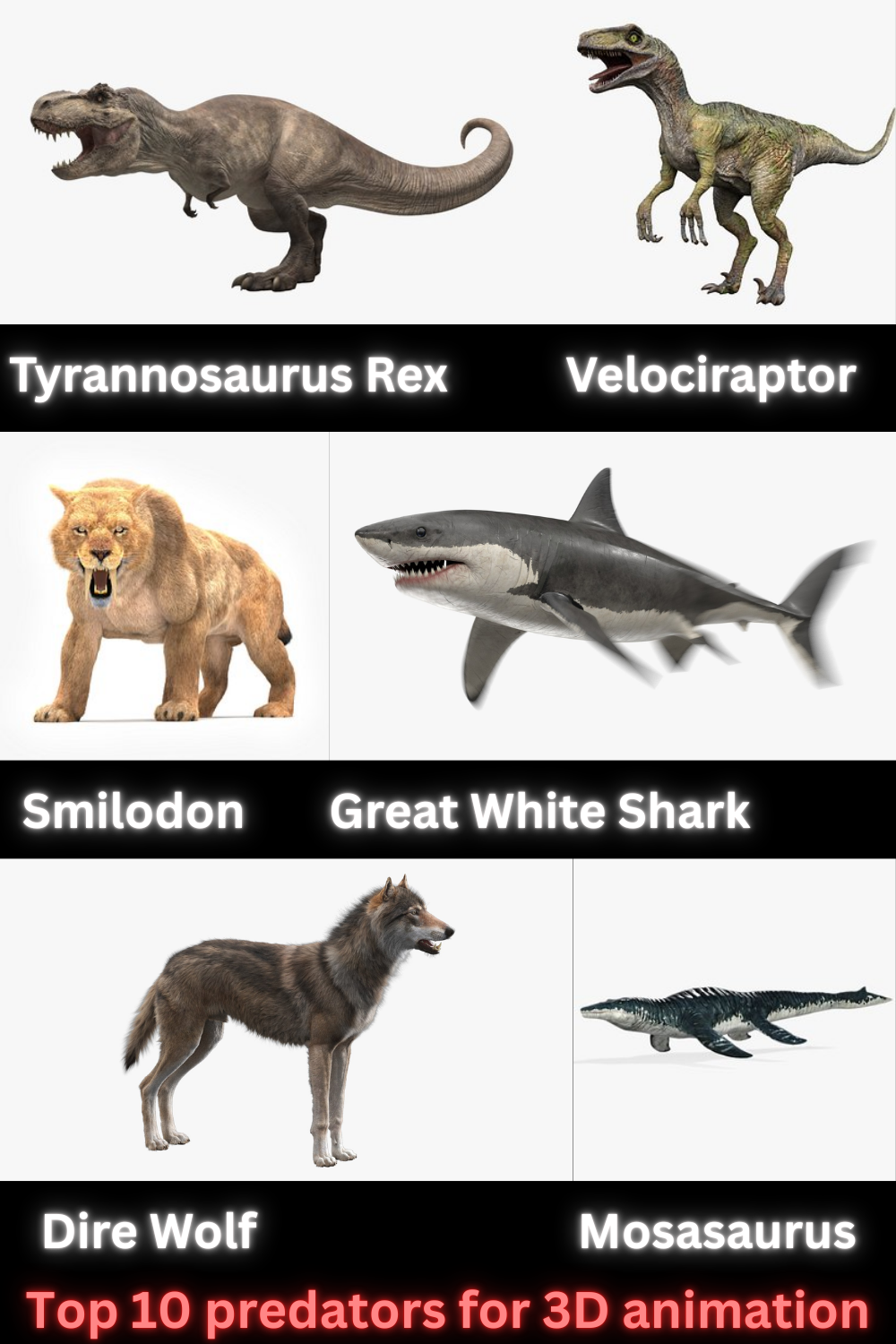
We have selected these animals not just for their “cool factor,” but because each one forces you to solve a unique biomechanical puzzle.
Animating predators in 3D offers animators a unique opportunity to hone their skills through complex movements, dynamic behaviors, and intricate anatomical details. From extinct giants like dinosaurs and Ice Age beasts to modern ocean hunters, these creatures challenge artists to capture raw power, agility, and realism.

Tyrannosaurus Rex animation turbosquid
This article explores the top 10 predators ideal for 3D animation practice, spanning various eras and environments. Whether you’re a beginner or seasoned professional, mastering these will elevate your portfolio and technical prowess.

Mosasaurus animation turbosquid
Pay close attention to details, muscular anatomy, how body deforms with movement, tension, color, textures, weights, skeletons, reconstruct animals with clay, proportions, draw 2D animals with pencil, sculpt 3D digital animals, learn from Mother Nature.
1. Tyrannosaurus Rex (The Bipedal Heavyweight)
Category: Dinosaur
Why it’s Strategic: The ultimate lesson in weight and balance. The T-Rex is massive but walks on two legs. Mastering it requires understanding how a gigantic tail acts as a counter-balance to a heavy skull. If your T-Rex feels floaty, your animation fails.
How to get References: Since they are extinct, rely on comparative anatomy. Study gigantic ground birds (ostriches, emus) for leg mechanics, and elephants for the sense of sheer, lumbering mass.
Poses and Animation Cycles:
- The Importance: The “T-pose” is useless here. You need a balanced neutral pose where the center of gravity is over the hips. Cycles must emphasize the “down” position of the hip to sell the weight impact.
- Top Cycles:
- Games: The Stalking Walk. A slow, deliberate loop where the head remains level while the legs handle the terrain. Essential for stealth gameplay mechanics.
- Film: The Roar. This isn’t just opening the mouth; it’s a full-body event involving inhaling, chest expansion, lunging forward, and the vibrating recoil of the release.
- Scientific Behaviors: Modern paleontology suggests T-Rex was likely an ambush predator, not a high-speed pursuer. Focus on explosive bursts of energy rather than sustained running.
2. Velociraptor / Deinonychus (The Agile Specialist)

Velociraptor: https://www.cgtrader.com/3d-models/raptor
Category: Dinosaur
Why it’s Strategic: The antithesis of the T-Rex. This teaches agility, bird-like twitchiness, and rapid weight shifts. You must master the “spring-loaded” mechanic of their legs.
How to get References: Heavily study large predatory birds like hawks and eagles (for head movements and twitch responses) and ostriches for high-speed running mechanics.
Poses and Animation Cycles:
- The Importance: Poses must look “ready.” They should rarely be completely still; incorporate “moving holds” where the creature is tense and breathing.
- Top Cycles:
- Games: The Sprint Loop. Needs to be incredibly fast with high sharp knees, showing the body staying low and aerodynamic.
- Film: The Pounce. A complex action involving coiling the legs, launching, orienting in mid-air, and absorbing the impact with the target.
- Scientific Behaviors: These were intelligent pack hunters. Animate them looking at each other to coordinate, not just staring blankly ahead. Use sharp, bird-like head isolations.
3. Smilodon (Sabertooth Cat) (The Front-Heavy Grappler)

Smilodon turbosquid
Category: Ice Age Predator
Why it’s Strategic: It is feline, but not a modern tiger. It has massively overdeveloped front, shoulders, and neck muscles to support its heavy head and driving takedowns. It forces you to animate a quadruped that is significantly heavier in the front than the back.
How to get References: Use modern lions and tigers for basic quadrupedal mechanics, but exaggerate the shoulder mass and limit the flexibility of the spine compared to a cheetah.
Poses and Animation Cycles:
- The Importance: A powerful, low-to-the-ground stalking pose is essential. The shoulders should always look engaged.
- Top Cycles:
- Games: The Idle Crouch. A tense loop waiting for player input. The tail should have a subtle twitch, showing pent-up energy.
- Film: The Grapple/Takedown. Unlike modern cats that suffocate with a throat bite, Smilodon likely used its weight to pin prey before delivering a precision shearing bite. The animation should emphasize wrestling and pinning weight.
- Scientific Behaviors: Their jaws had a smaller gape (opening width) constraint than modern cats to protect the saber teeth. They were ambush predators specialized for wrestling large, slow herbivores.
4. Great White Shark (The Hydrodynamic Engine)

Great White Shark turbosquid
Category: Ocean Predator
Why it’s Strategic: You lose the ground. This teaches drag, hydrodynamics, and continuous motion. The challenge is animating an animal that never truly stops moving, requiring smooth arcs and subtle banking turns.
How to get References: High-quality nature documentaries (Shark Week footage) are essential. Pay attention to how they use their pectoral fins for lift and steering, like airplane wings.
Poses and Animation Cycles:
- The Importance: Poses are defined by the curve of the spine. Avoid straight lines; the shark should always be in a subtle “C” or “S” curve.
- Top Cycles:
- Games: The Cruising Loop. A highly efficient, slow tail beat. The challenge is making the loop seamless without a “hiccup” in the spine’s wave motion.
- Film: The Breach (Hunting Seal). Explosive vertical energy. The transition from water drag to sudden zero-gravity airtime, and the heavy crash back down.
- Scientific Behaviors: Sharks often investigate with their mouths (“test bites”). They also roll their eyes back protectively just before striking, a crucial detail for realism.
5. Dire Wolf (The Pack Endurance Runner)

Dire Wolf low poly sketchfab
Category: Ice Age Predator
Why it’s Strategic: The gold standard for quadrupedal locomotion. Mastering the canine gait (walk, trot, cantor, gallop) is essential for any creature animator. Dire Wolves were heavier than modern wolves, adding a layer of weight to standard dog mechanics.
How to get References: Grey Wolves and large domestic dog breeds (like Mastiffs for weight).
Poses and Animation Cycles:
- The Importance: Strong silhouettes showing the distinct “saddle” shape of the back and the deep chest.
- Top Cycles:
- Games: The Trot. The most common travel gait for canines. It’s a diagonal two-beat gait that must look efficient and tireless.
- Film: Pack Coordination. Animating multiple wolves moving together, adjusting their speed to stay in formation without looking robotic.
- Scientific Behaviors: They were pursuit predators specializing in endurance. Their movements should feel tireless rather than explosive. They rely heavily on ear and tail positioning for social communication.
6. Mosasaurus (The Marine Reptile Goliath)

Mosasaurus sketchfab
Category: Ocean Predator / Extinct
Why it’s Strategic: A mix of serpentine motion and heavy aquatic power. Unlike a shark’s tight tail beat, the Mosasaurus used its entire body in a massive anguilliform (eel-like) motion to displace water.
How to get References: Crocodiles swimming, large monitor lizards, and eels for the spinal wave pattern.
Poses and Animation Cycles:
- The Importance: The pose must convey immense size. The curves of the body should be long and sweeping.
- Top Cycles:
- Games: The “Patrol” Swim. A slow, menacing sweep of the tail. The challenge is selling the scale—massive objects move slower underwater due to resistance.
- Film: The Surface Breach. Inspired by whales or crocodiles snapping at the surface. The massive displacement of water and the heavy, uncontrolled fall back into the depths.
- Scientific Behaviors: It likely had poor sustained swimming speed but incredible burst acceleration to ambush prey from below.
7. Pteranodon (The Flier)

Pteranodon turbosquid
Category: Extinct (Pterosaur)
Why it’s Strategic: Flight mechanics. You must deal with gravity, lift, drag, and stall speeds. It’s not just flapping; it’s gliding and using air currents. The challenge is the transition from awkward ground movement to graceful flight.
How to get References: Large seabirds like Albatross or Pelicans. Focus on how they launch from the ground using all four limbs.
Poses and Animation Cycles:
- The Importance: In flight, the pose must show tension in the wing membranes. On the ground, they should look ungainly and uncomfortable.
- Top Cycles:
- Games: The Glide Loop with Banking. The character needs to tilt and roll; the wings must adjust to catch the “air” while the head stays focused on the horizon.
- Film: The Quadrupedal Launch. Using the folded wings as front legs to vault into the air before snapping the wings open.
- Scientific Behaviors: They were largely gliders using thermal currents over oceans. Flapping was energy-intensive and used primarily for takeoff or gaining altitude quickly.
8. Titanoboa (The Serpentine Crusher)

Titanoboa turbosquid
Category: Extinct Predator
Why it’s Strategic: The ultimate lesson in path animation and spinal fluidity. You have no limbs to rely on for propulsion. Every movement comes from waves rolling down the spine.
How to get References: Anacondas and Pythons. Study how they use friction points on the ground to push themselves forward.
Poses and Animation Cycles:
- The Importance: Poses should involve coiling and overlapping shapes to create visual interest and demonstrate length.
- Top Cycles:
- Games: Slithering Locomotion. The head must lead, and the body must follow the exact path of the head (follow-through) without sliding sideways, unless intended.
- Film: The Constriction. A terrifyingly slow squeeze. This involves complex rig deformation as the snake compresses another object, requiring careful management of interpenetration.
- Scientific Behaviors: As a massive cold-blooded animal in a hot climate, its movements would be slow and deliberate until the moment of the strike.
9. Spinosaurus (The Amphibious Enigma)
Category: Dinosaur
Why it’s Strategic: A biomechanical nightmare that forces you to make awkward proportions work. It has short hind legs, a long body, a massive sail, and a heavy head. It is currently believed to be semi-aquatic and perhaps a quadruped on land. It challenges you to animate a creature that doesn’t fit standard bipedal or quadrupedal molds.
How to get References: Crocodiles, grizzly bears hunting salmon (for water interaction), and wading birds like herons.
Poses and Animation Cycles:
- The Importance: The sail is a huge, rigid structure that must not warp during movement. Balance is tricky; the center of gravity is strange.
- Top Cycles:
- Games: The Transition (Land to Water). Going from a clumsy waddle on land to graceful swimming.
- Film: The Fishing Strike. Standing still in water like a heron, waiting, and then a lightning-fast snap of the long snout into the water.
- Scientific Behaviors: Highly debated, but modern consensus leans toward a wading predator that used its tail for swimming propulsion. It was likely not a runner.
10. Dunkleosteus (The Armored Tank)

Dunkleosteus trubosquid
Category: Extinct / Ocean
Why it’s Strategic: Rigid body mechanics. Unlike the shark or mosasaurus, the front half of this fish was encased in heavy bone plates. It cannot bend its neck. The challenge is animating an aquatic creature that pivots from the mid-section like a hinged tank.
How to get References: Heavily armored modern fish like boxfish, or even submersibles, to understand rigid pivoting movement.
Poses and Animation Cycles:
- The Importance: The head and thorax must move as one solid unit.
- Top Cycles:
- Games: The Pivot Turn. It can’t curve its body to turn. It has to use side fins to rotate its entire rigid front section on the spot.
- Film: The Bite. It didn’t have teeth; it had self-sharpening bone plates. The jaw mechanism was a four-bar linkage system that opened incredibly fast, creating a vacuum to suck in prey. Animate the terrifying speed of that mechanical jaw snap.
- Scientific Behaviors: The jaw opening was one of the fastest in known history. The animation must reflect this mechanical, almost industrial snap.
Conclusion
Mastering these ten predators will arm you with a diverse animation toolkit. You will understand weight from the T-Rex, fluid dynamics from the shark, complex quadrupedal mechanics from the Dire Wolf, and specialized movement from the Pteranodon.
Remember, excellent creature animation is 20% software knowledge and 80% observation and understanding of biomechanics. Don’t just guess how it moves; research it, find the closest living analogue, study the physics, and then bring that beast back to life, one keyframe at a time.
Study hard 3D animation, watch documentaries on top streaming services, pay close attention to Mother Nature best artist, draw (have a drawing book and with pencil draw dinosaurs in different poses (muscle memory), and practice a lot, you will need to study hard to bring 3D ancient extinct creatures to life.
Never give up as an artist!
References
Academic & Scientific Sources on Biomechanics:
- Alexander, R. M. (2003). Principles of animal locomotion. Princeton University Press.
- Hutchinson, J. R., & Garcia, M. (2002). Tyrannosaurus was not a fast runner. Nature, 415(6875), 1018-1021. https://doi.org/10.1038/4151018a
- Lauder, G. V., & Tytell, E. D. (2005). Hydrodynamics of undulatory propulsion. In Fish Physiology (Vol. 23, pp. 425-468). Academic Press.
- Witton, M. P., & Habib, M. B. (2010). On the size and flight diversity of giant pterosaurs, the use of birds as pterosaur analogues and comments on pterosaur flightlessness. PLoS One, 5(11), e13982. https://doi.org/10.1371/journal.pone.0013982
Animation Theory & Technique:
- Johnston, O., & Thomas, F. (1981). The illusion of life: Disney animation. Disney Editions. (While focused on cartoons, the 12 principles are essential for believable creature weight and anticipation).
- Williams, R. (2012). The animator’s survival kit: A manual of methods, principles and formulas for classical, computer, games, stop motion and internet animators (2nd ed.). Faber & Faber.