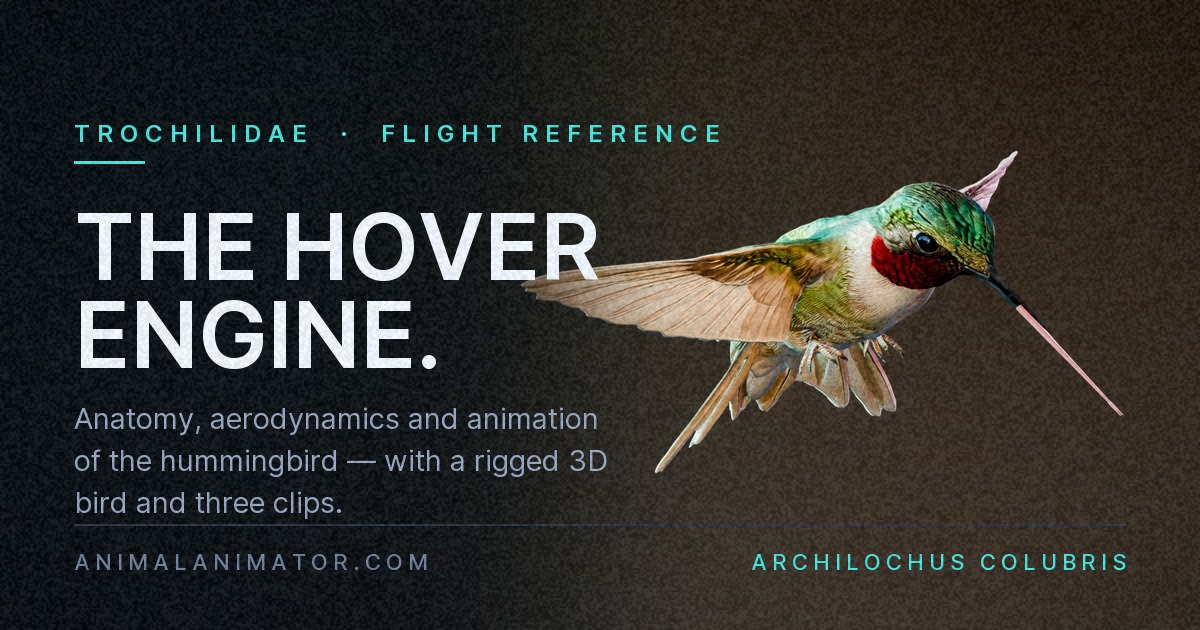
Flight reference · Trochilidae
The Hover Engine
Anatomy, aerodynamics and animation of the hummingbird
Modelled on Archilochus colubris, the ruby-throated hummingbird
A hummingbird is not a small bird that happens to hover. It is a bird rebuilt around hovering, from the shoulder joint outward — and almost every habit carried over from animating other birds is wrong for it. What follows is the reference I wanted while rigging one: the numbers, the mechanism underneath them, and the three clips that earn their place in a library.
The numbers, up front
Read these as one machine rather than a list of records. Every figure is downstream of the same trade: the hummingbird gave up the ability to glide in exchange for the ability to stand still in the air.
Ranges are across the family (Trochilidae). Single figures are for the ruby-throated hummingbird, Archilochus colubris — the species the model on this page was scanned from.
Where they live
Hummingbirds are an exclusively American family. Nothing in Europe, Africa, Asia or Australia has ever been one; the sunbirds and honeyeaters that look the part are unrelated, and none of them truly hovers. The range runs from southern Alaska to Tierra del Fuego, and from sea-level mangrove to Andean paramo above 5,000 m.
The centre of gravity of the family is the northern Andes — Ecuador alone holds well over a hundred species, stacked by elevation band and by bill shape. That stacking matters more to an animator than it sounds. Bill length and curvature are the visible signature of which flowers a species feeds from, so the bill is a costume decision, not a detail.
- Sea level to 5,200 m. High-altitude species work thin air with a larger stroke amplitude, not a faster beat.
- Migration. Ruby-throated hummingbirds cross the Gulf of Mexico non-stop: roughly 800 km, about twenty hours, on a body that weighs three grams.
- Torpor. Overnight they let body temperature fall toward ambient and cut metabolism by around 95 per cent. A bird in torpor is rigid and unresponsive, and takes twenty minutes to restart.
The flight engine
Take an ordinary bird wing. Shorten the arm, lengthen the hand, then replace the shoulder hinge with a swivel. That is the entire redesign, and everything else follows from it.
- The hand is the wing. Humerus and forearm are stubby; the manus carries most of the wing’s length and all ten primaries. Functionally the wing is a single stiff blade hinged at the body.
- The shoulder rotates about 140° — not sweeps, rotates, about the long axis of the humerus. This is the single most important fact on this page.
- Two large muscles, not one. In most birds the upstroke muscle (supracoracoideus) is about a tenth of the downstroke muscle. In a hummingbird it is roughly half. The backstroke is powered.
- Elbow and wrist barely move within a stroke. A rig that flexes them mid-cycle reads as a swallow, not a hummingbird.
- No gliding. Wing area is far too small for the mass. A hummingbird that stops beating drops.
All of which is why the rig below has a long stiff hand chain and a shoulder allowed to roll through more than a right angle.
One wingbeat
The wingtip does not go up and down. In a hover it sweeps forward and back through a nearly horizontal plane, and the wing turns over at each end so that the same edge leads on the way back. That inversion is what buys the backstroke its quarter of the lift. An ordinary bird gets almost nothing from its upstroke.

Right wingtip seen from the side, traced from the actual keyframes of the clips below. In the hover the loop is long and almost level; in forward flight the whole plane tips over and the loop grows a vertical component. The white ring marks the shoulder.
Two more things happen inside that loop, and both are worth keying by hand:
- The reversal is not a pause. At each end of the stroke the wing is edge-on and rolling fast. Hold it flat there and the bird reads as a toy.
- The tip lags the shoulder. The roll starts at the body and travels outward, so the primaries reach the new angle a frame or two late. That lag is most of the perceived life in the wing.
- A leading-edge vortex sits over the wing through the middle of each half stroke. You cannot draw it, but it is why the wing can run at an angle of attack that would stall an aeroplane.
Turning, backing, braking
A hovering hummingbird has no forward momentum to trade, so it steers by changing what the two wings do relative to each other and by pointing the whole body. There are two turns in its repertoire and they look different on screen:
- The yaw pivot. Rotation about a vertical axis, on the spot, with almost no translation. The outer wing takes a bigger stroke than the inner one. Fast and tight — the turn for a bird inspecting a feeder.
- The pitch-roll turn. The bird pitches, rolls onto its side and carves an arc. Wider, faster over the ground — the turn for a chase.
- Backward flight. Routine, sustained, and about as cheap metabolically as flying forward. The bird pitches nose-up and tips the stroke plane behind itself.
- Braking. It stops by pitching up and fanning the tail into the airflow. The tail is an airbrake far more often than it is a rudder.
And then there is the dive. A male Anna’s hummingbird climbs thirty metres and drops at roughly 27 m/s — about 385 body lengths per second, the highest length-specific speed measured in any vertebrate — then pulls out at close to nine times gravity. The chirp at the bottom is not a call. It is the outer tail feathers fluttering as they open into the airstream for a few milliseconds.
The tongue, and the deal with the flower
For two centuries the textbooks said hummingbirds drink by capillary action. High-speed footage killed that in 2011. The tongue is a pump.
- It is forked, and the fork opens. The two tips are rolled into grooves. They spring open on contact with nectar and close as the tongue is withdrawn, trapping fluid mechanically.
- It is elastic. Squeezed flat between the mandibles on the way out, it re-expands inside the nectar, and that recoil does the pumping. No muscle reaches the tongue tip at all.
- Thirteen to seventeen licks per second — roughly one lick every three or four wingbeats. It is the fastest thing on the animal after the wings.
- It reaches about a bill-length past the tip. The hyoid apparatus driving it wraps up over the back of the skull and around the eyes.
The flower has been shaped by the same negotiation. Bird-pollinated flowers — the ornithophily syndrome — are typically red or orange, tubular, scentless, hang without a landing platform, and offer a dilute, sucrose-dominant nectar. Every one of those traits is an exclusion: no perch for a bee, no scent for a moth, a corolla too deep for a short tongue.
And the pollen is placed, not smeared. Corolla length and bill curvature together decide whether a flower daubs its anthers on the forehead, the crown, the chin or the base of the bill. Two plant species sharing one bird can stay reproductively separate purely by aiming at different parts of its face. A bird visiting one to two thousand flowers a day is a delivery network with addressing.
Which is why the feeding clip below moves the tongue and not the bill. A hummingbird does not gape at a flower; it holds the bill nearly shut and works the tongue.
Everything that is not flight
The legs were sacrificed. Hummingbird feet are anisodactyl — three toes forward, one back — and they exist to grip a twig. The bird cannot walk. It cannot turn around on a perch without flying; it shuffles sideways or takes off.
For an animator that is liberating and unforgiving in equal measure. There is no walk cycle to build. But there is also no cheating: every transition between two positions in a scene is a flight, and the feet stay folded under the body for all of it. A hummingbird with dangling legs reads instantly as wrong.
- Perched. Body upright, wings folded, tail down, feet gripping. Long stillness broken by very fast head flicks.
- Airborne. Feet tucked and pressed forward against the belly, toes curled. They drop only in the last few centimetres before a landing.
- The head is the exception to the stillness. It is held so steady during a hover that the body visibly oscillates underneath it.
The rig
Thirty-one bones, built in Blender on a photogrammetry scan retopologised to 17,328 triangles. The whole thing is scripted, so it rebuilds from the mesh in about three seconds — which matters, because it took four rebuilds to get the shoulder deforming cleanly.

| Chain | Bones | Notes |
|---|---|---|
| Wing | 12 | shoulder → humerus → ulna → hand → prim1 → prim2, per side. Placed on the leading edge sampled in 0.068-unit bands, so the chain sits on the bone, not the feather. |
| Body axis | 4 | hips, spine, chest, neck — traced along the |y| < 0.09 midline of the mesh. |
| Head | 5 | head, bill, and a three-bone tongue that SLIDES rather than stretches. |
| Tail | 5 | three-bone shaft plus one bone per outer rectrix, so the fan opens and closes. |
| Legs | 4 | two per side, in the tucked flight position. |
| Root | 1 | at the centre of mass (−0.05, 0, 0.15), not on the floor — a hovering bird pivots about itself. |
Four decisions in there are worth stealing, and one is worth avoiding:
- The mesh is 61 disconnected shells, so bone-heat weights tear along every shell boundary — and topological weight smoothing cannot cross one. Averaging the weight field over a spatial KD-tree radius instead heals all of them at once.
- The tongue slides, it does not stretch. It is modelled retracted, from inside the skull to just short of the bill tip, and animated by translating one bone along its own axis. Bone scale would have exported to glTF as a compounding node scale.
- The root sits at the centre of mass, not on the ground. A hovering bird yaws about itself; a root on the floor swings it through an arc.
- Wings are measured, not mirrored. The two wings of a scanned bird are not symmetric — up to 0.1 units apart here — so each chain follows its own leading-edge samples. The poses stay symmetric because the rolls are aligned to a common up vector.
- No jaw bone. The scan has no oral cavity, so any gape shows the hollow inside the bill. The bill stays one rigid piece, which is also what the animal does when it feeds.
Rebuild it with rig/build_hummingbird_rig.py; export the web GLB with rig/export_web_glb.py.
Three clips
Three states, chosen because between them they cover almost everything a hummingbird does on screen, and because each one fails in a different way if you get it wrong. Use the tabs on the viewer at the top of the page to switch between them.

Hover & Feed
The default state and the hardest one to fake. The body holds a fixed attitude roughly 40° nose-up while the wings sweep through a near-horizontal plane, and the tongue runs out once every four wingbeats.
- The head is stabilised against the body. The hips pitch and lift with each beat; the spine, neck and head chain cancels it, so the eye stays put while the belly moves under it. Kill this and the whole hover dies.
- The tail is fanned and depressed — it is acting as a stabiliser, not a rudder.
- The tongue is on its own clock: one extension every 40 frames against a 10-frame wingbeat, which is the real 1:4 ratio. The bill never opens.
- Feet stay tucked and forward for every frame.

Forward Flight
Cruise. The whole animal tips about 30° nose-down into the airflow, the stroke plane tips with it, and the wingtip loop acquires the vertical component you can see in the diagram above.
- Amplitude drops and the roll reversal softens — in forward flight the bird can afford to let the backstroke do less.
- The rectrices close into a spike. A fanned tail at cruise is drag.
- The head is counter-rotated back to level. The body is at 30°; the eyes are not. This is the reason to build a neck chain at all.
- The beat is faster than the hover clip: 8 frames per cycle against 10.

Pivot & Backstep
The manoeuvre reel: back away from the flower, return, then yaw a hundred degrees on the spot and come back. Everything a hummingbird can do that nothing else can.
- Backstep. The body pitches nose-up, the stroke plane tips behind the bird and it translates backwards. The tail fans hard as an airbrake.
- Pivot. The turn is driven by stroke asymmetry — the outer wing takes 16% more amplitude than the inner one — with a 10° bank and the tail tilted into the turn.
- The head leads the body through the yaw by about a third of the angle. Birds look where they are going before they get there.
- It loops: the bird ends where it started, so the clip can run forever behind a UI.
All three run at one ninth of life speed. A real ruby-throated beats its wings about 53 times a second; on a 60 fps timeline that is barely one frame per stroke and the screen shows a grey smear. These clips beat every eight to ten frames, which is fast enough to read as a hummingbird and slow enough to see. Say so in your shot notes rather than pretending otherwise.
Animator’s checklist
Do
- Drive the wing from the shoulder. Roll it about its own long axis by more than a right angle every half stroke.
- Keep elbow and wrist almost locked. The wing is a paddle.
- Stabilise the head against the body, always.
- Let the tip lag the shoulder by a frame or two, and let the primaries flick at the reversal.
- Fan the tail to brake and to hover; close it to cruise.
- Keep the feet tucked and forward for every airborne frame.
Do not
- Do not flap up and down. The hover stroke plane is horizontal.
- Do not hold the wing flat through the reversal — it is edge-on and rolling.
- Do not open the bill to feed. Move the tongue.
- Do not glide, ever, not even for six frames.
- Do not animate a walk. Hummingbirds cannot walk.
- Do not run the wings at true speed on screen. At 53 Hz there is nothing to see; slow the beat and say that you did.
Sources
- Warrick, Tobalske & Powers 2005, Nature — aerodynamics of hovering; the 75/25 lift split.
- Warrick, Tobalske & Powers 2009, Proc. R. Soc. B — the leading-edge vortex.
- Rico-Guevara & Rubega 2011, PNAS — the tongue traps fluid; it is not a capillary tube.
- Rico-Guevara, Fan & Rubega 2015, Proc. R. Soc. B — the tongue as an elastic micropump.
- Clark 2009, Proc. R. Soc. B — Anna’s hummingbird dive speed and acceleration.
- Clark & Feo 2008, Proc. R. Soc. B — the dive sound is made by tail feathers.
- Sapir & Dudley 2012, J. Exp. Biol. — the cost of backward flight.
- Read, Segre, Middleton & Altshuler 2016, J. Exp. Biol. — the two turn types.
- Stoddard et al. 2020, PNAS — non-spectral colour vision.
Model: photogrammetry scan of a ruby-throated hummingbird, retopologised, rigged and animated for this article. Rig, clips and build scripts are reproducible from the repository that accompanies it.
Colour is load-bearing on this page: — flight engine, control, feeding, support, signal. The bird’s own emerald and ruby are kept out of the interface so the renders stay the only saturated thing here.