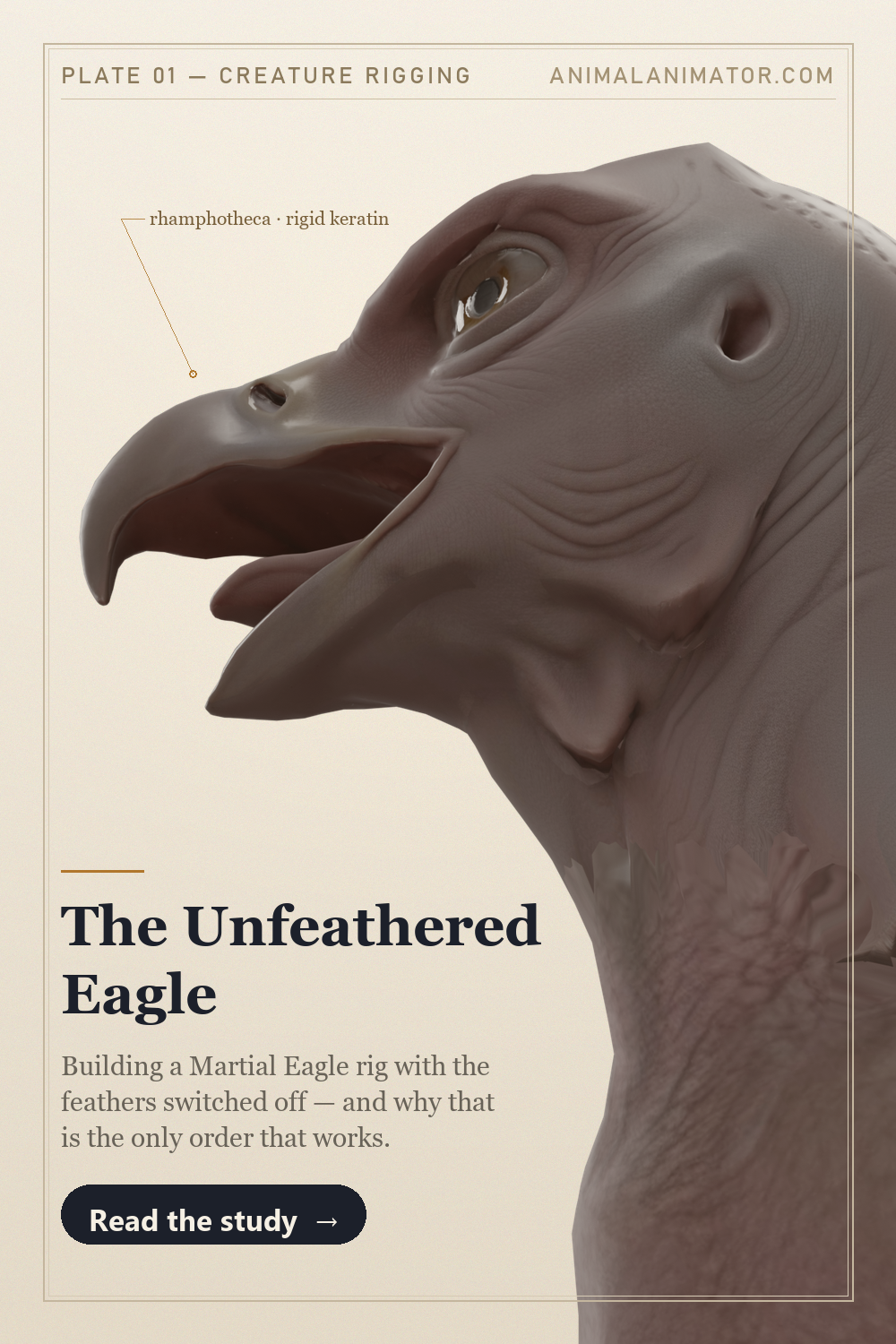
Africa’s largest eagle is disappearing, and almost nobody has seen what one looks like on day one. Over the past few sessions I rigged a featherless baby Martial Eagle in Blender straight from a raw sculpt — a 41-bone armature with a working beak, closing eyelids, and drivers that reproduce cranial kinesis, the mechanism that lets a bird lift its upper bill. Then I animated a begging gape and an inertial swallow on top of it.
The model has no feathers at all, and that is deliberate. This article walks through every rig decision, the Martial Eagle science that drove it, and the export trap that quietly destroyed the whole setup the first time I sent it to Unity.
Why the model has no feathers
Feathers are the last thing you add to a bird, not the first. Here are the four reasons, ordered by how much production time each one saves you.
Feathers hide broken deformation
Every weighting error, every collapsing shoulder, every pinch at the neck base vanishes under a groom. On bare skin you can watch the rictus tear the instant the jaw over-rotates. I caught a mirrored-roll bug on the left eyelid purely because the naked mesh made the asymmetry obvious.
Grooms don’t survive rig changes cheaply
Move a bone, re-weight a region, and the feather system needs re-running. Lock the skeleton first and you groom exactly once.
Silhouette reads before texture does
A begging chick is recognised by neck extension and gape angle, not by plumage. If the pose doesn’t read naked, feathers will not save it.
Ecosystem sims need the bare LOD anyway
When you run hundreds of agents at once, the low-detail anatomy mesh is a shipping asset — not a throwaway stage.
None of this is a shortcut. It is the creature-pipeline equivalent of an anatomy or muscle pass, and it sits in the same slot in any serious workflow — see the definitive 3D production pipeline guide for where that stage falls between sculpt and texture.
A real Martial Eagle chick is not naked. It hatches altricial, covered in white natal down, and grows contour feathers across the nestling period. This bare model is a production stage, not a depiction of the living animal. If you are building a Martial Eagle for a documentary or a museum piece, the down goes on before anything ships.
The animal behind the rig
The Martial Eagle (Polemaetus bellicosus) lays a single egg, incubates it for roughly seven weeks, then spends three months raising one chick. That reproductive strategy is so slow that most pairs only attempt it every other year — and it is exactly why the species collapses so fast under pressure. Every number below shaped a decision in the rig.
| # | Fact | What it changed |
|---|---|---|
| 1 | Africa’s largest eagle. 78–96 cm long, 3.1–6.2 kg, wingspan 188–260 cm, with reverse sexual dimorphism — males run about 76% of female size.1 | Adult scale reference for the growth target. |
| 2 | One egg, one chick. The female usually lays a single egg, rarely two, incubated for about 45–53 days.1 | No sibling-rivalry animations needed. One chick per nest prop. |
| 3 | A three-month nestling period. Chicks fledge at 90–100 days (mean ≈ 96), then linger near the nest for months more.1 | A long sitting-and-begging phase justifies a dedicated nestling rig. |
| 4 | Often breeds only every second year, because dependency runs so long.1 | Sim tuning: nest events are rare, so each one must read clearly. |
| 5 | Altricial and nidicolous. The chick hatches helpless in natal down; contour feathers develop over the nestling period.1 | Bind pose is sitting, not standing. Begging is the core interaction. |
| 6 | Enormous home ranges. GPS tracking in Kruger National Park showed ranging requirements too large for protected areas to contain.4 | Territory radius for the adult agents that feed this chick. |
| 7 | ~60% decline in South Africa in atlas reporting rates between SABAP1 (1987–92) and SABAP2 (2007–12) — 64% outside protected areas versus 42% inside.2 | The reason this build exists at all. |
| 8 | Continental collapse. Part of a documented crash across African savanna raptors, with roughly 90% of the 42 species examined in decline.3 | Context for the wider ecosystem simulation. |
| 9 | Endangered. Globally Endangered on the IUCN Red List (2024) and regionally Endangered in South Africa (2025), with an estimated 950–1,100 mature individuals left.5 | Every reference image you can gather is worth keeping. |
Reference gathering matters more for a declining species than for a common one, because you will not simply go and film it. The approach is the same one I use in the ultimate lion reference for animators and the jaguar reference: build the fact table first, then let it constrain the sculpt.


Why the baby Martial Eagle is posed like this

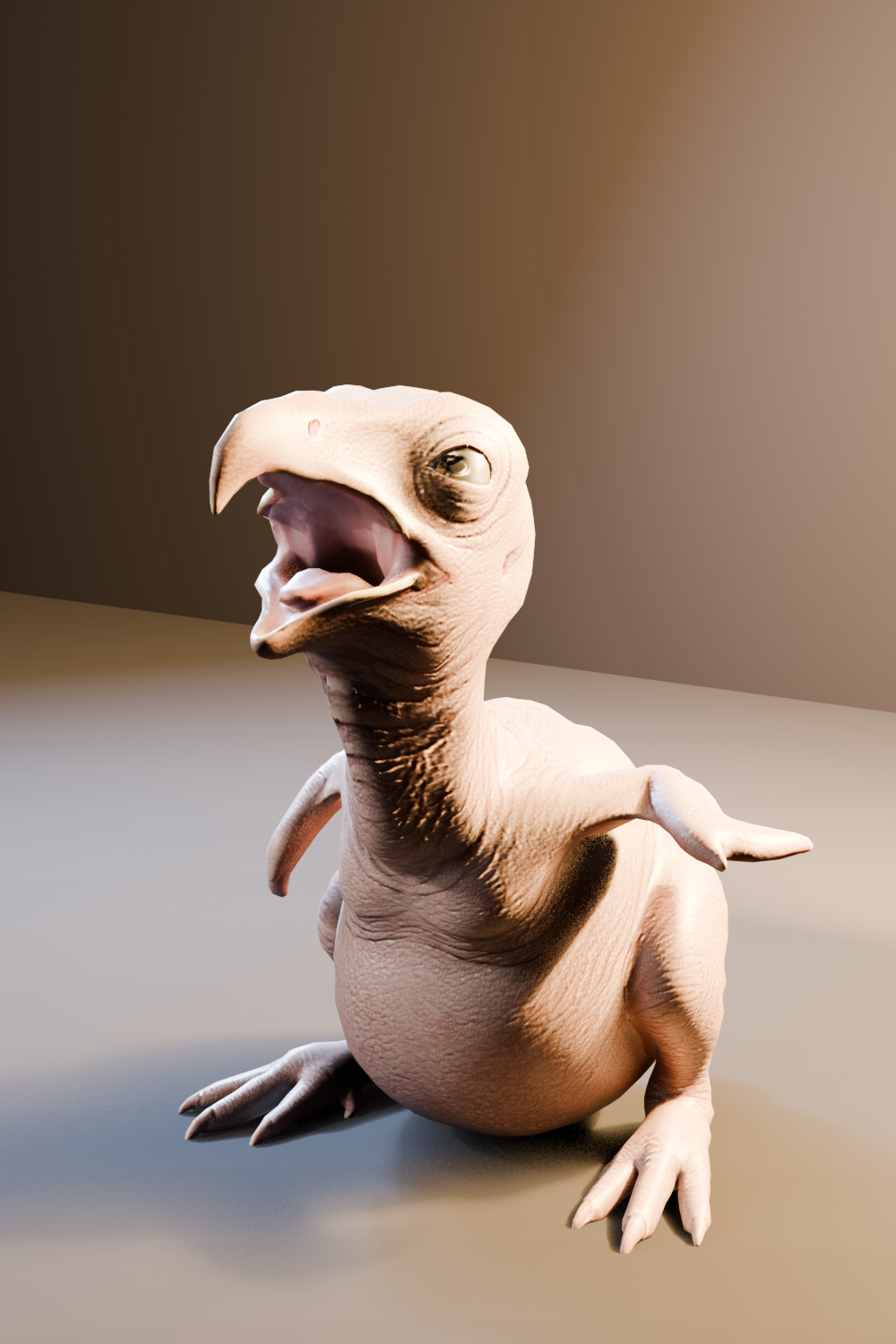
Nobody sculpts a creature in this position because it looks good. They sculpt it this way because every later stage of production depends on it. The pose in the turnaround above is a bind pose — the neutral state the skeleton is fitted to, and the position all deformation is measured from. Get it wrong and you fight it through the entire rig.
The open beak is the single most important choice
This is the one that surprises people, so it is worth stating plainly: a mouth modelled closed cannot be opened.
Sculpt a beak shut and the upper and lower mandibles fuse into one continuous surface. There is no oral cavity, no tongue, no palate, no cutting edges — none of that geometry exists, because there was never any space for it. Opening that mouth later means sculpting the interior from scratch or hand-authoring corrective shape keys.
Model it open and the problem inverts. Every surface the animation needs is already there, and closing the bill becomes a single bone rotation. On this rig the mandible reaches full occlusion at jaw = −52° about the hinge — no shape keys, no corrective sculpting, just rotation.
Model at the extreme, animate toward the neutral. Open beaks, open hands, spread digits, splayed talons. You can always close geometry that exists; you can never open geometry that doesn’t.
The symmetry is for the solver, not for looks
The pose is precisely bilateral, and that is a technical requirement rather than an aesthetic one. Perfect symmetry means the rig is only built once: one side is authored, the other mirrored, and the weight maps mirror with it. It also keeps Blender’s X-mirror tools reliable during weight painting, which saves hours on a model with this much surface detail.
Mirroring only works if your naming does. Every paired bone on this rig ends in .L or .R — lid_lower.L, humerus.R, toe3_02.L — because that suffix is what Blender’s mirror operators, and later Unity’s avatar mapper, actually key off. Break the convention on one bone and you will find it the hard way, three clips later.
Break symmetry in the bind pose itself and you inherit that asymmetry into every animation you ever make on the rig.
Why the limbs are held away from the body
Notice that the wing stubs project laterally and the toes fan apart rather than resting together. This is about geometry separation.
Automatic weighting solvers work by measuring proximity from bone to surface. If a wing stub sits flush against the flank, the solver cannot tell which surface belongs to which bone, and weight bleeds across the boundary — you get a wing that drags the ribcage with it. The same applies to toes: four digits touching read as one mass.
Holding everything apart gives the solver unambiguous geometry and cuts manual weight cleanup down to the areas that genuinely need it. If you are new to automatic weighting on birds, start with rigging a bird with automatic Blender tools, then move up to Rigify for animals once the manual version makes sense.
This isn’t a T-pose, and it shouldn’t be
The T-pose is a biped convention. It exists because human arms hang at the sides and need separating from the torso. A bird’s anatomy does not work that way, and a nestling’s certainly doesn’t — this chick has vestigial wing stubs and cannot stand.
What matters is the purpose a T-pose serves. Once you list those purposes, the bird pose delivers all of them:
| Purpose of a T-pose | How this bind pose satisfies it |
|---|---|
| Bilateral symmetry for mirroring | Exact, to the vertex. |
| Limb separation for auto-weighting | Wing stubs abducted, toes fanned. |
| Predictable joint axes | Every hinge rotates on local X, with a Limit Rotation constraint on it. |
| Near the centre of the animation range | Yes — the chick lives in this posture. |
| Human-retargeting compatibility | Not applicable. This is a Generic rig, never a Humanoid one. |
The bind pose is also the animal’s real resting posture
The chick sits on its tarsometatarsi — what most people would call the shins — with the belly on the ground and the feet flat and forward. That is not a stylisation. It is how a nestling raptor actually rests, weeks before its legs can support standing.
A bird’s knee is high on the body and usually hidden. The prominent joint that appears to bend “backwards” is the intertarsal (ankle) joint, and the long segment below it is the tarsometatarsus — a fused foot bone, not a shin.6 Name your bones femur → tibiotarsus → tarsometatarsus → toes and the whole chain stops fighting your intuition. Accipitrid feet are anisodactyl: three toes forward, the hallux back — which is why the rig has four digit chains, not five.
There is a second benefit. A good bind pose sits near the centre of the animation range, so no clip has to travel far from neutral. Since this eaglet spends nearly all its time sitting, begging and swallowing from roughly this position, every animation stays close to bind. That means less extreme deformation, fewer volume-loss artefacts, and clean results without corrective shape keys.
Lock these before you place a single bone
Rigging is cheap to redo. Everything upstream of it is not. Clear this checklist first and the rest of the build stops surprising you:
- Apply all transforms. Scale and rotation baked to identity, origin at the contact plane — on this model,
z = 0is the ground. - Fix real-world scale now. Retro-scaling a rigged, animated asset is a whole afternoon you will never get back.
- Clean the topology around the deformers. Concentric loops around the eyes and the gape, poles pushed out to flat regions.
- Triangulate later, never now. Keep quads for sculpting and weighting; add a Triangulate modifier at export time (more on that below).
- Decide the pose is final. A refined sculpt with different topology will not accept the old weights — though bone placements and landmark measurements do carry straight over.
It happens on every project. If the new mesh is a genuine re-topologise, the vertex groups will not transfer — but you do not start from zero. Use Data Transfer → Vertex Group Weights from the old mesh, re-parent to the existing armature, then hand-fix the gape, the eyelids and the toes. That is typically 20 minutes rather than a day, and the armature itself never moves.
Inside the 41-bone armature
EagletRig carries 41 bones, of which 37 deform. The remaining four are control and driver targets. Every hinge rotates on its local X axis and every hinge carries a Limit Rotation constraint, so the rig physically cannot be posed into anatomical nonsense — a constraint I would recommend to anyone rigging a creature they do not know well.
| Control | Sign and range | Why |
|---|---|---|
jaw | Negative closes. −52° is full occlusion. | The mesh was sculpted wide open, so jaw = 0 is the beg pose. |
skull | Negative raises the bill. −45° beg, −78° swallow head-throw. | Cranio-inertial transport needs a genuinely extreme throw. |
lid_lower.L/R | Negative raises the lid. −30° = closed. | In birds the lower lid is the dominant mover. |
lid_upper.L/R | Positive lowers the lid. +22° pairs with the above. | A small assist, not the driver of the blink. |
neck_01…05 | Positive leans forward. | Craning is a five-bone chain, not one rotation. |
bill_kinesis | Driven from jaw at −0.20. | Never keyed. See the next section. |
tongue_01 | Driven from jaw at −0.50. | Retracts automatically as the bill opens. |
The lower eyelid rises to meet a relatively immobile upper lid — the reverse of the mammalian pattern.6 Animate a bird blink with the upper lid and it reads as subtly wrong to anyone who watches birds, even if they cannot say why. Birds also have a third eyelid, the nictitating membrane, which sweeps horizontally across the eye and does most of the routine moistening. This rig does not have one yet; it is the next thing I want to add, because a horizontal flick is instantly, unmistakably bird.
One current limitation worth flagging: the eyes are painted into the head texture rather than being separate geometry with their own bones. It reads fine at the distances this asset is used at, but it means no pupil dilation and no independent gaze — and gaze is the single strongest signal of intent in a predator. Separate eyeball meshes are on the list.
Cranial kinesis: the mechanism running underneath both clips
Neither animation keyframes the upper bill. It is driven.
Most birds have prokinetic skulls: the upper bill moves as a single unit, hinging at the nasal–frontal hinge where a flexible lamina of bone connects it to the braincase. Depressing the lower jaw drives the quadrate forward, which pushes the palate and jugal bars, which elevates the upper bill.7 The two jaws are mechanically coupled — mammals have nothing equivalent.
So on this rig they are coupled too, by a Blender driver: bill_kinesis rotates at −0.20 of the jaw’s rotation, automatically, in every clip. tongue_01 retracts on the same principle at −0.50. An animator opens the beak and the rest of the skull responds correctly without a single extra keyframe.
Three reasons. It cannot drift out of sync across 40 frames. It halves the F-curves you maintain per clip. And it makes the coupling a property of the rig, so every future clip — preening, pellet casting, calling — inherits correct kinesis for free. This is the difference between a rig that depicts a bird and one that works like one.
The animation set
Three actions ship on this rig, all at 24 fps and all in place — no root motion, because the game code drives position. Loops are authored as n+1 frames with the last frame identical to the first, which is the convention that makes them weld instead of pop.
Eaglet_Neutral — the base pose
- 1 frame
- reference state
- not an animation
The sculpt’s default pose has the beak wide open, which means frame zero of this rig is a screaming chick. Every clip therefore starts by driving the jaw to −52° and working from there.
Rather than repeat that in every file, the neutral pose is stored as its own single-frame action. Every other clip begins and ends here, which is what lets them blend into one another without a pop.
Why it matters: if your bind pose is not your resting pose, you need an explicit neutral or you will fight it in every transition. Five minutes of setup that saves hours later.
Eaglet_Beg — food solicitation
- 40 frames @ 24 fps
- 1.67 s
- seamless loop
- 54 F-curves
- 18 bones
The behaviour. A nestling raptor solicits food with a coordinated display, not just an open mouth. Ethologists break it into separate components: gaping, neck-craning, wing-quivering, and begging calls. I animated all four, because reproducing only the gape gives you a yawning bird, not a begging one.
How it is built. The cycle runs: settle → anticipation → gape → call → recovery.
The anticipation beat does real work. Before the gape opens, the bill clamps further shut and the body dips for four frames. That wind-up is what makes the opening read as a lunge rather than a fade. The gape itself snaps from fully closed to fully open in four frames on an eased-out tangent — fast attack, long hold, slow release. Begging is staccato and urgent, and smooth interpolation kills it instantly.
Through the held gape, the head wobbles on its vertical axis while the jaw tremors slightly, at deliberately mismatched frequencies. That mismatch is what produces the unsteady, uncoordinated quality of a young bird.
The wing quiver runs on its own timing entirely. The humerus alternates every two frames on linear interpolation; the forearm follows at 75% amplitude one frame behind; the hand at 50% two frames behind; and the whole left side is offset one further frame from the right. Nothing on this rig moves in lockstep, because nothing on a living animal does.
Lagging each segment of a limb behind its parent by one to four frames is the cheapest believability upgrade in creature animation, and it works on anything with a chain — a tail, a neck, a wing, a spine. I use the identical trick on the adult eagle’s flap cycle and on quadruped tails; the principle is laid out in top 10 predators to elevate your 3D animation skills.
Scientific justification. Martial Eagles are altricial, and the chick is entirely dependent on parental provisioning across a nestling period of roughly 90–100 days.1 Begging is not incidental behaviour; it is the mechanism the entire parent–offspring relationship runs on. For an ecosystem simulation it is the clip that drives the feeding interaction loop, which makes it the most functionally important animation in the set.
Eaglet_Swallow — cranio-inertial transport

skull at −78°, bill vertical. This is the swallowing mechanism, not a display.- 52 frames @ 24 fps
- 2.17 s
- one-shot
- 51 F-curves
- 17 bones
The behaviour, and why it looks so strange. Birds do not swallow the way mammals do. Rather than moving a bolus down by tongue and peristalsis alone, many birds use cranio-inertial transport — informally “catch and throw”. The bird accelerates its head backward and upward while holding the food, releases it, then reverses the head movement, displacing the item toward the oesophagus.8 Gravity does the rest.
That is why a feeding chick throws its head back until the bill points at the sky. It is not a display. It is the swallowing mechanism.
How it is built. Intake → seize → wind-up → throw → three gulps → recovery.
The head-throw takes the skull to −78° across four frames on an eased-out tangent, so it whips rather than drifts. Then the critical detail: the gulps are narrow-band. The jaw cycles only between fully closed and roughly halfway open — never a full gape.
A swallowing bird does not re-open to a begging gape on every gulp. It makes small, fast, repeated movements. If your bird’s swallow looks like three yawns in a row, this is why — clamp the gulp range to about half the maximum and the whole shot changes character.
Each successive gulp is shallower than the last, and the head-throw shallows with it: the bolus is further down, so less work is needed. The tongue shuttles backward two frames behind each gulp, the neck counter-oscillates against the skull to read as gular pumping, and there is a blink on every gulp — right eye leading the left by a frame.
Accipitrids have a crop (ingluvies), an expandable pouch at the base of the neck that stores food before digestion.6 A well-fed nestling shows a visible bulge there — one of the clearest “this bird has eaten” reads available to you, and a free bit of storytelling if you drive a blend shape from a fullness value. It also sets up the companion behaviour: raptors later cast an indigestible pellet of fur and bone, which is a great one-shot clip and is next on my list.
What is still missing from the set
Two clips make a prototype, not a character. For the nestling to hold up in a running simulation it needs a broader vocabulary, and I am building these in roughly this order:
- Idle / breathing loop — the state it will spend 90% of its screen time in, and therefore the one worth the most polish.
- Sleep — head tucked, lids closed. Cheap to build, huge for a day-night cycle.
- Wing stretch and shuffle — the discrete beats that break up a long idle without breaking the loop.
- Pellet cast — the mirror image of the swallow, and a genuinely uncommon animation to see done well.
- Threat / defensive gape — same jaw control, opposite emotional read, driven by neck extension and body inflation.
Blender to Unity without losing the rig
This section is the one I wish someone had written for me, because everything described above — the drivers, the Limit Rotation constraints, the coupled bill — is invisible to FBX.
Export the eaglet and re-import it, and Blender silently loses every action, all Limit Rotation constraints and both drivers, resets every rotation mode to Quaternion, and adds 19 *_end leaf bones for good measure. Geometry, bone rolls and vertex groups survive intact — which is exactly what makes the damage easy to miss.
Rule: the .blend is always the master. The FBX is a build artefact, never a source of truth.
The fix is to bake. Baking is what converts drivers and constraints into plain bone tracks that FBX can actually carry, so bake each clip to a throwaway action immediately before export and delete it afterwards. The settings that matter:
| Setting | Value | What breaks without it |
|---|---|---|
| Add Leaf Bones | False | 19 junk *_end bones pollute the hierarchy. |
| Bake Animation | True | Drivers and constraints simply do not travel. |
| All Actions | False | Every other clip gets dragged into the file. |
| Simplify Factor | 0.0 | Blender smooths away the 3-frame head snaps. |
| Forward / Up | −Z / Y | The bird arrives in Unity lying on its face. |
| Triangulate modifier | added below Armature | N-gons make Unity discard self-intersecting faces and block tangent export entirely. |
The FBX take is named after the scene, not the action. With “All Actions” off, Blender writes a single take named for scene.name — so every clip lands in Unity called …_Scene and your Animator states end up with names nobody can read. Rename the scene around the export and restore it afterwards.
A hidden object cannot be selected. If you hide the armature while posing and then export with “Selected Objects” on, you get a perfectly plausible file containing the mesh and no bones at all. Unhide first, and verify the export rather than trusting the file size.
On the Unity side the eaglet imports as a Generic avatar, not Humanoid — Humanoid retargeting expects a biped skeleton and will mangle a bird. From there, the two clips wire into an Animator Controller as an idle-to-beg loop with a one-shot swallow triggered by the feeding event. If that graph is new to you, I have walked through the whole thing twice: once for idle, walk and run locomotion in Unity and once more thoroughly in animal locomotion with the Animator Controller.
A broken export looks identical to a good one in the file browser, because embedded textures dominate the size. Scan the binary instead: a healthy clip file has the expected AnimationCurve count, contains the bone names you care about, carries the take name you intended, and has zero hits for any other clip’s name. One of my flap exports scored 14 curves where it should have had 658 — and it was 18 MB, so nothing looked wrong.
Why this matters for ecosystem simulation
This eaglet is not a hero asset. It is one agent in a savanna simulation where dozens or hundreds of animals run at once, and that context changes what “good” means.
At simulation scale, three things dominate: bone count, clip count and draw calls. A 41-bone armature is deliberately modest — a film rig for the same bird would run several hundred. Every clip is in place with no root motion, so the game code owns position and the animation only owns pose, which keeps agents cheap to steer and trivially poolable. And the featherless mesh is the distant LOD, so the anatomy pass you saw at the top of this article ships rather than gets thrown away.
The behavioural loop the two clips serve is small and complete: an adult returns to the nest, the chick’s begging state fires, a feeding event resolves, the swallow plays one-shot, the chick’s hunger value drops and it returns to idle. Everything else — growth, fledging, the enormous adult home ranges from row 6 of the fact table — is state on top of that loop. For the wider architecture of building assets that survive contact with a running game, see mastering the 3D animation production pipeline for indie devs and small studios.
Want a rigged animal you can drop into Unity today?
Before you spend a week on your own creature rig, take a working one apart. The animated giraffe pack is free and includes idle, walk and run clips already set up for the Animator Controller.
Frequently asked questions
Why rig a bird with no feathers at all?
Because feathers conceal deformation errors. On bare skin, weight-painting mistakes, collapsing shoulders and pinching at the neck base are immediately visible, so you fix them before a groom locks them in. Grooming also has to be re-run whenever the skeleton changes, so locking the rig first means grooming exactly once. For an ecosystem simulation there is a third reason: the bare mesh doubles as the distant LOD, so it ships rather than being discarded.
Should a bird be modelled with the beak open or closed?
Open, always. A beak sculpted shut fuses the upper and lower mandibles into one surface, so there is no oral cavity, tongue, palate or cutting edge — that geometry was never created. Opening it later means sculpting the interior from scratch. Model it open and closing the bill is a single bone rotation; on this rig, full occlusion is jaw = −52°. The general rule is: model at the extreme, animate toward the neutral.
What is cranial kinesis, and how do you rig it?
Cranial kinesis is movement between the upper bill and the braincase — something mammals cannot do. Most birds are prokinetic: the upper bill hinges as a unit at the nasal–frontal hinge, and depressing the lower jaw drives the quadrate forward, which pushes the palate and elevates the upper bill. You rig it with a driver rather than keyframes, so the upper bill rotates at a fixed ratio of the jaw. On this rig that ratio is −0.20, with the tongue retracting at −0.50.
Why does a bird throw its head back when it swallows?
It is called cranio-inertial transport, or informally “catch and throw”. Rather than relying on tongue and peristalsis the way mammals do, many birds accelerate the head backward and upward while holding the food, release it, then reverse the movement so inertia and gravity carry the item toward the oesophagus. The most common animation error is re-opening to a full gape on every gulp — real gulps are narrow, fast and progressively shallower.
Do birds blink with the upper or lower eyelid?
The lower lid is the dominant mover in birds, rising to meet a relatively immobile upper lid — the reverse of the mammalian pattern. Birds also have a nictitating membrane, a translucent third eyelid that sweeps horizontally across the eye and handles most routine moistening. Animating a bird blink with the upper lid reads as subtly wrong even to viewers who cannot articulate why.
Do Blender drivers and constraints survive an FBX export to Unity?
No. FBX carries no drivers, no constraints and no custom properties. You must bake each clip to keyframes before exporting, which is what converts driven and constrained motion into plain bone tracks. Keep the .blend as your master file — a full FBX round-trip back into Blender silently strips every action, constraint and driver, resets rotation modes to Quaternion, and adds leaf bones, while leaving the geometry intact so the damage is easy to overlook.
Should a bird rig use a Humanoid or Generic avatar in Unity?
Generic. Humanoid retargeting assumes a biped skeleton with a specific joint hierarchy, and forcing a bird into it distorts the neck, wings and legs. Generic preserves your bone names and hierarchy exactly as authored, which is also what keeps the .L / .R naming convention useful on the Unity side.
Is a real baby Martial Eagle actually featherless?
No. Martial Eagle chicks are altricial and hatch covered in white natal down, developing contour feathers across a nestling period of roughly 90–100 days. The featherless model in this article is a production stage, not a depiction of the living bird.
Where this goes next
The rig works, the two clips read, and the bare anatomy did its job by exposing three bugs I would otherwise have shipped under a groom. Next comes the idle loop, then the nictitating membrane and separate eyeball geometry, then the pellet cast — and only after all of that, feathers.
If you are building a creature of your own and are not sure where to start, start where I did: with the fact table, not the sculpt. The animal will tell you what the rig needs.
Keep reading
Working on your own bird rig? Tell me in the comments which part is fighting you — the wing fold, the neck chain or the feet. Those replies are what decide which tutorial I write next.
References
- Animal Diversity Web. Polemaetus bellicosus (martial eagle). University of Michigan Museum of Zoology. Available at: animaldiversity.org [Accessed 12 August 2026]. ↩
- Amar, A. and Cloete, D. (2017) ‘Quantifying the decline of the Martial Eagle Polemaetus bellicosus in South Africa’, Bird Conservation International, 28(3), pp. 363–374. doi:10.1017/S0959270917000314. ↩
- Shaw, P., Ogada, D., Dunn, L. et al. (2024) ‘African savanna raptors show evidence of widespread population collapse and a growing dependence on protected areas’, Nature Ecology & Evolution, 8, pp. 45–56. doi:10.1038/s41559-023-02236-0. ↩
- van Eeden, R., Whitfield, D.P., Botha, A. and Amar, A. (2017) ‘Ranging behaviour and habitat preferences of the Martial Eagle: implications for the conservation of a declining apex predator’, PLoS ONE, 12(3), e0173956. doi:10.1371/journal.pone.0173956. ↩
- BirdLife South Africa. Martial Eagle — regional Red List assessment. Available at: birdlife.org.za [Accessed 12 August 2026]. ↩
- Proctor, N.S. and Lynch, P.J. (1993) Manual of Ornithology: Avian Structure and Function. New Haven: Yale University Press. — general reference for the avian hindlimb, the crop, and eyelid and nictitating-membrane anatomy. ↩
- Bock, W.J. (1964) ‘Kinetics of the avian skull’, Journal of Morphology, 114(1), pp. 1–41; and Zusi, R.L. (1984) A functional and evolutionary analysis of rhynchokinesis in birds, Smithsonian Contributions to Zoology 395. ↩
- Zweers, G.A. (1982) ‘Pecking of the pigeon (Columba livia L.)’, Behaviour, 81, pp. 173–230; and Tomlinson, C.A.B. (2000) ‘Feeding in paleognathous birds’, in Schwenk, K. (ed.) Feeding: Form, Function and Evolution in Tetrapod Vertebrates. San Diego: Academic Press. — foundational work on avian food transport. ↩