
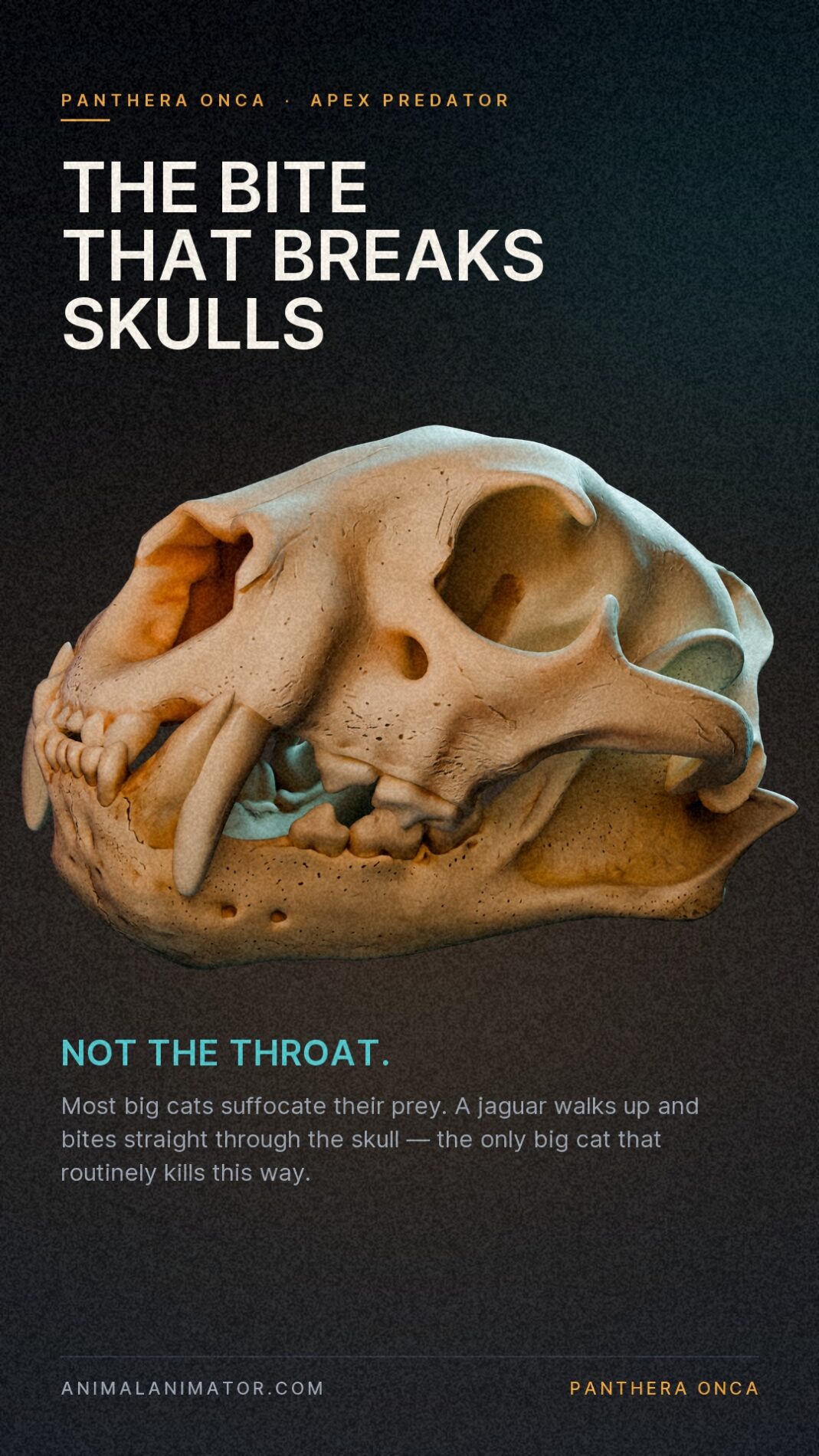
The Jaguar Skull, in 3D
Sculpted and rigged in Blender. The jaw is driven by a two-bone rig; the bite cycle runs 48 frames at 24 fps.
Seven Things That Make a Jaguar Skull
Drag to turn the skull. Each glowing point marks a structure that does real work — three teeth, four regions of bone. Tap a point to pin its note, tap again to clear it.
Tap a glowing point to read it
The Jaguar Skull, Labelled
Four anatomical plates rendered from a sculpted and rigged 3D skull. Tap any plate to open it full size — the labels are small, so it is worth zooming in.
Comparative osteology
Jaguar lower mandible
Panthera onca · 20 cm · 17,340 polygons · 2K PBR
Drag · scroll · double-click
The jaguar (Panthera onca) is the heaviest cat in the Americas and the most mechanically extreme big cat you can animate. It kills by crushing skulls rather than suffocating throats, swims by choice, climbs like a leopard, and carries all of that in a body shorter and stockier than a lion's. If you animate it like a generic big cat, it reads as a leopard with a weight problem. This jaguar reference for animators gathers the anatomy, proportions, gait timing, poses and rigging notes you need to make it read as a jaguar in the first three frames.
What you'll take away
- Silhouette first. Short limbs, deep chest, oversized head — the jaguar's read is 70 % skull and shoulder mass.
- Bite is the character. The mandible you can rotate above is built for compression, not shearing. Every aggressive pose should route force through the jaw.
- Gait is lateral-sequence. Footfalls land LH → LF → RH → RF, not in diagonal pairs. Get this wrong and the walk reads as a dog.
- Spine does the acting. Six to eight rotation-capable spine controls beat any amount of limb polish.
- Rosettes are structure, not noise. They stretch, compress and wrap with the muscle underneath.
Jaguar at a Glance
Before you open Blender or Maya, fix these numbers in your head. They are the difference between a jaguar and a repainted leopard.
Silhouette and Proportions: What Makes a Jaguar Read as a Jaguar
A jaguar is a compressed big cat. Compared with a leopard of similar length, it carries roughly 50 % more mass on limbs that are shorter and thicker. That single fact drives almost every silhouette decision.
Largest skull-to-body ratio of any big cat
Short, deep muzzle; wide zygomatic arches; a domed forehead. Block the head one size larger than instinct suggests, then widen the cheeks.
Deep barrel chest, short waist
The chest is the widest point in top view. The waist tucks quickly — this is what sells power rather than length.
Short, heavy, front-loaded
Forelimbs are visibly thicker than hind. The scapula rides high and slides visibly under the skin on every step.
Shorter than a leopard's
45–75 cm — roughly 45 % of body length, versus a leopard's 60 %+. Never let it trail as long as a snow leopard's.
Jaguar Dimensions: Shoulder Height and Body Length
Jaguars vary in size by region. Central American animals are noticeably smaller than the Pantanal and Venezuelan Llanos populations, where the largest individuals are found. The figures below are averages that exclude record extremes; cubs grow rapidly through the first year.
| Measure | Male | Female | Cub (at birth) |
|---|---|---|---|
| Shoulder height | 69–79 cm (27–31 in) | 63–76 cm (25–30 in) | ~20 cm (8 in) |
| Head–body length | 147–183 cm (4′10″–6′) | 130–170 cm (4′3″–5′7″) | 40–50 cm (16–20 in) |
| Tail length | 45–75 cm (18–30 in) | 45–70 cm (18–28 in) | ~15 cm (6 in) |
| Weight | 90–120 kg (198–265 lb) | 57–100 kg (126–220 lb) | 0.7–0.9 kg (1.5–2 lb) |
| Canine crown | up to ~5 cm | up to ~4.5 cm | deciduous, erupt ~2 weeks |
Skull, Mandible and Bite: The Engine of the Character
Rotate the 3D mandible at the top of this page and look at the coronoid process — the tall blade of bone at the back. That is where the temporalis muscle anchors, and it is proportionally taller in a jaguar than in a leopard. Everything about the jaguar's head is a lever built to close hard and resist twisting.
Unlike lions and tigers, which usually kill by clamping the throat, jaguars frequently bite through the skull or the back of the neck of their prey, and their jaws routinely puncture the shells of turtles and the armour of caiman. That behaviour dictates the pose language: a jaguar's aggression comes from the head and shoulders driving forward, not from a swipe.
| Feature | What it does | Animation / rigging note |
|---|---|---|
| Coronoid process | Temporalis anchor; the primary closing lever | Drive a corrective blendshape that bulges the temple whenever jaw-close exceeds 60 % |
| Mandibular symphysis | Fused, exceptionally robust join between the two halves of the jaw | Never let the lower jaw halves splay — model it as one rigid piece |
| Carnassial (m1 / P4) | Shears meat like scissor blades | Only engages in the back of the mouth; drives head-shake tearing actions |
| Canines (~5 cm) | Puncture and hold; short and thick relative to a tiger's | Show them in threat poses via a lip-curl shape, not by opening wider |
| Wide zygomatic arches | Room for a bulky masseter | Cheek width is a jaguar signature — do not narrow it in stylisation |
| Short muzzle | Shortens the load arm, raising bite force | Keep snout length under ~30 % of skull length in blockout |
Skeleton and Muscles: A Guide for 3D Animators
Understanding the jaguar's skeleton and muscle systems is what separates a rig that deforms plausibly from one that shrink-wraps. Jaguars share the felid body plan — around 230 bones and a famously flexible spine — but load it with more mass per unit of length than any other spotted cat.
Skeletal landmarks that show through the skin
- Scapula: the felid clavicle is vestigial and floating, so the shoulder blade travels freely up and back over the ribcage. On a walking jaguar it rises above the spine line on every forelimb reach — the single most recognisable big-cat motion cue.
- Cervical spine: seven vertebrae, heavily muscled, carried low and forward. The head sits ahead of the shoulders, not above them.
- Thoracolumbar spine: the flex-and-extend engine for the gallop. Model at least 13 thoracic and 7 lumbar joints if you want a credible bound.
- Digitigrade limbs: the jaguar walks on its toes; what looks like a backwards knee on the hind leg is the ankle (hock). The true knee is tucked inside the body silhouette.
- Retractable claws: controlled by the deep digital flexor. Rig them as a single 0–1 attribute per paw that also spreads the toes slightly as it fires.
The muscles that matter for deformation
| Muscle group | Key players | Why an animator cares |
|---|---|---|
| Jaw | Masseter, temporalis, pterygoids | The jaguar's signature. Fibre architecture here is what produces its bite advantage; bulge the temple and cheek on every hard close. |
| Neck & shoulder | Trapezius, rhomboideus, deltoid, brachiocephalicus | Carries the head and absorbs impact on a pounce. Drives roar poses and the drag when hauling prey. |
| Forelimb | Triceps, brachioradialis, extensor carpi radialis, deep digital flexor | Grip and pull. Jaguars pin prey with the forelimbs — these need real volume preservation. |
| Back & core | Latissimus dorsi, longissimus, external obliques | Spine twist and the sling that suspends the ribcage between the shoulder blades. |
| Hindquarters | Gluteals, biceps femoris, quadriceps, gastrocnemius | Launch power. On a pounce these fire ~4 frames before the paws leave the ground — animate the anticipation in the hip, not the foot. |
For primary-source anatomy, two papers are worth reading before you build a rig: Souza et al. on the comparative anatomy of the forearm and hand in wildcat, jaguar and ocelot, and Hartstone-Rose et al. on bite force estimation and the fibre architecture of felid masticatory muscles.
Fur, Rosettes and Melanism: A Texturing Brief
The jaguar's coat is the fastest way to give away an inexperienced artist. Its rosettes are not leopard rosettes: they are larger, fewer, more angular, and — crucially — they contain one to four small dark spots inside the ring. Leopard rosettes are empty.
Rosettes with interior spots
Broken rings of 3–5 dark blocks around a tawny centre, with small dots inside. Bigger and sparser than a leopard's.
Solid where it bends
Rosettes break into solid spots on the head, lower legs and tail tip; belly and inner limbs are near-white with sparse blots.
Black jaguars are ~10 %
Caused by a dominant 15 bp deletion in MC1R. Ghost rosettes remain visible in raking light — never texture a black jaguar as flat black.
Short, dense, low-lift
Guard hairs sit close to the body. Resist long fluffy grooms; a jaguar's fur reads almost like painted leather in motion.
Key Jaguar Poses for 3D Artists
Static key poses are where the jaguar's presence, stealth and agility are established. During blocking, focus on weight distribution, muscular tension and expressive features like the eyes and tail — the polish pass cannot rescue a pose whose centre of gravity is wrong.
| Pose | Description | Weight & tension cue |
|---|---|---|
| Neutral idle | Relaxed stance, even weight on all four paws, tail low, head slightly lowered and observant. | Weight 55 % forward. Head ahead of shoulders. Never perfectly symmetrical — offset one hind paw. |
| Alert | Ears perked and rotated forward, eyes locked, body tensed with one forepaw advanced. | Weight shifts back onto the hind legs, loading them. Tail tip stills completely. |
| Stalking | Low crouch, body elongated, hindquarters slightly raised, tail held straight and low. | Chest almost brushes the ground. Scapulae peak above the spine. Paws place toe-first. |
| Coiled / pre-pounce | Hind legs gathered under the hips, forequarters low, haunches quivering. | Weight 80 % on the hind limbs. The strongest anticipation pose in the whole set. |
| Aggressive | Mouth open in a snarl, ears flattened back, body arched, paws spread wide. | Force routes through the jaw and the shoulder line, not the paws. Widen the stance for threat display. |
| Perched (branch) | Draped along a horizontal limb, forelimbs hanging, tail dangling as a counterweight. | Spine curves to the branch. Jaguars are genuine climbers — use this to differentiate them from lions. |
| Swimming | Head and upper neck above water, body angled, forelimbs paddling. | Buoyancy takes ~85 % of the weight; only the head and shoulder line carry visible effort. |
| Resting | Lying with paws tucked under, head on forelimbs, tail curled around the body. | Full contact with the ground; ribcage compressed, breathing amplitude visible. |
Jaguar Animation Cycles and Sequences
Animation cycles bring the jaguar's movement to life: fluid locomotion, explosive leaps and precise predatory actions. Prioritise spine flexibility, limb overlap and secondary elements like ear twitches and tail swings, always cross-checking against real footage.
| Animation | Key mechanics | Suggested length @ 24 fps |
|---|---|---|
| Walk cycle | Lateral-sequence gait, flexible spine, soft paw plants, tail counterbalancing. | 32–40 frames |
| Prowl / stalk | Same footfall order as the walk but slower, lower and with longer suspension in each swing. | 48–60 frames |
| Trot | Diagonal pairs, short suspension, head held steadier than in a walk. | 20–24 frames |
| Run / sprint | Rotary gallop; extended and gathered suspension phases; body low, tail streaming. | 12–16 frames |
| Leap / pounce | Coiled build-up, explosive hip extension, forelimbs extended, jaws opening late. | 36–48 frames incl. landing |
| Climb | Forelimbs pull, hind limbs push, claws engage, tail sweeps for balance. | 40–56 frames |
| Swim | Diagonal paddling, head above the waterline, tail steering rather than propelling. | 28–36 frames |
| Ambush burst | Zero-to-full acceleration from stillness; two strides decide the shot. | 18–24 frames |
| Roar / vocalise | Chest expansion, mouth wide, head tilted back, throat vibration. Jaguars saw and grunt more than they roar. | 60–90 frames |
| Tail flick | Idle overlay: rhythmic wave travelling base to tip with 3–5 frame lag per segment. | 24–48 frames, loopable |
| Grooming | Neck flexion beyond human intuition; tongue rasp; paw-lick-and-wipe over the ear. | 90–120 frames |
| Cub play | Bouncy, over-shooting, poor landings, exaggerated head-to-body ratio. | 48–72 frames |
The Jaguar Walk Cycle, Frame by Frame
Cats use a lateral-sequence, diagonal-couplet walk. The footfall order is left hind → left front → right hind → right front. Three paws are on the ground at almost all times (duty factor around 0.65), which is why a jaguar's prowl looks so silent and so stable.
On a 32-frame cycle at 24 fps, plant your contacts at these positions:
Secondary channels that sell the walk
- Hips: two full up-down oscillations per cycle, amplitude ~2 cm. Small. The jaguar's prowl has almost no bounce.
- Shoulders: the scapula peaks 3–4 frames before its forepaw contacts. This lead is the cue most animators miss.
- Spine: a gentle lateral S-wave, roughly 4° of yaw at the lumbar, opposing the shoulder swing.
- Head: almost level. Stabilise it in worldspace and let the neck absorb the body's motion — cats are optical stabilisers on legs.
- Tail: low, with a 5–8 frame delay behind the hips and a secondary whip at the tip.
Run, Pounce, Climb and Swim
Sprint (rotary gallop)
Jaguars are not distance runners. They reach roughly 80 km/h in short bursts and give up within about 100 m. Animate the gallop as an asymmetric, four-beat rotary pattern with two airborne phases per stride: extended suspension after the hind push-off, and gathered suspension with all four limbs folded under the body. The spine is the biggest amplitude channel in the whole rig — 25–30° of flex-extend across the cycle.
Pounce
Structure it in five beats: freeze (hold 6–10 frames of stillness with only tail-tip motion), coil (hips drop, hind paws gather, 8 frames), release (hip and stifle extend over 3 frames — this is the fastest thing in the shot), flight (forelimbs extend, claws unsheathe, jaws open in the last third), impact (forelimbs absorb, spine compresses, then the head drives forward into the bite). Never open the jaws during the coil — it kills the surprise.
Climb
Unlike lions, jaguars climb readily and descend head-first only over short drops. The forelimbs do the pulling; hind limbs provide push and are placed high. Give the claws a visible engage-and-release, and let the tail counter-rotate to stabilise.
Swim
This is the jaguar's true differentiator among big cats — it hunts caiman and turtles in water by choice. Use a diagonal paddle with reduced amplitude, keep the muzzle and ears above the waterline, and let the tail act as a rudder rather than a propeller. A wet coat should darken, clump into spikes, and reduce silhouette volume by roughly 15 %.
Jaguar Rigging Blueprint
A production-ready jaguar rig does not need to be complicated — it needs the right joints in the right places.
| Region | Joints | Controls to expose |
|---|---|---|
| Spine | 6–8 (thoracic + lumbar) | FK chain + a curve-driven spline; separate flex, twist and side-bend attributes |
| Neck | 3–4 | FK/IK blend with a worldspace head-stabilise switch |
| Head & jaw | 1 head, 1 jaw, 2 ear roots | Jaw open/close, lip curl, ear rotate + a "flatten" pose |
| Forelimb (×2) | Scapula, humerus, radius/ulna, carpus, 2 toe joints | IK/FK switch, scapula slide, paw roll, claw extend 0–1 |
| Hind limb (×2) | Femur, tibia, hock, metatarsus, 2 toe joints | IK/FK switch, reverse-foot roll, hock pin |
| Tail | 10–14 | FK chain + dynamic/jiggle overlay you can bake |
| Face | Blendshapes only | Snarl, blink, squint, whisker flare, nostril flare, cheek bulge |
Jaguar vs Leopard, Lion and Tiger: A Reference Comparison
Most jaguar mistakes are actually leopard habits. This table is the quickest correction pass you can run on a work-in-progress.
| Trait | Jaguar | Leopard | Lion | Tiger |
|---|---|---|---|---|
| Build | Stocky, deep-chested | Lean, long | Tall, long-limbed | Long and heavy |
| Head size | Largest relative to body | Moderate | Large, maned in males | Large, broad |
| Rosettes | Large, with interior spots | Smaller, hollow | None (cubs spotted) | Vertical stripes |
| Tail : body | ~45 % | ~60 %+ | ~50 %, tufted | ~50 % |
| Kill method | Skull / nape crush | Throat clamp | Throat clamp / suffocation | Throat or nape |
| Water | Swims by choice | Avoids | Avoids | Swims readily |
| Climbing | Frequent | Expert, caches prey in trees | Occasional | Rare in adults |
| Vocal signature | Sawing grunt series | Rasping saw | Full roar, carries 8 km | Roar plus chuff |

Behaviour, Social Roles and Ecology
Jaguars are solitary apex predators with little social structure outside mating and cub-rearing — though research published in 2022 documented the first confirmed male jaguar coalitions, which challenges the strictly-solitary picture. If you are writing a sequence with two adult males cooperating, that is now defensible.
| Category | Male | Female | Cub |
|---|---|---|---|
| Social role | Territorial; roams large ranges; occasional coalitions for hunting or mating. | Raises cubs alone; range overlaps with males. | Fully dependent; learns hunting through play. |
| Feeding | Ambush predator; takes large prey (capybara, peccary, caiman) with a crushing bite. | Similar prey, skewed smaller; teaches cubs to hunt. | Nursed 3–6 months, then weaned to meat. |
| Ecological role | Regulates prey populations; disperses seeds via scat. | Same, with cub survival as the priority. | Minimal; learner. |
| Activity pattern | Crepuscular to nocturnal; more diurnal where undisturbed. | Same, with denning periods. | Follows the mother's rhythm. |
Sexual dimorphism
Dimorphism is modest and almost entirely a matter of scale and mass. Males run 10–20 % larger with broader heads and heavier forequarters; females are proportionally more agile. Cubs show almost no difference until maturity, so a single cub model can serve both sexes.
Traits and details by age and sex
| Category | Male | Female | Cub |
|---|---|---|---|
| Body shape | Muscular, broad shoulders, robust skull. | Slightly slimmer and more streamlined. | Rounded, oversized head, short limbs. |
| Motion | Deliberate, heavy strides; aggressive charges. | Agile, protective, quicker direction changes. | Bouncy, uncoordinated, over-shooting. |
| Texture detail | Thick coat, facial scars, worn canines. | Smoother coat; teats visible post-birth. | Fluffier, paler fur; large eyes; spots not yet forming rosettes. |

Seven Mistakes That Give a Jaguar Away
Hollow rosettes
Empty rings make it a leopard. Add the interior spots.
Legs too long
Jaguars are low-slung. Shorten the limbs, deepen the chest.
Diagonal walk
Trot timing on a walk reads canine. Use lateral sequence.
Bobbing head
Cats stabilise the head. Kill the vertical bounce.
Flat black melanistics
Ghost rosettes must survive in the specular response.
Static scapula
If the shoulder blade doesn't ride, the walk dies.
Lion-style roar
Jaguars saw and grunt. Reserve the full open roar.
Quick Tips: Rigging, Polish and Reference
- Rigging: give the spine multiple controls for arching and twisting to capture felid flexibility, and add extra joints to the tail for expressive overlap.
- Polish: layer in secondary motion — muscle jiggle on impacts, ear flicks, whisker drift — and offset limb follow-through by 2–4 frames.
- Reference: study high-speed wildlife footage frame by frame for weight shifts, and test your animation under three lighting setups to check that fur and rosettes hold up.
- Performance: for games, bake the tail dynamics and cap the rig at ~90 joints. A 17k-polygon LOD0 with 2K PBR maps — the same budget as the mandible model above — is comfortable on current hardware.
Frequently Asked Questions
How is a jaguar different from a leopard for a 3D artist?
Three things: the jaguar's rosettes contain small interior spots while a leopard's are hollow; the jaguar is stockier with shorter limbs and a proportionally larger head; and the jaguar's tail is shorter, roughly 45 % of body length versus a leopard's 60 %. In motion, jaguars also swim by choice, which leopards avoid.
What footfall order should a jaguar walk cycle use?
A lateral-sequence walk: left hind, left front, right hind, right front, evenly spaced across the cycle. On a 32-frame loop at 24 fps that is frames 1, 9, 17 and 25. Each paw stays grounded for about 65 % of the cycle, so three paws support the body nearly all the time.
How strong is a jaguar's bite, really?
Published absolute figures vary a lot with method, so treat the widely quoted "1,500 psi" as approximate. What is solid is the relative measure: the jaguar has the highest bite force for its body size of any big cat, with a bite force quotient near 137, and Guinness World Records cites about 705 kgf at the carnassial notch for a 100 kg animal.
How many joints does a game-ready jaguar rig need?
Around 80–95. Budget 6–8 for the spine, 3–4 for the neck, 10–14 for the tail, and roughly 12 per limb including the scapula and toes. Facial expression is better handled with blendshapes than joints.
Are black jaguars a separate species?
No. Melanistic jaguars are the same species, Panthera onca, carrying a dominant 15 base-pair deletion in the MC1R gene. About 10 % of wild jaguars are melanistic, and they are more common in dense, humid forest. Their rosettes are still present as "ghost" patterns visible in raking light.
How fast can a jaguar run, and for how long?
Roughly 80 km/h in a short burst, sustained for only about 100 metres. Jaguars are ambush specialists, not pursuit predators — build your chase sequences around a two- or three-stride commitment, not a long run.
What software is best for animating a jaguar?
Either Blender or Maya will do the job. Blender's Rigify has a solid quadruped meta-rig that gets you to a posable character quickly; Maya remains the studio standard for large-team pipelines. The rig requirements in this article are software-agnostic.
Continue your big-cat study
References and Further Reading
Models, photo reference and tutorials
- Jun's Anatomy — jaguar anatomy chart and models
- ArtStation — realistic jaguar for production
- Sketchfab — animated jaguar 3D model
- 3D.sk — jaguar pose photo sets
- YouTube — looping jaguar animation, Blender tutorial
Scientific and institutional sources (APA)
- Animal Diversity Web. (n.d.). Panthera onca (jaguar). animaldiversity.org
- San Diego Zoo Wildlife Alliance Library. (2025). Jaguar (Panthera onca) fact sheet: Physical characteristics. ielc.libguides.com
- U.S. Fish & Wildlife Service. (n.d.). Jaguar (Panthera onca). fws.gov
- World Wildlife Fund. (n.d.). Jaguar. worldwildlife.org
- Dimensions.com. (2025). Jaguar (Panthera onca) dimensions & drawings. dimensions.com
- Hartstone-Rose, A., et al. (2012). Bite force estimation and the fiber architecture of felid masticatory muscles. The Anatomical Record. wiley.com
- Souza, J. B., et al. (2019). Comparative anatomy of the forearm and hand of wildcat, jaguar and ocelot. Anatomia Histologia Embryologia. thieme-connect.com
- Hast, M. H. (1989). Hyoid apparatus and pharynx in the lion, jaguar, tiger, cheetah and domestic cat. Journal of Anatomy. ncbi.nlm.nih.gov
- Panthera. (2022). New study documents first male jaguar coalitions. panthera.org
- Crawshaw, P. G., et al. (2009). Spatial ecology and social interactions of jaguars in the southern Pantanal, Brazil. Journal of Mammalogy. academic.oup.com
- Conde, D. A., et al. (2010). Modeling male and female habitat differences for jaguar conservation. Biological Conservation. scholars.duke.edu
- Schneider, A., & Ripperger, S. (2017). Ecology and evolution of melanism in big cats. IntechOpen. intechopen.com
- Luypaert, T., et al. (2025). First record of mating involving a melanistic jaguar in the wild. Ecology and Evolution. onlinelibrary.wiley.com
- Mooring, M. S., Eppert, A. A., & Botts, R. T. (2020). Natural selection of melanism in Costa Rican jaguar and oncilla. Tropical Conservation Science. sagepub.com