
Interactive anatomy
Grey Wolf
Canis lupus lupus
Twelve landmarks and two concepts that explain the whole coat. Tap each aura.
A grey wolf’s colour does not live in the region, it lives inside each hair. A single guard hair carries a pale base, an ochre band and a black stretch near the tip. The grey you see is optical mixing of those bands, not a grey pigment. That is why a flat texture never convinces: the moment the coat moves, the colour changes.
Over that banding lies a gradient: dark dorsal saddle, pale underside. It cancels overhead light and flattens the animal’s volume to a watching predator. On the face the gradient inverts into signal: pale muzzle and throat, a dark rim on the eye and a black nose — a pattern that reads at a hundred metres.
A pale subject on a dark ground, the inverse of the melanistic build. The coat is made from real agouti bands running along each hair, not from per-region colours.
Creature animation reference · Canis lupus
The gray wolf is the Rosetta Stone of quadruped animation. Learn its gaits, its skeleton and its social logic, and you can retarget that knowledge onto dogs, foxes, big cats, hyenas and every four-legged fantasy creature you will ever rig. This is the complete, biomechanically accurate wolf reference for 3D animators, riggers and indie game developers — anatomy tables, gait timing charts, rig recipes for Blender and Maya, pack-AI behaviour states, and the 2026 locomotion science that is quietly rewriting how we animate a gallop.
Quadruped locomotionBlender & Maya riggingUnity / Unreal readyWolf anatomyPack AI design
What you will find in this guide
Introduction: biology is the shortcut to believable animation
Creating a believable 3D animal requires more than a good rig; it requires a working understanding of natural science, biomechanics and behavioural ecology. For indie game developers and 3D animators, bridging the gap between art and biology is what separates a stiff, robotic model from a living, breathing creature. Every keyframe you place is really a small biomechanical claim: this much mass, moved by this muscle, across this joint, in this many frames.
When it comes to quadruped animation, mastering the wolf is an essential rite of passage. This guide dives into the biomechanics, anatomy and locomotion of Canis lupus to give you the ultimate reference sheet for your next project — a cinematic in Maya, a survival game in Unity, or a portfolio reel that has to survive a lead animator’s scrutiny.
Watch animal documentaries, then go outside and watch the real thing. Pay close attention to details, shapes, curvatures, texture, colours and motion. Mother Nature is the best artist — and the only one who never breaks her own rigging rules.
🐺 Key takeaways
- Wolves are digitigrade endurance specialists: what looks like a backwards knee is the heel (hock), held permanently off the ground.
- They have no functional collarbone, so the scapula slides along the ribcage — the biggest single source of stride length, and the most common rigging mistake.
- The five cycles you actually need are walk, trot, rotary gallop, pounce and idle. Everything else is a blend or a transition between them.
- The spine is a spring, not a plank. Gallop power comes from flexion and extension of the lumbar region, not from the legs alone.
- A wild wolf pack is a family, not a dominance ladder. Get this wrong and your NPC AI reads as fantasy instead of nature.

The importance of animal animation cycles (and why wolf cycles are gold for animators)
Why start with wolves? The anatomy and locomotion of the gray wolf are a perfect baseline for almost every digitigrade (toe-walking) mammal. Wolves are endurance runners built for efficiency: a pack can cover 25–50 km in a night at a steady trot without visibly tiring. By studying that movement you learn the crucial mechanics of energy transfer, weight distribution and spinal flexibility. Once you master the timing of a wolf’s trot or gallop, the same underlying principles adapt directly to dogs, foxes, hyenas, big cats and fantasy creatures in your game engine.
There is a production argument too. A wolf skeleton is close enough to a domestic dog that veterinary anatomy applies directly, close enough to a coyote or jackal that one rig can serve three creatures, and different enough from a feline that animating both teaches you what actually changes between families — spine flexibility, shoulder freedom and paw compliance. If you are building an ecosystem simulator or a predator roster, wolf-first is simply the cheapest path to five believable species. Our top 10 predators for 3D animators breaks down which species reuse the most of this work.
Quick-reference numbers for scaling, timing and rig budgeting. Sprint figures are short bursts, not sustained speed.

What the newest locomotion science (2025–2026) means for your animation
Animal locomotion research has had an unusually productive two years, and several findings translate straight into keyframes. Here is what changed, and exactly what to do about it in your scene file.
Finding 01 · Gallop type is a choice, not a speed
Racing sled dogs — the closest working analogue to a wolf under load — switch between rotary and transverse gallop within a few strides, with no change in speed, stride duration or terrain. The team modelled it with a spring-loaded inverted pendulum (SLIP) and identified swing-leg stiffness as the control knob that flips one gallop into the other, describing the animal as locomotor multistable.
Animate it: stop treating rotary gallop as a single locked cycle. Author two gallop variants at the same speed and let your state machine pick between them on turns and direction changes. A predator that occasionally swaps its footfall sequence mid-chase reads as alive; one that loops a single gallop reads as a machine. Source: J. R. Soc. Interface (2026) · preprint.
Finding 02 · There are 16 ways to gallop, and flight phases decide the cost
A 2025 analysis catalogued 16 distinct galloping gaits, sorted by the number of flight phases per stride and the phase relationship between front and rear legs. The energetic verdict: flight-phase count, not rotary-versus-transverse, drives the cost. No flight phase is cheapest at low speed; two flight phases minimise energy at high speed.
Animate it: build your run blend tree around airtime, not around gait names. Lope/canter = one short suspension. Full gallop = gathered suspension plus extended suspension. Interpolating between them is what makes an acceleration feel physical. Source: Alqaham, Cheng & Gan, 2025.
Finding 03 · Three-legged dogs invent organised gaits, not stumbles
Twelve amputee dogs were captured on 3D motion capture and force plates in 2026. At speed, forelimb amputees use a rotary-like three-beat gallop; hindlimb amputees use both rotary and transverse sequences. At low speed they either keep the three-legged gallop with longer stride periods, or decouple front and hind timing entirely. The authors’ conclusion is the useful part: none of these gaits is random.
Animate it: gold dust for injury states, wounded-boss phases and hunting damage. A limping wolf should not be a walk cycle with noise added — it should be a re-timed cycle with a genuinely different footfall pattern and a heavier peak load on the remaining limb. Source: Proc. R. Soc. B (2026).
Finding 04 · Wolves fear people, but they learn fast
A 2026 PNAS study tested 185 identified wild wolves across 44 locations along an urbanisation gradient. Wolves from more urbanised areas showed less fear of a novel object on first contact but more caution when that object changed. Human voice playbacks triggered fear in over 80% of trials regardless of urbanisation, individuals habituated quickly, and being in a group buffered fear — lone wolves reacted more fearfully than pack members.
Design it: this is a ready-made AI spec. Give your wolves a per-agent habituation counter, a strong hard-coded response to human voice specifically, a re-alert trigger when a familiar object changes, and a group-size modifier on the flee threshold. Source: Wolves respond differently to human cues as they expand into urban landscapes, PNAS 2026.
Finding 05 · Markerless capture is now a legitimate reference pipeline
Deep-learning pose estimation (DeepLabCut and successors) reconstructs 3D animal kinematics from ordinary multi-view video, and has been pushed as far as force estimation in wild cheetahs. On the rigging side, UniRig (SIGGRAPH 2025) predicts skeletons and skin weights for arbitrary meshes, quadrupeds included.
Use it: track a documentary clip to get real joint trajectories as a reference curve underneath your keys, then hand-animate on top. Auto-rig for blockout speed, then rebuild the shoulder and hock by hand — that is exactly where the generated skeletons still fall down.
Top 5 most useful wolf animation cycles
To build a robust animation controller you need these five foundational cycles. Everything else in a shipped game is a blend, an additive layer or a transition between them.
| Cycle | Beat / footfall | Typical speed | Suspension | Frames @30fps | Animator’s tell |
|---|---|---|---|---|---|
| Walk | 4-beat lateral: LH → LF → RH → RF | 4–6 km/h | None (3 feet down) | 32–40 | Direct registering: the hind paw lands in the front paw’s print. Head bobs down on the forelimb contact. |
| Trot | 2-beat diagonal pairs | 8–10 km/h | Brief, at the top end | 20–24 | Head and spine go quiet and level. This is the travelling gait — it can run for hours. |
| Lope / canter | 3-beat, leading limb | 15–25 km/h | One phase | 20–24 | Asymmetric roll. The lead limb must swap on turns or the animal looks broken. |
| Rotary gallop | 4-beat asymmetric, circular footfall | 45–60 km/h (burst) | Two: gathered and extended | 14–18 | Spine flexes and extends like a bow. Maximum stride comes from the back, not the legs. |
| Pounce / leap | Acyclic | — | Full airborne arc | 24–40 (3 clips) | Split into crouch, launch and land. All power originates in the hindquarters; the spine is a coiled spring. |
Frame counts are production starting points at 30 fps, not biological constants — retime them to your character’s real-world scale.
⚡ The one equation that kills foot sliding
Ground speed = stride length × stride frequency. Measure the stride length in your cycle (distance travelled by the root between the same contact pose), divide by the cycle duration, and drive your locomotion blend from that value. If the engine moves the capsule faster than the animation’s own stride speed, the paws skate — no amount of foot IK will hide it. Full walkthrough in our Unity Animator Controller locomotion guide.
1. The walk — a 4-beat gait
Slow, purposeful and energy-saving. The head drops slightly below the shoulder line, and the animal exhibits direct registering: the hind paw lands exactly in the footprint left by the front paw on the same side. That is not a stylistic detail — it is why wolf tracks in snow look like a single-file line, and it is the fastest way to prove your walk cycle is authentic. Three feet stay on the ground at any moment, so there is no suspension and no bounce; the body vaults over the supporting limbs like an inverted pendulum.
2. The trot — a 2-beat diagonal gait
The classic wolf travelling pace: diagonally opposite legs move together, so the body is supported at two points on opposite corners and stays remarkably level. It is highly efficient and can be maintained for hours, which is why almost every documentary shot of a wolf crossing open country is a trot. Animate the head and neck as a stabiliser here — the more the body oscillates, the more the head counter-moves to keep the eyes on a level horizon line.
3. The gallop — a 4-beat asymmetrical gait
For high-speed chases. Wolves favour a rotary gallop, where the footfall sequence travels around the body in a circle, with two suspension phases: one gathered, with the legs collected under the body and the spine flexed, and one extended, with the body stretched and the spine hyperextended. Those two airborne poses are the money frames of the cycle. As the 2026 sled-dog work shows, a real animal will also drift into a transverse pattern and back again at the same speed — so a second gallop variant is a legitimate investment, not a luxury.
4. The pounce and leap
Essential for hunting mechanics, and best authored as three clips rather than one: crouch (anticipation, weight shifting back, hindquarters loading), launch (explosive extension, forelimbs tucked, spine unfurling) and land (forelimbs absorbing, scapulae riding up, spine flexing to dissipate the shock). Power is generated almost entirely from the hindquarters, with the spine acting as a coiled spring. The classic mouse-pounce — a near-vertical arc where the wolf drives its forepaws down through snow — is one of the most recognisable behaviours in the species and a superb portfolio piece.
5. The idle and alert
Never leave a character perfectly still. Include weight shifting, independent ear twitching, blinking on an irregular rhythm, tail micro-movement, and panting or sniffing that engages the chest cavity and neck. The cheapest professional trick here is an additive breathing layer: one two-second additive clip of the ribcage expanding, blended over every other state at low weight, instantly removes the mannequin feeling from an entire animation set.
Top wolf animations for a video game or film
Whether you are rendering a cinematic short in Maya or setting up an animation controller for an animal game, your wolf needs a comprehensive list of states. To make a quadruped feel alive, prioritise the animations below. Treat this as a production checklist: a complete, shippable wolf is roughly 28–35 clips, and about a third of them are behaviour rather than locomotion.
| Category | Clips | Priority | Production note |
|---|---|---|---|
| Locomotion | Sneak, walk, trot, lope, gallop, turn 90°/180°, stop, backpedal | Must have | Author each one in-place and with root motion. Keep the root node’s forward axis consistent across every clip. |
| Idles | Standard idle, alert idle, sniff/investigate, scratch, shake-off, yawn | Must have | Randomise idle selection with a weighted timer. Two idles feel scripted; five feel alive. |
| Transitions | Stand→sit, sit→lay, lay→stand, sleep loop | High | The transitions matter more than the poses. A snap between sit and stand ruins an otherwise perfect set. |
| Combat | Snarl, bark, lunge/bite, dodge, hit react (L/R/front), stagger, death | High for games | Bites need a clean contact frame for hit registration; keep the jaw open pose readable in silhouette. |
| Social | Howl, muzzle-lick greeting, submissive crouch, play bow, tail wag | Medium | This is what makes a pack read as a family instead of a spawn table. |
| Additive layers | Breathing, head look-at, ear flick, limp overlay | Cheap win | One additive layer removes the mannequin feeling from every state at once. |
A shippable quadruped animation set, ordered by return on effort.
The essential locomotion suite
- Sneak / stalk: low centre of gravity, slow weight transfers, intense head tracking. The elbows and hocks stay flexed throughout so the silhouette never straightens.
- Walk (in-place and root motion): the standard 4-beat gait. Always create both versions to give the programming team flexibility — root motion for cinematics and precise turns, in-place for capsule-driven movement.
- Rotary gallop: high-speed sprint with gathered and extended suspension phases. Consider authoring a transverse variant at the same speed for chase variety.
- Turns (90° and 180°): animals do not rotate on a dime like a tank. They lead with the eyes, then the head, then the neck, then the spine, and finally the hips — a delay chain of two to four frames per link. Add a slight banking lean into the turn.
Idles and behavioural animations
- Standard idle: subtle breathing, slight weight shifting, occasional ear flicks and blinks on an irregular rhythm.
- Investigate / sniff: head lowered to the ground, small irregular steps, tail wagging slowly at a low angle. Scent is a wolf’s primary sense — a wolf that never uses its nose reads as a dog-shaped robot.
- Howl: the chest expands, the head tilts sharply upward, and the muzzle forms an O shape. Hold the pose — a real howl runs three to eleven seconds, far longer than animators instinctively key it, and the tail lifts as the lungs fill.
- Resting transitions: stand-to-sit, sit-to-lay, and sleeping idles. Wolves curl tightly and cover the muzzle with the tail in cold weather — a single pose that sells an entire biome.
Combat and action (vital for games)
- Aggressive display (snarl): ears pinned back, lips curled to expose the canines, stiff-legged stance, raised hackles along the shoulders and rump. This is a full-body pose, not a face pose.
- Pounce / bite: a quick, explosive lunge powered by the hind legs. Wolves are slashing biters that grip and pull back rather than crush-and-hold, so follow the bite with a tug.
- Hit reactions / stagger: flinches from the left, right and front. Drive the impact through the spine first and let the limbs catch up.
- Death / incapacitation: a staged fall that blends into ragdoll on a specific frame, rather than a physics dump from frame one.
- Wolf kisses: muzzle-licking between pack members. Biologically it is a food-solicitation and appeasement behaviour inherited from puppyhood — and it is the animation that makes players care about your pack.
Top techniques to create the wolf rig in Blender and Maya
Quadruped rigging is notoriously tricky because of the digitigrade legs and the floating shoulder blade. Here are the techniques that keep your rig biologically correct in Blender or Maya — and if you want an automated head start, our Blender Rigify guide for animals covers generating the base skeleton before you hand-tune the joints below.
Deform bones
55–75 for a game-ready wolf: 3 spine, 2 neck, 1 head, 1 jaw, 2 ears, 5–7 tail, 4–5 per limb, plus twist joints.
Control bones
Unlimited in a film rig; strip to deform-only on FBX export. IK, poles, root and reverse-foot chains never leave the DCC.
The hock
The ankle, not the knee. It sits high on the leg and bends backwards. Getting this wrong is the number-one giveaway of an amateur quadruped.
The scapula
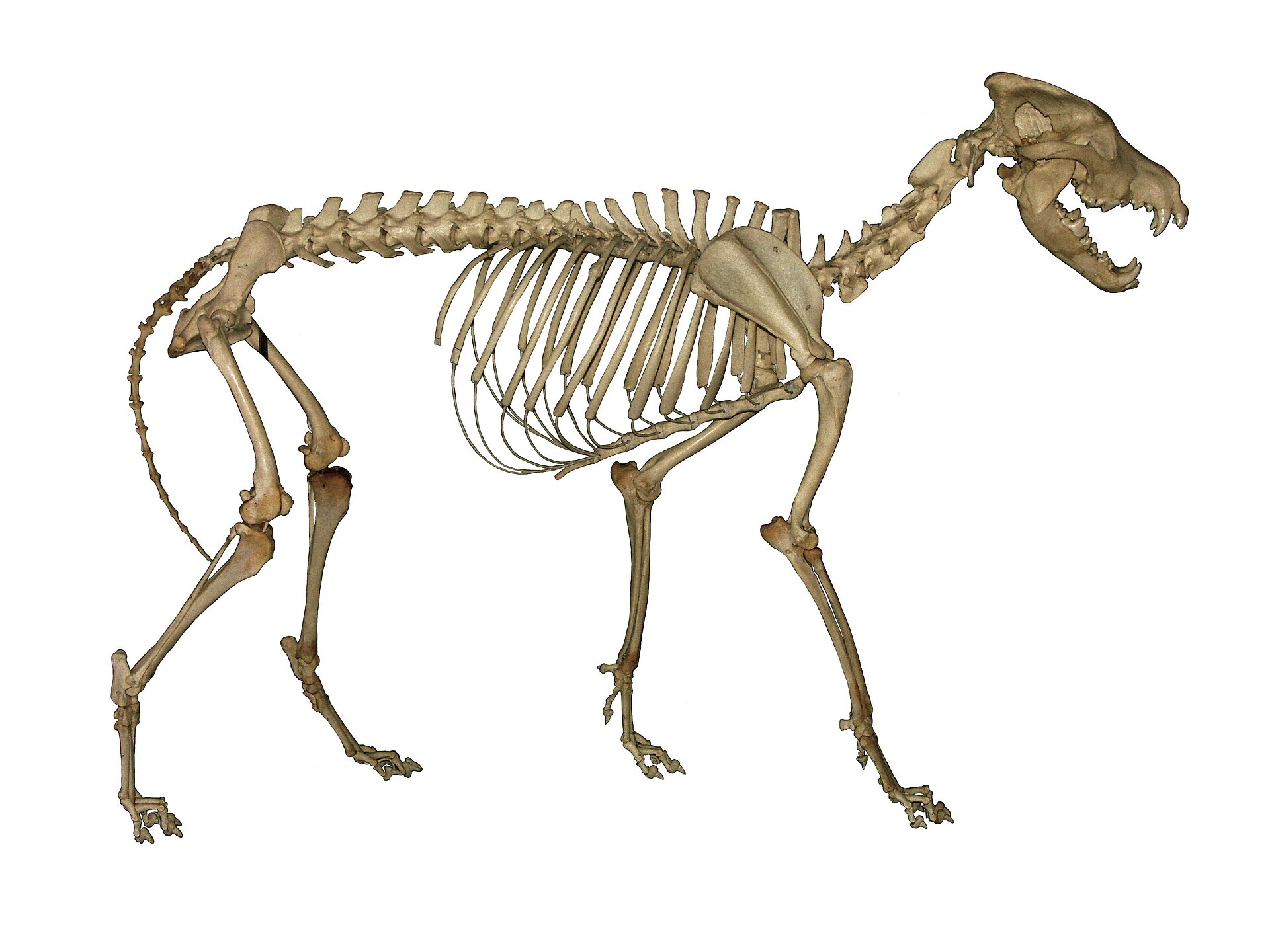
No clavicle means the shoulder blade slides on the ribcage. It supplies a large share of forelimb reach.
1. The digitigrade reverse-foot setup
A wolf walks on its toes, which means the heel (hock) is high up the leg and the visible "backwards knee" is really an ankle. The stifle — the true knee — is tucked up against the body wall and largely hidden by the flank.
- Maya: use an IK Spring Solver (or a standard IK handle from the hip to the ankle, plus another from the ankle to the ball of the foot). Create custom attributes to drive toe roll and heel lift so the animator never touches the underlying joints.
- Blender: use an IK bone constraint with a pole target for the stifle. Build a reverse-foot mechanism from a chain of parented bones at the toe, ball and heel so the foot rolls off the ground cleanly during the walk cycle. Cap the chain length at 3–4 bones or the solver fights itself.
- Both: add a ground-contact IK layer driven by raycasts in-engine. Foot IK is what keeps paws planted on slopes and stairs, and it is far cheaper than authoring terrain-specific clips.
2. The sliding scapula (shoulder blade)
Because wolves have no functional collarbone, the front legs do not pivot from a fixed socket. The scapula slides and rotates along the ribcage, and this movement contributes a significant portion of total stride length. It is also why a galloping wolf’s shoulders visibly rise above the line of the back.
- Technique: never parent the front leg straight to the spine. Create a dedicated scapula bone, then use a Shrinkwrap constraint (Blender) or a Geometry constraint (Maya) to force it to slide across a low-poly proxy of the ribcage. Keep the proxy invisible at render time and excluded from export.
- Cheap alternative for games: if constraints are too expensive, drive scapula rotation with a driver / set-driven key from the forelimb IK target’s forward position. Ninety percent of the read, none of the cost.
3. Spline IK for the spine and neck
A wolf’s power comes from flexion and extension of its back. Canids are far less flexible than felines — a wolf does not coil like a cheetah — but the lumbar spring is still the engine of the gallop.
- Maya: run a Spline IK handle down the spine and neck, and bind the curve to three control curves (chest, mid-back, pelvis) so the animator can shape the S-curve of a gallop without rotating individual vertebrae.
- Blender: use Bendy Bones (B-Bones) or a Spline IK constraint. Bendy bones distribute a smooth curve across the back and neck and make overlapping action trivial when the wolf stops suddenly.
- Watch the limits: add rotation limits per vertebra. An unconstrained spline spine will happily bend a wolf into shapes that read as injury.
4. Hybrid facial rigging (bones + blendshapes / shape keys)
- Technique: use bones for the main jaw rotation and the base of the ears, where movement is large and rigid. For the fleshy parts — lips pulling back into a snarl, the nose wrinkling, the brow furrowing — use blendshapes (Maya) or shape keys (Blender). This hybrid keeps the rig light for game engines while allowing genuinely expressive snarls.
- Do not skip the ears. Wolf ears move independently and constantly, and they are the fastest readable signal of emotional state at distance. Two bones per ear plus a floppy tip is enough.
- Corrective shapes: add driven correctives at the shoulder, hip and jaw extremes. A single corrective shape on the shoulder at full extension fixes more silhouette problems than a week of weight painting.
5. Tail, dewclaw and paw compliance
Five to seven tail bones with a soft follow-through, dewclaws that never touch the ground (front limbs only), and toe pads that splay slightly under load. Paw compliance — the toes spreading on impact and closing on lift — is a two-frame detail that reads enormously in close-up shots and costs almost nothing.
Animation workflow tips for 3D artists
Reference first
Frame-by-frame analysis of real wolves is non-negotiable. Build a PureRef board or a SyncSketch session before you key anything.
Block in stepped mode
Contact, down, passing, up. Judge the silhouette in flat grey before you touch a spline handle.
Spline and offset
Convert to spline, then offset the tail, ears and head by 2–4 frames to create drag.
Polish contacts
Lock the paws to the ground plane. Any sub-pixel slide on a contact frame reads as ice.
Bake and export
Bake IK and constraints to the deform skeleton, strip control bones, export FBX at the engine’s frame rate.
Test in engine
Nothing is finished until it has been walked over a slope with foot IK on and animation compression enabled.
Baking for the game engine: if you are exporting to Unity or Unreal, bake your IK constraints, Spline IKs and any driver-based setups down to the raw deformation bones before writing the FBX. Keep the deform hierarchy identical across every clip so the engine can share a single avatar or skeleton asset, and match your export frame rate to the project’s. See our idle, walk, run and jump Animator Controller breakdown for the engine-side setup, and the definitive 3D production pipeline guide for everything upstream of it.
Always use video reference: frame-by-frame analysis of real wolves is non-negotiable. SyncSketch, PureRef boards, or simply a documentary scrubbed at quarter speed will catch timing errors that no amount of intuition will. Modern markerless pose tools can even lift a rough 3D trajectory out of that footage to sit underneath your keys as a guide curve.
Master overlapping action: a wolf’s tail and ears are secondary animation. When the hips drop, the base of the tail drops with them, but the tip follows a few frames later. That drag is what gives the model weight and organic life. The same principle governs the head during a trot, the loose skin at the neck, and the guard hair on the ruff.
💡 Pro tip — the 3-limb rule for LODs
At distance, players cannot perceive individual footfalls; they perceive bounce frequency and silhouette. For LOD2 and beyond, drop the tail chain to two bones, collapse the toes, and keep only the spine and limb roots. You can typically cut 40% of the skeleton before a single player notices — and animation compression on a 70-bone quadruped in a 40-wolf pack is not a micro-optimisation, it is the difference between shipping and not.
a) Top wolf poses and locomotion animation references
When building your keyframes, focus on the line of action running from the tip of the nose, through the spine, down to the tail. In a resting pose a wolf’s head is generally level with or slightly below the line of its back — unlike a domestic dog, which often carries its head high. That single difference is the fastest way to make a canine model read as wild rather than pet.
For locomotion, watch the shoulders: because wolves have no functional collarbone, the scapula rotates heavily along the ribcage and dramatically extends stride length. And watch the proportions — a wolf is leggier than it looks. Long limbs, a narrow chest (the front paws track almost in a single line under the body), large paws, and a deep but laterally compressed ribcage built for endurance, not for power.
| Pose | Head | Ears | Tail | Body / reads as |
|---|---|---|---|---|
| Neutral / confident | Level with the back | Forward, upright | Horizontal or low, relaxed | Weight even on all four. The breeding pair’s default. |
| Alert | Slightly raised, eyes fixed | Pricked hard forward | Raised to the spine line | Body frozen, weight shifted marginally forward. Hold the stillness. |
| Stalk | Low, level with shoulders | Forward, flattened slightly | Straight out, low and still | Elbows and hocks deeply flexed, body long and low. |
| Aggressive display | Forward and low, muzzle wrinkled | Pinned back and down | Raised, bristled | Stiff-legged, hackles up along the shoulders and rump. Maximum apparent size. |
| Fearful / defensive | Lowered, turned away | Flat against the skull | Tucked between the hind legs | Crouched, weight back. Minimum apparent size. |
| Active submission | Raised toward the other wolf’s muzzle | Back and low | Low, wagging fast | Crouched, licking upward. The greeting ceremony pose. |
| Play bow | Level, mouth open and relaxed | Forward | High, wagging broadly | Forelimbs down, hindquarters up. The universal canid invitation to play. |
The wolf posture ladder. Body language runs on three channels — head height, ear position and tail angle — and they must always agree with each other.
b) Female wolf, male wolf and wolf cubs: anatomy facts and core features
Understanding biological variance is key to creating diverse NPCs and dynamic pack mechanics. If every wolf in your pack is the same mesh at the same scale, players read it as a copy-paste spawn — two or three body types plus randomised scale within the ranges below fixes that instantly.
| Metric | Adult male | Adult female | Pup (8 weeks) |
|---|---|---|---|
| Typical weight | 30–50 kg (66–110 lb) | 23–41 kg (50–90 lb) | 4–7 kg (9–15 lb) |
| Exceptional maximum | Up to ~80 kg (175 lb) in northern subspecies | Around 55 kg (120 lb) | — |
| Shoulder height | 68–85 cm | 63–78 cm | ~25 cm |
| Head and body length | 105–160 cm | 100–145 cm | — |
| Skull | Blockier, broader, pronounced sagittal crest | Narrower muzzle, lighter crest | Proportionally huge, short muzzle |
| Silhouette note | Thicker neck and ruff, longer legs | More streamlined, finer bone | Big head, big paws, short thick legs |
Ranges vary by subspecies and latitude — Arctic and northern wolves sit at the top of every column, Arabian and Mexican wolves near the bottom.
- Sexual dimorphism: yes, but subtle. Males are typically 15–20% larger. For modelling, males have blockier, broader skulls, thicker necks and longer legs; females have narrower muzzles and a more streamlined silhouette. Do not exaggerate it — overstated dimorphism is one of the tells of a fantasy wolf.
- Pregnancy and cubs: gestation is about 60–63 days, with a typical litter of 4–6 pups born in a den. Pups are born deaf and blind; eyes open around 11–15 days and they emerge from the den at roughly three weeks.
- Animating pups: completely different proportions — proportionally larger heads, shorter and thicker legs, oversized paws, and a clumsy, uncoordinated gait caused by underdeveloped stabilising muscles. Key them with wider stances, more lateral wobble, overshoot on every stop, and a much shorter attention span in the idle logic. Pups also have blue eyes for the first weeks, shifting to amber — a free storytelling detail for a shader parameter.
c) Adult male and female wolf skeletal anatomy

Note: while this section mentions muscle in passing, these metrics focus on the skeletal framework that dictates your armature.
- How many bones: wolves have approximately 319 bones, varying slightly with the number of tail vertebrae.
- Male vs female bone differences: the structure is fundamentally identical, differing mainly in scale and density. The most visible difference is the sagittal crest — the ridge along the top of the skull — which is more pronounced in males and provides a larger attachment area for the jaw muscles.
| Bone | Region | Why it matters to your rig |
|---|---|---|
| Scapula | Shoulder | Floats on the ribcage with no clavicle anchor. Must be its own bone with a sliding constraint — it drives forelimb reach. |
| Humerus / radius / ulna | Forelimb | The elbow sits close to the body wall. Add a twist joint on the radius or the forearm will candy-wrap on turns. |
| Pelvis and femur | Hindquarters | The powerhouse of thrust. Femur angle sets the gather pose of the gallop. |
| Calcaneus (hock) | Hind leg | The heel, permanently elevated. This is the joint that reads as a backwards knee — place it high and the rig instantly looks canine. |
| Lumbar vertebrae | Lower spine | The spring of the gallop. Needs at least 3 animatable spine bones with rotation limits. |
| Caudal vertebrae | Tail | Up to ~20 in nature; 5–7 bones is plenty for animation. The balance rudder and the emotion display. |
| Skull and sagittal crest | Head | Anchors the temporalis. A flat-topped skull instantly reads as a dog, not a wolf. |
| Carnassial teeth (P4 / m1) | Jaw | The shearing pair. Visible in every snarl — model them, do not fake the mouth interior. |
- Structure and locomotion: the skeleton maintains stability through tension. The absence of a functional clavicle lets the scapula pivot forward and maximise stride reach. The spine acts as a flexible bridge, bowing upward when the legs gather and flexing downward when they extend during a run — the same spring-mass behaviour the SLIP models in the 2026 sled-dog study are built to capture.
- Recommended sources for learning: for scientifically accurate reference, look to the work of L. David Mech, the Animal Locomotion plates by Eadweard Muybridge, and veterinary anatomy textbooks such as Miller’s Anatomy of the Dog, which is structurally near-identical to a wolf for rigging purposes.
d) Muscle anatomy of wolves
Like most canids, wolves have over 700 skeletal muscles. You will never model them all — but the five below determine where your mesh must deform, where your correctives go, and where a lazy weight-paint job will be spotted immediately.
| # | Muscle | Region | Function | What the animator must show |
|---|---|---|---|---|
| 1 | Biceps femoris | Hind legs | Extends hip, stifle and hock | The explosive thrust of a jump or gallop. The hindquarter should visibly bunch and release, not stay a rigid volume. |
| 2 | Latissimus dorsi | Back / ribcage | Retracts the forelimb | Once the front paw plants, this pulls the body forward over the leg. Drives the ripple along the flank at speed. |
| 3 | Brachiocephalicus | Neck to arm | Protracts the forelimb | Pulls the front leg forward to start a stride — and dictates the heavy head-bob of the walk cycle. |
| 4 | Triceps brachii | Front legs | Extends the elbow | Absorbs the landing impact of the whole body weight. Bulges hard on every forelimb contact frame. |
| 5 | Masseter (with temporalis) | Jaw | Closes the jaw | Exceptionally thick, anchored to the sagittal crest. Weight this area properly or every snarl and bark collapses the cheek. |
Bite force at the canines is commonly cited at roughly 1,400 N — among the highest of any living canid relative to skull size.
e) Fur, silhouette and expression: the layer most artists skip
A wolf’s coat is not one material. It is a dense insulating undercoat beneath long, coarse guard hairs, and the two behave completely differently under motion and light. The undercoat reads as volume and soft rim light; the guard hairs read as directional strands, catch specular highlights, and are what make the ruff, the shoulder cape and the tail feel like they belong to a living animal rather than a plush toy.
- Seasonal molt: the winter coat is dramatically thicker, with a pronounced ruff around the neck and shoulders. Summer wolves look startlingly lean and leggy. Shipping both variants costs one groom and gives you two visually distinct creatures.
- Piloerection (hackles): raised hair along the shoulders and rump during aggression or fear. Drive this with a blendshape or a groom attribute wired to your aggression parameter — it is a huge readability win in combat.
- Coat colour: not just grey. Wild populations run from near-white through cream, tawny, rust, grizzled grey and solid black, with agouti banding along each individual hair. Randomise hue and value per NPC within a controlled range.
- Wind and secondary motion: the ruff and tail should react to gusts and to the animal’s own acceleration. A static groom on a galloping wolf is the single fastest way to break the illusion in a cinematic.
- Games versus film: hair cards with an anisotropic specular for real time; strand-based grooms with a hair BSDF for offline. Either way, sculpt the underlying silhouette correctly first — fur amplifies a good form and exposes a bad one.
f) Wolf social structure and pack dynamics for NPC AI
Monogamous or polygamous? It does not matter whether you are building a video game, a film or a portfolio piece — getting the social dynamics right is as important as perfecting the walk cycle. A pack that moves correctly but behaves wrongly still reads as fake.
⚠ Myth vs fact: the alpha wolf
The myth: wolf packs are aggressive groups of unrelated adults constantly fighting for an alpha position.
The fact: that model came from captive wolves forced together in enclosures. In the wild, packs are nuclear families built around a single monogamous breeding pair and their offspring from this year and previous years. L. David Mech — who popularised the term — publicly retracted it and now prefers breeding male, breeding female or simply parents. Reference: Mech, Alpha status, dominance, and division of labor in wolf packs, Can. J. Zool. 77 (1999).
Why you should care: if your AI spawns six unrelated adults who brawl for rank, you have built a dog-fighting ring, not a wolf pack. Spawn a family instead and the emergent behaviour does the storytelling for you.
Core features of wolf social structure
- The breeding pair (monogamy): only this core pair reproduces. They form long-term bonds and lead the pack. If you are coding mating behaviours, denning mechanics or pack-spawning logic, restrict reproduction strictly to these two entities.
- Sub-adults and yearlings: the subordinate members are almost entirely the couple’s older children. They act as cooperative helpers, assisting in hunts and guarding the newest litter.
- Dispersal mechanics: between 1 and 3 years old, young wolves leave to become dispersers (lone wolves), travelling to find a mate and establish new territory. In a game engine this is a free, biologically grounded mechanic for migration events, population control and spawning new packs across the map.
- Territory and scent: packs hold territories of tens to hundreds of square kilometres, marked by scent posts and defended by howling. Territorial patrol routes are the most naturalistic navmesh behaviour you can give a predator NPC — and 2026 research found that breeders specifically show much higher rates of investigatory, territorial and locomotor response to foreign scent than non-breeders. Different roles should mark differently.
| AI state | Trigger | Animation set | Posture signature |
|---|---|---|---|
| Patrol | Idle timer, territory waypoint | Trot loop, sniff, scent-mark | Head level, tail horizontal, ears forward |
| Investigate | Sound or scent stimulus in range | Walk, sniff, alert idle, head look-at | Head low, ears rotating independently |
| Alert / assess | Target confirmed, out of range | Alert idle, stare, low growl | Frozen, weight forward, tail raised to spine line |
| Stalk | Target within pursuit range, cover available | Sneak loop, slow turn | Body long and low, elbows and hocks flexed |
| Chase | Target flees or detection breaks | Lope, gallop, hard turns | Spine flexing, full extension, ears back against wind |
| Engage | Contact range | Lunge, bite, dodge, hit react | Hackles raised, lips curled, stiff-legged between attacks |
| Greet (pack) | Proximity to breeding pair after separation | Muzzle-lick, submissive crouch, tail wag | Lowered body, ears flat, tail low and fast |
| Retreat | Health low, group size low, human voice detected | Backpedal, turn, gallop away | Tail tucked, head turned back over the shoulder |
A behaviour-state table you can lift straight into a behaviour tree. Note the last row: 2026 fieldwork found group size measurably buffers fear, so make your flee threshold a function of nearby pack members.
Animation and rigging takeaways for pack interactions
Because the pack is a close-knit family, their social animations are highly nuanced. To make a virtual pack feel like a cohesive living unit rather than a group of independent AI agents, build distinct behavioural states:
- Confidence and leadership (breeding pair): the parents stand taller, ears pricked forward, tail held horizontal or slightly raised. They initiate travel and hunting phases, and they lead the file when the pack moves.
- Active submission and greeting (offspring): lowered body posture, ears pinned flat, tucked tail, active muzzle-licking. Blending these greeting animations into your idle states is crucial for believable pack AI — it is the single behaviour that makes players perceive a family.
- Spatial formation: wolves travel single file in deep snow and fan out in open terrain. A formation offset driven by ground type costs almost nothing and reads as intelligence.
- Chorus howling: when one wolf howls, the others join within a second or two, each on a different pitch. Offset the start frames per agent — synchronised howling is instantly uncanny.

g) Dire wolves and fantasy scaling: how to make a big wolf that still reads as real
Almost every fantasy project eventually asks for a bigger wolf, and 2025 made the subject unavoidable: Colossal Biosciences edited 14 genes in gray wolf cells and produced three animals they present as de-extinct dire wolves — Romulus, Remus and Khaleesi. Independent biologists dispute the label, since the animals are engineered gray wolves rather than true Aenocyon dirus. Either way, the real dire wolf is a great case study in scaling a creature honestly.
- Mass scales as the cube of length; bone strength as the square. Double a wolf’s height and it becomes roughly eight times heavier while its bones only get four times stronger. That is why a giant wolf must be thicker in the limb, not simply a scaled-up mesh.
- Bigger animals move slower in frame terms. Stride frequency drops as size rises. If you scale a wolf up 1.5×, slow the cycle by roughly the square root of the scale factor (about 1.22×) as a starting point, then adjust by eye. Elephant timing is the extreme version of the same rule — see the African elephant reference for how far it goes.
- Real dire wolves were not giants. They were roughly gray-wolf sized but heavier built, with a broader skull, stronger jaws and shorter limbs — ambush power over endurance. Model the mass, not the height.
- Fewer suspension frames. Heavy animals spend less time airborne. Cut the extended suspension phase of the gallop and increase the ground contact duration, and your big wolf will feel heavy instead of floaty. For an extinct-predator study in the same spirit, see our Smilodon reference for 3D sculptors.
Recommended websites and sources for learning: top 3 quality references
As a 3D animator and game developer, your internal reference library and your external research sources are your greatest tools for creating believable motion in your ecosystem simulators. Generic stock footage has its place, but realistic quadruped animation requires biological accuracy and specific, high-quality visual reference. These three authoritative, science-based sources should be cornerstones for perfecting your wolf mechanics and behaviour.
1. The Wolf Conservation Center (WCC) — live cams
- Why it is essential for animators: real-time, high-definition motion reference of wolves behaving naturally in large enclosures. The WCC hosts gray, Mexican gray and red wolves, giving you a spectrum of species and individual variation. The cams deliver endless opportunities to observe complex social interactions — subtle ear twitches, tail postures, the muscle work of an active submission greeting — plus pure locomotion from multiple angles.
- Animator’s workflow: use WCC footage for frame-by-frame analysis of gait transitions, weight distribution during leaps and turns, and secondary overlapping action such as tail drag and breathing-induced chest movement.
- Link: WCC live cams
2. Miller’s Anatomy of the Dog (textbook)
- Why it is essential for animators: the definitive scientific resource for quadruped rigging and dynamic muscle deformation. Surface anatomy is misleading; you need the under-the-hood precision. Because wolves and domestic dogs are structurally and biomechanically near-identical, this veterinary textbook is the accepted gold standard for creature artists, with detailed illustrations of skeletal topology, joint articulation limits and the exact origin and insertion points of every core muscle group.
- Animator’s workflow: refer to these diagrams while building your technical rig, especially for the floating scapula and the digitigrade hock. Knowing where muscles attach is what makes them deform correctly over the bone.
- Link: Miller’s Anatomy of the Dog (Elsevier)
3. Wolf.org (International Wolf Center) and the publications of L. David Mech
- Why it is essential for animators: factual, science-based context for behavioural logic and pack dynamics. Realistic animation is not only about how an animal moves, but why. Dr L. David Mech is the world’s preeminent wolf biologist, and his research is the definitive documentation of wolf ethology — including the correction that wild packs are cooperative families led by a breeding pair, not aggression-driven hierarchies led by an alpha.
- Animator’s workflow: use Mech’s research to inform your behavioural state machines. Define entity states (confident parent vs submissive yearling) from biological reality so your virtual pack moves and responds like a real one during denning, travel and hunting.
- Links:
Peer-reviewed papers cited in this guide
| Year | Study | Why an animator should read it |
|---|---|---|
| 2026 | Gait transitions in load-pulling quadrupeds (J. R. Soc. Interface) | Proves gallop type can switch at constant speed. Build two gallop variants. |
| 2026 | Locomotion on three legs: tripedal gaits of canine amputees (Proc. R. Soc. B) | The reference for injured, limping and wounded-creature animation. |
| 2026 | Wolves respond differently to human cues as they expand into urban landscapes (PNAS) | A ready-made fear, habituation and group-buffering model for NPC AI. |
| 2025 | 16 ways to gallop: energetics and body dynamics of high-speed quadrupedal gaits | Flight-phase count, not gait name, drives cost. Blend your run tree by airtime. |
| 2025 | Behavioural energetics: how energy use influences how we move (J. Exp. Biol.) | Why animals choose gaits at all — the logic behind your transition thresholds. |
| 1999 | Mech, Alpha status, dominance, and division of labor in wolf packs | The paper that retired the alpha myth. Required reading before you design pack AI. |
Introduction to the Wolf Conservation Center — a good overview of the WCC’s enclosures, showing the natural environment and terrain variation you can observe when studying their animals for reference.
Wolf animation FAQ
How many bones should a game-ready wolf rig have?
Between 55 and 75 deform bones is the practical range for a modern game engine: three spine bones, two neck, one head, one jaw, two ears, five to seven tail, four to five per limb, plus twist joints on the forearms and shanks. Control bones, IK chains and pole targets live only in Blender or Maya and are stripped before FBX export. For distant LODs you can drop to around 40 bones without any perceptible loss.
What is the difference between a rotary and a transverse gallop?
Both are four-beat asymmetrical gaits. In a rotary gallop the footfall sequence travels around the body in a circle; in a transverse gallop the lead swaps diagonally between the front and hind pairs. Wolves and most canids favour the rotary pattern, but 2026 research on sled dogs showed that animals switch between the two within a few strides at the same speed — so both are biologically correct.
Why does a wolf’s back leg look like it bends backwards?
It does not. What you see is the ankle, called the hock, which sits high on the leg because wolves are digitigrade and walk on their toes. The true knee, the stifle, is tucked up against the body wall and hidden by the flank. Placing the hock too low is the most common mistake in amateur quadruped rigs.
How fast does a wolf actually run?
Wolves cruise at a trot of roughly 8 to 10 km/h and can hold it for hours, covering 25 to 50 km in a night. Chase speeds are typically 35 to 45 km/h, with short sprint bursts approaching 60 km/h. If your game’s wolf sprints at 60 km/h continuously, it is a fantasy creature, not a wolf.
Is the alpha wolf real?
Not in the wild. The concept came from studies of unrelated captive wolves. Wild packs are family units led by a breeding pair, and L. David Mech, who popularised the term, has publicly asked people to stop using it. For NPC design, spawn a family with parents, yearlings and pups rather than a group of rivals competing for rank.
Can I reuse a wolf rig for a dog, fox or coyote?
Yes, and you should. Canids share a near-identical skeletal layout, so the same armature retargets across dogs, coyotes, jackals and foxes with proportion tweaks, and even to hyenas with more work. What changes is proportion, mass and timing, not topology. Big cats need a different spine and a much more mobile shoulder, so treat them as a separate rig.
How long should a wolf walk cycle be?
A useful starting point at 30 fps is 32 to 40 frames for a walk, 20 to 24 for a trot, and 14 to 18 for a full gallop. Then verify against your engine: stride length multiplied by stride frequency must equal the character’s ground speed, or the paws will slide.
Next up: keep building your creature roster
🐾 Ready to master big cats? If you have nailed the digitigrade mechanics of the wolf, it is time to tackle the sheer power and flexibility of a feline — a completely different spine, a far more mobile shoulder, and retractable claws.


