The Ultimate Tiger Reference for Animators (2026 Guide)

Ten Things That Make a Tiger’s Jaw
Drag to turn the jaw. Each glowing point marks a structure that does real work — five teeth, five pieces of architecture. Tap a point to pin its note, tap again to clear it.
Tap a glowing point to read it
Panthera tigris — Osteology
Five Views of the Tiger Lower Jaw
Every figure below is rendered from a 3D scan of a real Panthera tigris mandible. Each label sits on a measured point of the mesh — nothing is drawn by hand.
Figure 01 — Left lateral view
The Lower Jaw, Named
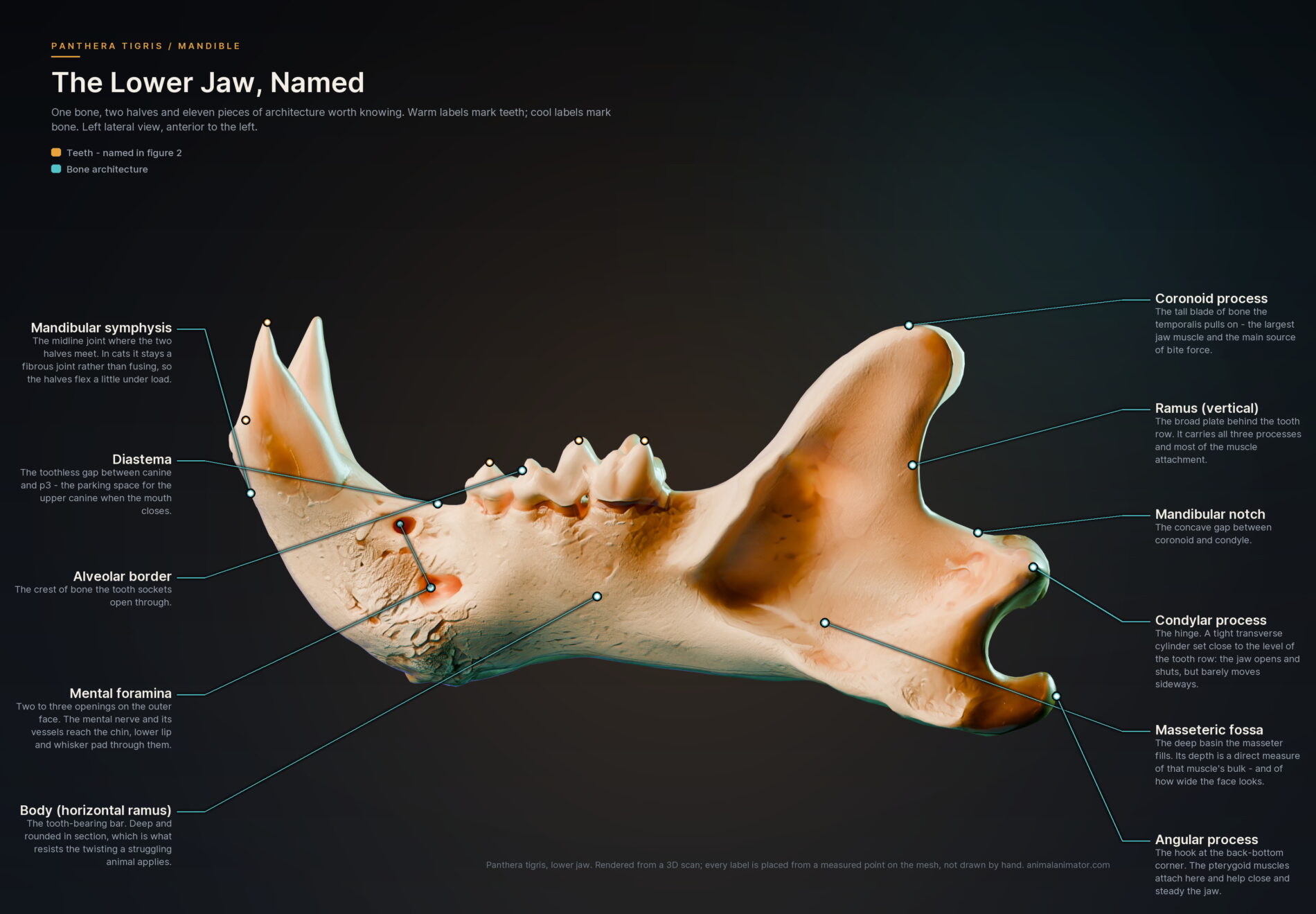
Figure 02 — Dentition
Six Teeth a Side, and Four That Never Grow
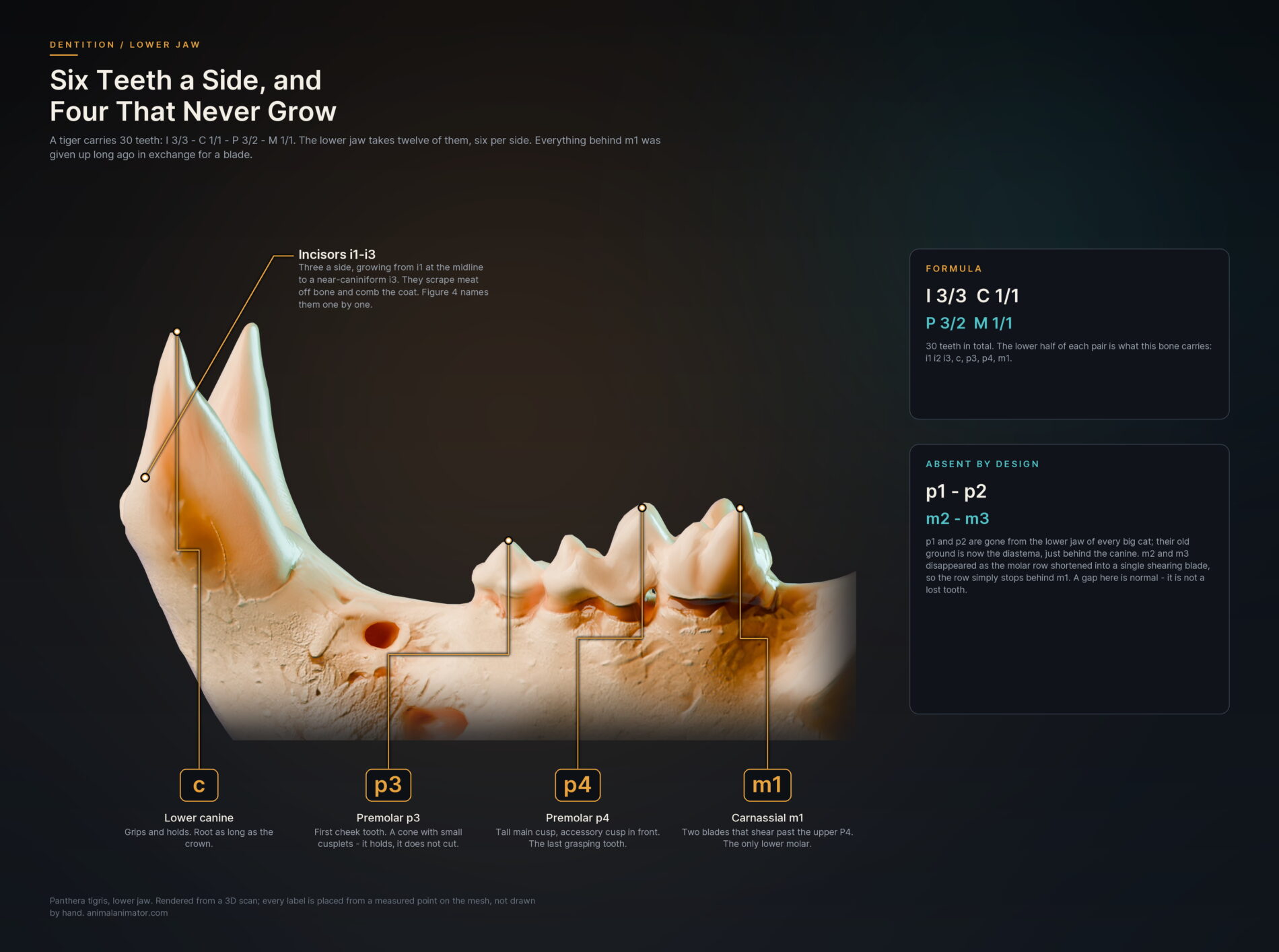
Figure 03 — The shearing pair
Where the Jaw Becomes a Blade
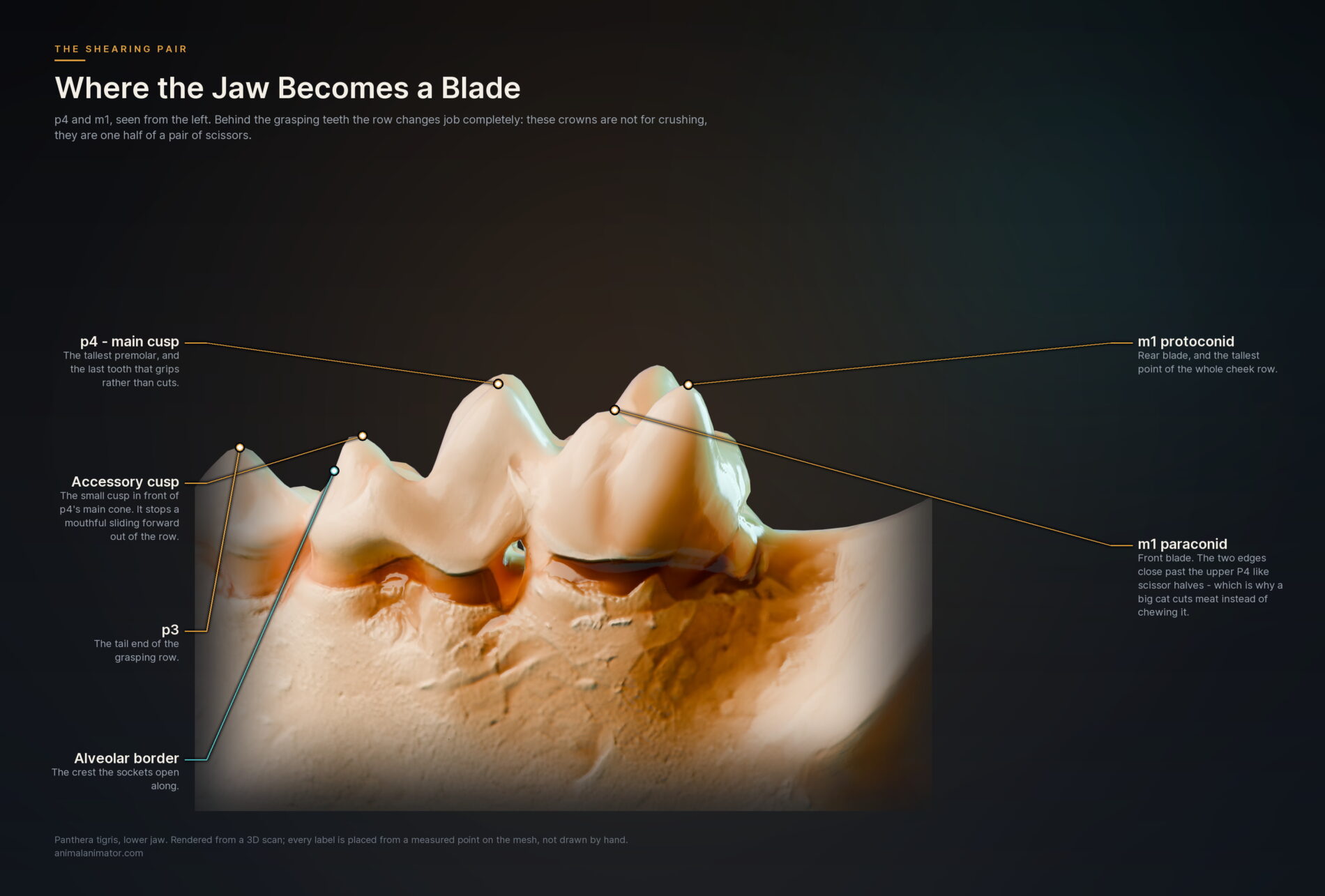
Figure 04 — Incisors and canine
The Front of the Mouth
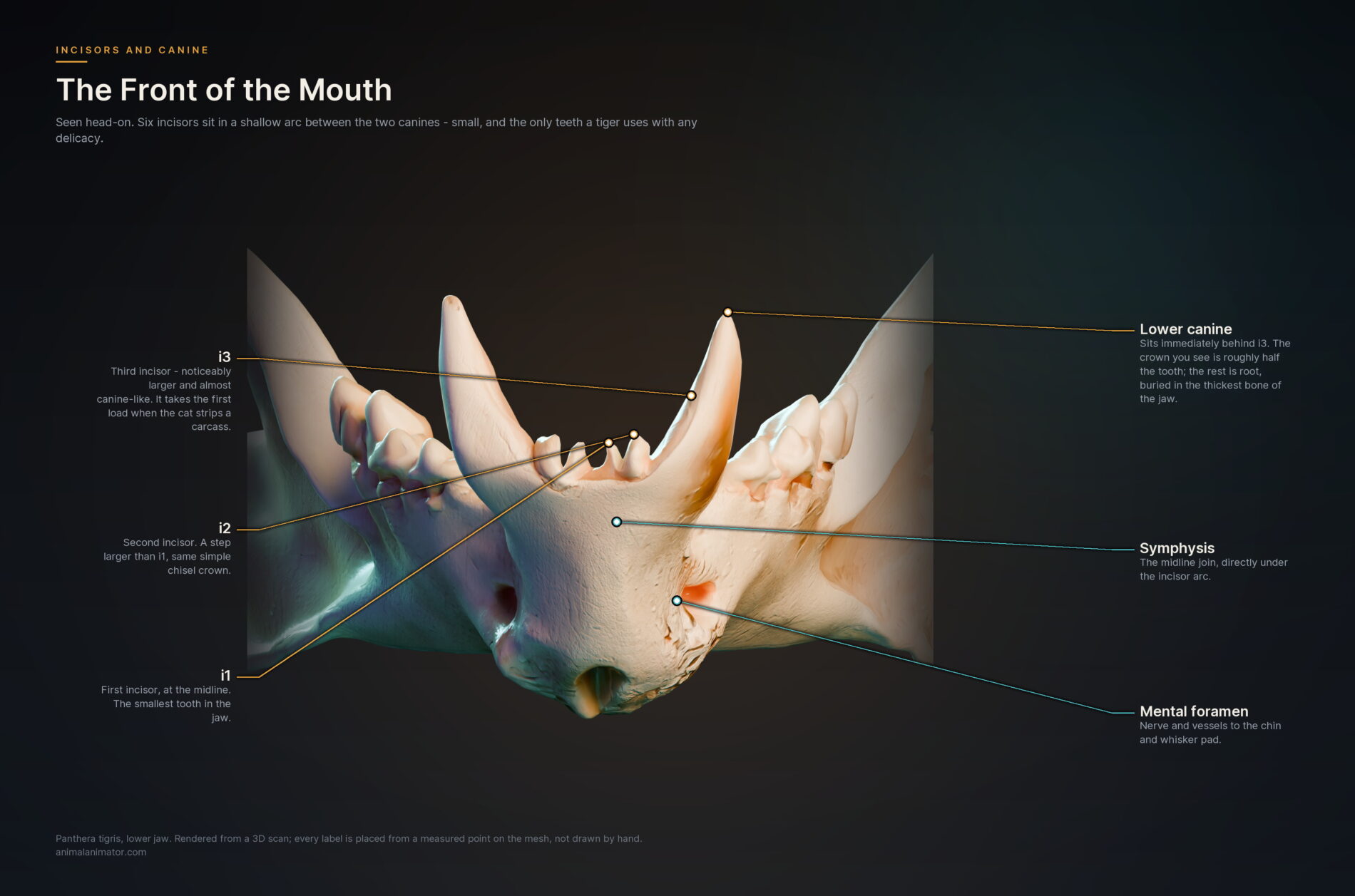
Figure 05 — Occlusal view
A Narrow V
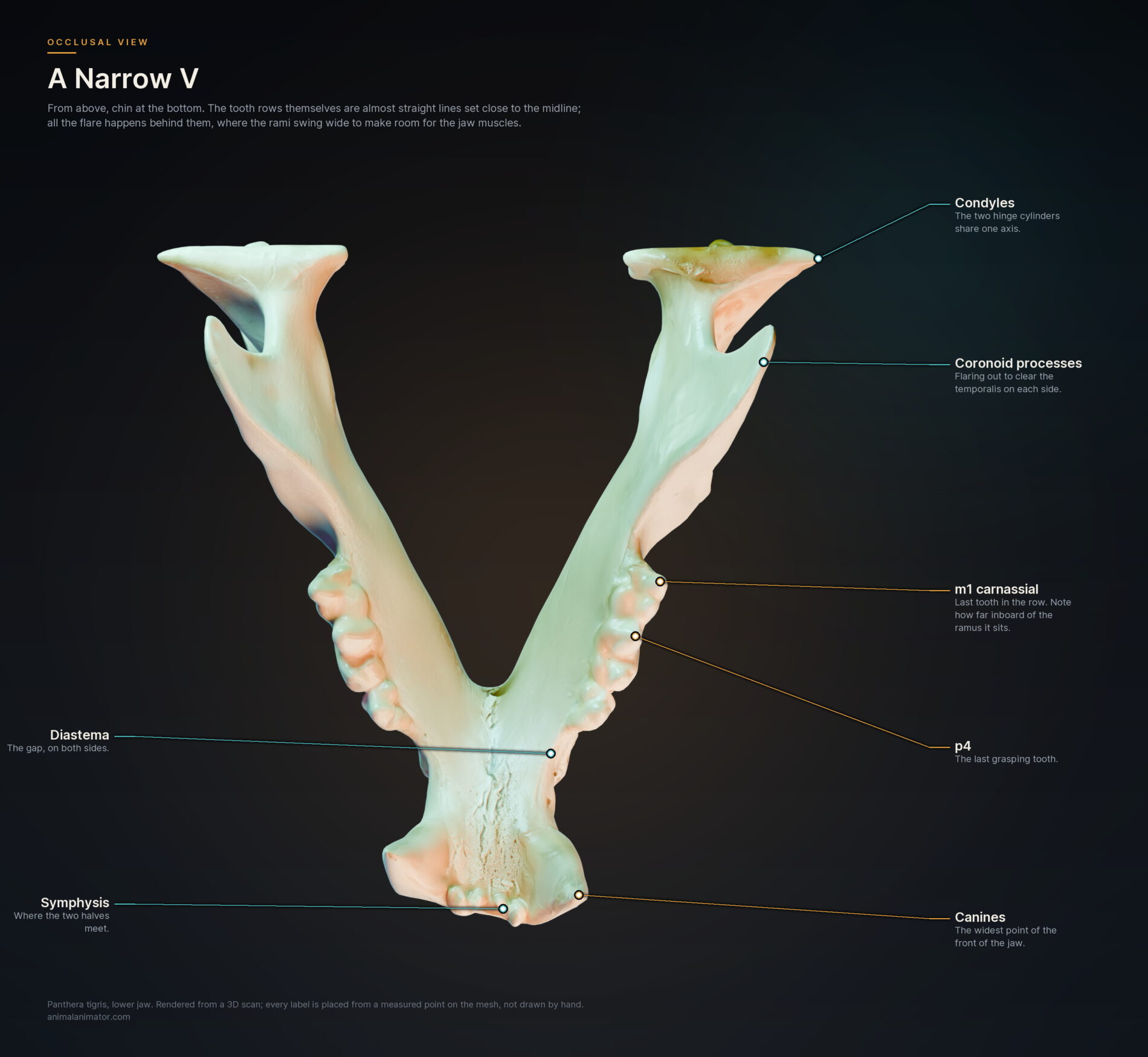
Panthera tigris, lower jaw. Rendered from a 3D scan; every label is placed from a measured point on the mesh, not drawn by hand.
Animating a tiger convincingly is one of the hardest — and most rewarding — challenges in creature animation. A tiger is 250 kg of muscle that moves like liquid. Get the weight wrong and it reads as a house cat. Get the spine wrong and it reads as a dog.
This guide is built for 3D and 2D animators working in games, film and real-time engines. Every section is grounded in observable biomechanics: footfall order, duty factor, spine flexion, scapula travel and real dissection data — plus the five cycles that cover roughly 90% of tiger shots you will ever be asked to animate.
Why Animation Cycles Matter (and Why Tiger Cycles Are Gold)
An animation cycle is a short, seamless loop of motion that repeats perfectly when played back-to-back. A walk cycle, a run cycle, an idle breathing loop — these are the atoms of character animation. In games they are the entire vocabulary a creature has.
Cycles carry more weight than most beginners expect. Here is why studios build their creature pipelines around them:
They are the reference skeleton
Every hero shot, every transition and every combat blend is measured against the base cycle. Get the cycle wrong and every derived animation inherits the error.
They collapse production time
Instead of animating 30 seconds of walking, you build one flawless 1.2-second loop and let the engine repeat it. That is a 25× saving before you touch polish.
They lock consistency
Timing, weight and personality stay identical across a 40-hour game. Without cycles, the same creature drifts in feel from level to level.
They are memory-cheap and blendable
A looping clip costs a fraction of baked linear animation, and real-time blend trees can cross-fade walk → trot → run on a single speed parameter.
Disney, DreamWorks and Blizzard all study real animal footage before a single key is set. Indie teams should too. Tigers are among the most-referenced big cats in the industry precisely because they are powerful, graceful and instantly readable — and because a tiger cycle retargets cleanly onto lions, jaguars, leopards and most large felids. Build the tiger once and you have unlocked a whole clade.
The Top 5 Tiger Animation Cycles Every Animator Needs
These five cycles are ranked by how often they appear in shipped games and finished films. Master them — even as rough block-outs — and you can convincingly cover the overwhelming majority of tiger work.
Stealth Walk (Patrol / Prowl)
Lateral-sequence, diagonal-couplets walk · the default state for almost every big-cat NPC
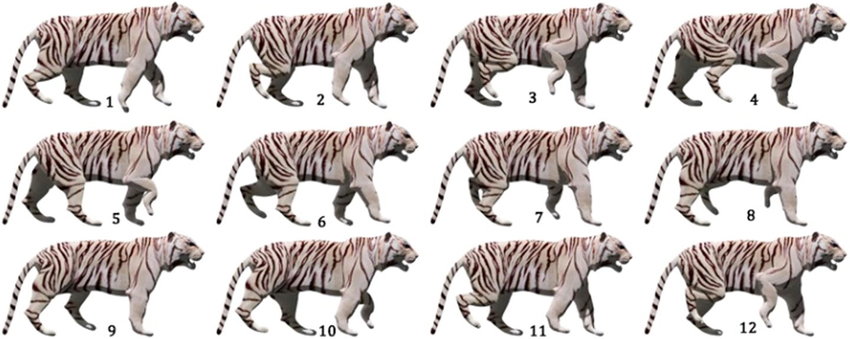
This is the shot that sells a tiger as dangerous before it does anything at all. The body stays low, the head rides almost level with the shoulders, and the weight rolls forward with the deliberateness of something that has never needed to hurry.
What to nail: at least two feet stay grounded at every instant — there is no airborne phase in a walk. The scapula rises above the spine line on each forelimb contact, and the tail sweeps in a slow, delayed arc that lags the hips by 4–8 frames.
Where you will use it: patrol AI in open-world games, stalking approach in cutscenes, and every establishing shot that needs to say "apex predator" without a roar. The Jungle Book (2016) and Life of Pi both lean on this cycle to make Shere Khan and Richard Parker feel simultaneously beautiful and lethal.
Trot / Fast Walk
Two-beat diagonal gait · the connective tissue of every locomotion blend tree
The trot is the transitional speed between walk and run, and it is genuinely harder to animate than either. Diagonal pairs strike together, the posture lifts, and the spine begins the vertical undulation that will become full flexion in the gallop.
What to nail: the body reaches its highest point mid-suspension, not on contact — beginners invert this and the trot reads as bouncing on springs. Keep the head remarkably still; the neck absorbs the vertical oscillation so the eyes stay locked on target.
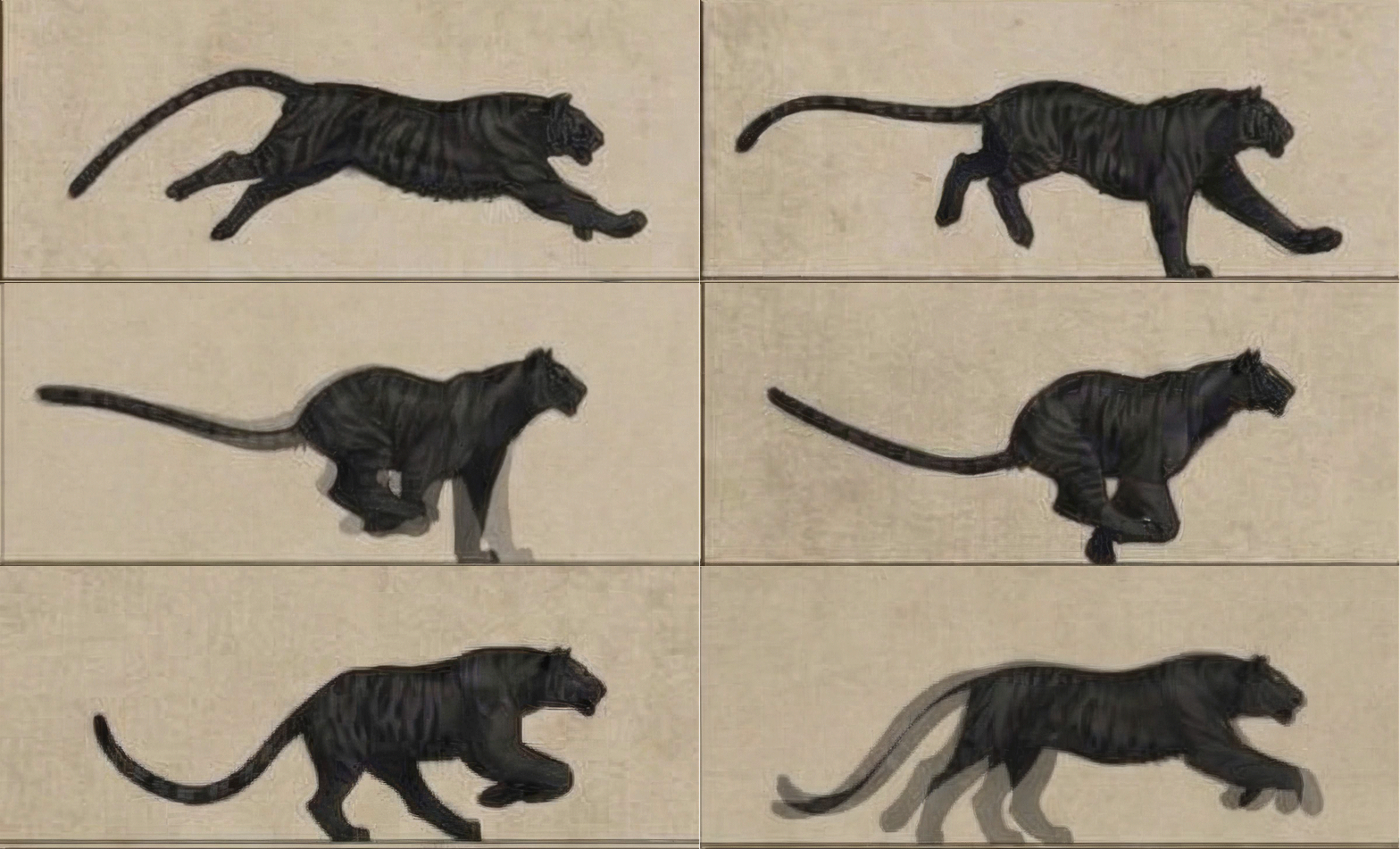
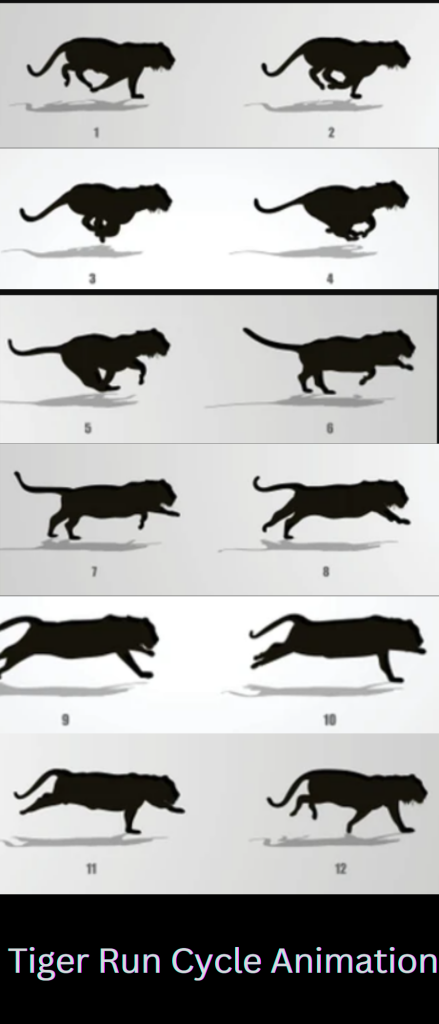
Run / Bounding Gallop
Asymmetric four-beat with two suspension phases · the money shot
Pure cinematic adrenaline — the charging tiger from every trailer. The hind legs gather under the body, the spine coils like a leaf spring, then everything releases and the front paws reach into open air.
What to nail: there are two airborne moments per cycle, not one. The gathered suspension (all four limbs tucked, spine flexed into a C) and the extended suspension (all four limbs stretched, spine arched the opposite way). Miss either and the run feels like a horse instead of a cat.
Where you will use it: chase sequences, boss charges and hero pursuit shots. Reference Amur (Siberian) tigers specifically — they carry the longest suspension phases of any big cat, which gives you more airborne frames to play with.
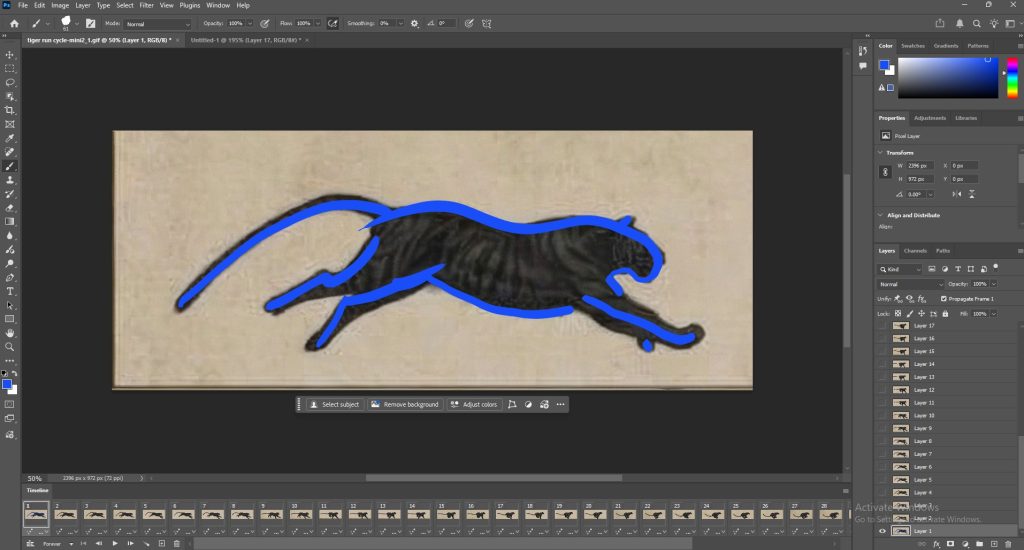
Deconstruct Before You Detail: The Line Block-Out
Before you touch fur, muscle or paw contact, reduce the whole animal to lines. Capture the general curves and nothing else.
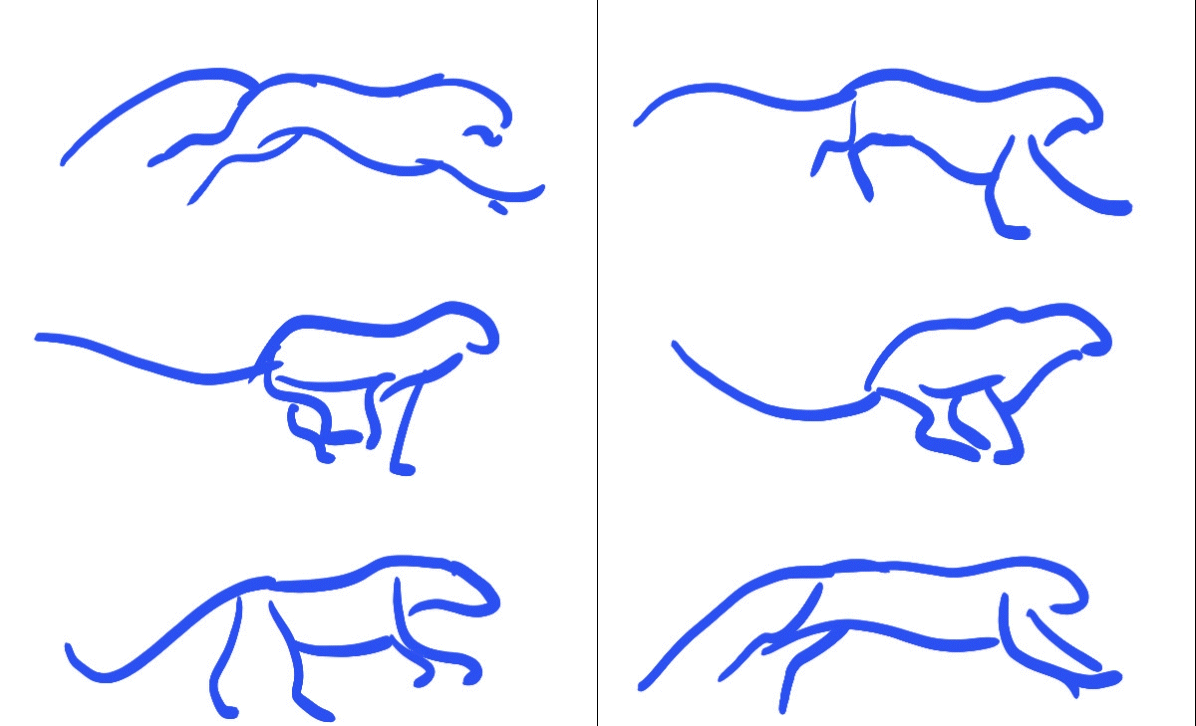
Deconstructing a run cycle into simple lines — a stick-figure block-out — is the single highest-leverage step in creature animation. Drawing basic lines forces you to solve the core mechanics before the details can hide your mistakes.
This technique locks three things at once: timing, weight transfer and the rhythm of the stride. Perfect that skeleton first and the motion underneath will be fluid and biologically believable. Rebuilding the full silhouette on top then becomes almost mechanical — and the result is a cycle that holds up in a game engine at any playback speed.

Idle / Breathing + Alert
Long, imperfect loop · the difference between a creature and a statue
The idle is the cycle players actually look at longest, and the one most teams under-budget. A static tiger is a dead tiger.
What to nail: layer at least four independent frequencies — ribcage breathing (slow, ~3–4 s per breath), tail sway (medium, offset), ear flicks (fast, random), and occasional head turns or blinks (sparse, unpredictable). Because the periods are different lengths, the composite never repeats visibly even though every layer loops.
Pro move: build two or three idle variants and let the state machine fire the rare ones on a weighted random timer. That is what stops a zoo exhibit or companion animal from feeling animatronic.
Pounce / Leap Attack
One-shot clip, not a loop · the single most reused tiger animation in the industry
The crouch, the coil, the explosive extension with claws out. This is blended into combat systems in Ark: Survival Evolved and Monster Hunter, and used as a hero beat in film after film.
What to nail: the anticipation is longer than beginners expect — often nearly half the clip. The hindquarters micro-adjust, the rear paws paddle for grip, the tail goes rigid, and only then does the release happen in three or four frames. Front paws touch down before the hinds, and the spine absorbs the landing in a visible compression over 5–8 frames.
Quick Reference & Frame-Budget Table
Pin this above your desk. Frame counts assume the midpoint of each duration range.
| # | Cycle | Duration | 24 fps | 30 fps | 60 fps | Duty factor | Primary use in games | Primary use in film |
|---|---|---|---|---|---|---|---|---|
| 1 | Stealth Walk | 1.0–1.6 s | 24–38 | 30–48 | 60–96 | 0.60–0.68 | NPC patrol, stalking approach | Establishing danger & grace |
| 2 | Trot / Fast Walk | 0.6–0.9 s | 14–22 | 18–27 | 36–54 | 0.42–0.50 | Transition speed, exploration | Travelling shots |
| 3 | Bounding Gallop | 0.4–0.7 s | 10–17 | 12–21 | 24–42 | 0.25–0.32 | Chases, charges, boss rushes | Action & pursuit scenes |
| 4 | Idle + Breathing | 4–8 s | 96–192 | 120–240 | 240–480 | 1.00 | Standing NPCs, cutscenes | Close-ups, tension building |
| 5 | Pounce / Leap | 0.8–1.3 s | 19–31 | 24–39 | 48–78 | 0 (airborne) | Combat finishers, boss attacks | Dramatic kills & hero beats |
Master these five and you can convincingly animate the overwhelming majority of tiger scenes. Reference slow-motion big-cat footage from BBC Earth or National Geographic, trace over it if you work in 2D, or use it as timing reference in 3D. Your tigers will read as real predators instead of stiff house cats.
Gait Science for Animators: Duty Factor, Footfall Order & Spine Flexion
Most animation tutorials describe gaits with adjectives. Biomechanists describe them with numbers — and those numbers are far easier to hit in a graph editor. Here are the four concepts that will fix more quadruped animation than any amount of polish.
1. The Hildebrand diagram is your gait blueprint
Zoologist Milton Hildebrand's footfall plots — the bar charts you saw in each cycle card above — encode an entire gait in two numbers per limb: when the foot contacts (as a percentage of the stride) and how long it stays down. Build those bars first in a spreadsheet, then place your contact keys to match. You will never guess at limb offsets again.
2. Lateral sequence vs. rotary: the felid signature
At walking speed a tiger uses a lateral-sequence, diagonal-couplets pattern: left hind → left fore → right hind → right fore. At full speed it switches to a rotary gallop, where the footfall order rotates around the body (LH → RH → RF → LF). Horses default to a transverse gallop instead — which is exactly why a tiger animated on horse timing feels subtly wrong. If you have animated a horse before, compare notes with our ultimate horse reference for animators.
3. The scapula is a fifth limb segment
Cats have no functional collarbone. The clavicle is a small floating sliver buried in muscle, which means the shoulder blade is not bolted to the ribcage — it slides freely along it, driven by the serratus ventralis sling. Functionally, the tiger's front leg has an extra joint that a human or a dog does not use the same way.
If your rig cannot translate the scapula independently of the ribcage, your tiger will never prowl correctly. Scapula travel of 3–6 cm is the visual signature of big-cat stealth — it is the rolling "shoulder blades punching through the back" that reads instantly as feline.
4. Spine flexion is the engine, not decoration
The tiger's 30-vertebra column stores and releases elastic energy exactly like a leaf spring. Robotics research on flexible-spine quadrupeds has quantified the payoff: adding an actuated spine to a robot dog raised average speed by roughly 0.4 m/s and cut body pitch by about 17%. Spine motion extends effective stride length and feeds auxiliary power to the legs.
For animators, the takeaway is blunt: animate the spine first, then the legs. If your spine curve is flat and the legs are doing all the work, no amount of foot-contact polish will rescue the shot.
10 Essential Tiger Poses & Locomotion References
These are the poses and gaits every tiger animator needs in their reference library, with what to watch for in each.
1. Relaxed Stand (Alert Resting Pose)
- Four feet evenly planted, weight shifted slightly forward.
- Tail relaxed or sweeping slowly for balance and mood.
- Why it matters: this is your neutral. A good relaxed stand encodes the tiger's mass distribution — roughly 60% of body weight sits on the forelimbs — and every believable transition launches from it.
2. Stalk / Crouched Hunting Pose
- Extremely low centre of gravity — the belly nearly grazes the ground.
- Shoulders high, hindquarters low, spine held in a gentle S-curve.
- Slow, deliberate steps with each paw placed rather than dropped.
- Why it matters: the signature big-cat silhouette. Push the scapula slide harder than feels natural — it is enormous in tigers and it is what sells silent power.
3. Walk (Standard Feline Walk)
- Sequence: left hind → left fore → right hind → right fore (lateral sequence, diagonal couplets).
- The spine describes two clear lateral bends per full cycle.
- Tail acts as a counterbalance, usually held low with a slight upward curl at the tip.
- Why it matters: the most common locomotion in non-combat scenes. Get the spine waves right and your tiger stops looking like a dog with stripes.
4. Trot
- Two-beat diagonal gait: left hind + right fore together, then right hind + left fore.
- Faster and bouncier than a walk, with a noticeably more upright posture.
- Tail carried slightly raised for balance.
- Why it matters: ideal for territory patrol or covering ground without looking rushed. It is also the cleanest bridge in a speed-driven blend tree.
5. Canter (Asymmetrical Gait)
- Three-beat gait used at medium-high speed.
- Typical sequence: one hind → opposite hind + diagonal fore together → remaining fore.
- Very fluid, with a floating suspension moment and a distinct lead side.
- Why it matters: the cruising speed tigers actually use in the wild. Most game engines fake it with a stretched run cycle — building a real canter is one of the cheapest ways to jump ahead of the pack.
6. Gallop / Full Run (Rotary Gallop)
- Fastest gait — four-beat, with both gathered and extended suspension phases.
- All four legs tuck beneath the body (gathered), then shoot outward (extended).
- The spine flexes dramatically — extreme arch into extreme curl.
- Why it matters: where you show explosive power. Reference Amur tigers specifically for the longest suspension phases among big cats.
7. Pounce / Leap
- Deep crouch → explosive hind-leg extension → all four legs extended in flight → front paws land first.
- The back arches strongly in flight; the tail straightens to control rotation.
- Why it matters: iconic hunting and play behaviour. Timing is everything — reach the front paws too early and it looks weak, too late and it floats.
8. Play Bow
- Front legs extended, chest low, hindquarters raised, tail high or wagging.
- Often paired with playful side-to-side swaying.
- Why it matters: instant personality and youth. Even adult tigers play, and this pose humanises them without cartooning them.
9. Aggressive Charge Pose
- Ears flattened and rotated back, mouth partly open, direct forward stare.
- Low, powerful posture with an exaggerated shoulder roll.
- Why it matters: the backbone of combat animation. Triceps and deltoids visibly bunch and release on every step — build corrective shapes for them or the charge reads as rubbery.
10. Climbing Pose (Tree or Rock)
- Front paws hug the surface with claws hooked in; hind legs push from below.
- The spine runs nearly vertical in steep climbs.
- Why it matters: tigers climb far better than most people assume, especially as cubs and sub-adults. It is a cheap way to remind an audience they are not just ground predators.
Bonus Micro-Poses That Sell Personality
- Independent ear flicks — tigers rotate each ear separately. Two-bone ear rigs with independent controls pay for themselves in every idle.
- Tail twitches and lashes — the fastest read on emotional state. Tip-flick = irritation; full lash = imminent action.
- Slow blink — the "kitty kiss". Three to five frames of closing, a hold, then a lazy open. Reads as trust and calm.
- Flehmen response — the lip curl when scent-analysing. Instantly says "this is a real cat, animated by someone who watched real cats."
- Paw lift and hover — uncertainty, curiosity, or a play invitation before a swat.
- Whisker flare — pushed forward when investigating, pinned back in aggression. Often forgotten and always noticed when present.
- Maternal grooming and cub-calling — head lowers, neck extends, jaw works in short repeated strokes.
The Quadruped Key-Pose Workflow
Biped animators learn four key poses per step: contact, down, passing, up. Quadrupeds use the same four — but you run them twice, offset, once for the front pair and once for the rear pair. That offset is the whole game.
| Pass | What you set | Time cost | Common failure |
|---|---|---|---|
| 1 · Spine & hips | Root translation, hip rotation and the spine flexion curve across the full cycle — legs ignored entirely. | ~20% | Skipping it. Legs animated over a dead spine can never be rescued. |
| 2 · Hind contacts | Hind foot plants at the percentages from your Hildebrand chart. Straight tangents on planted frames. | ~15% | Feet that slide because contacts are not pinned. |
| 3 · Fore contacts | Same, offset by the gait's fore–hind lag. Add scapula translation here, not later. | ~15% | Front and back mirrored instead of offset — reads as a rocking horse. |
| 4 · Down / passing / up | Vertical body oscillation and limb compression between contacts. | ~20% | Body highest on contact instead of mid-suspension. |
| 5 · Overlap | Tail, ears, head, jowls, belly — each lagging the driver by 2–8 frames. | ~20% | All overlaps on the same delay, which reads as machinery. |
| 6 · Loop weld | Match frame 1 and frame N, check the seam at 4× speed, offset noise so the join is invisible. | ~10% | A visible pop that only appears in-engine at runtime. |
If you are building the rig itself rather than animating on someone else's, our guide to Blender Rigify for rigging animals covers the quadruped meta-rig and the IK/FK setup these passes assume. Still choosing a package? We compared them head-to-head in Blender vs Maya for creature animation in 2026.
From Reference to Engine: Root Motion, Stride Matching & Blend Trees
A beautiful cycle that foot-slides in Unity or Unreal is a failed cycle. Here is what breaks between the animation package and the runtime, and how to prevent it.
In-place vs. root motion
Export cycles in place with a separate root bone carrying forward travel. That lets the engine drive velocity from gameplay while the legs stay authored. Root motion is better for one-shot attacks and pounces where exact displacement matters.
Stride-length matching
Foot sliding is a ratio bug, not an animation bug. Measure the distance one foot travels during stance, divide by cycle time, and drive playback speed as moveSpeed / cycleSpeed. Match it once and sliding disappears at every velocity.
Blend-tree topology
A 1D speed blend covering idle → walk → trot → canter → gallop handles 90% of cases. Add a second axis for turn angle only if your creature needs strafing or tight pursuit arcs.
Retargeting reality check
Unity's Humanoid system does not apply to quadrupeds — use Generic rigs with consistent bone naming. A shared naming convention across tiger, lion and jaguar lets you reuse one animation set across your whole predator roster.
Foot IK on uneven ground
Raycast down from each paw and offset the IK target to the hit point, then pitch the pelvis to split the difference. Without this, tigers wade through terrain on any slope steeper than a few degrees.
Curves & events
Bake a float curve for paw-contact frames and fire footstep audio, dust and camera shake from it. Free polish that costs no extra animation time.
Tiger, Tigress & Cub: Anatomy Facts for 3D Animators
Three reference tables covering dimensions, behaviour, coat variation, sexual dimorphism and the rigging implications of each. All figures describe the Bengal tiger (Panthera tigris tigris) unless noted.
Adult Male Bengal Tiger
| Category | Details |
|---|---|
| Dimensions | Total length 270–310 cm (110–120 in) including a tail of 85–110 cm (33–43 in). Shoulder height 90–110 cm (35–43 in). Head-body length 183–211 cm (72–83 in). |
| Average weight | 200–260 kg (440–570 lb); up to 295 kg (650 lb) in the largest recorded individuals. |
| Roles & behaviour | Solitary hunter and territorial defender. Patrols home ranges of up to 1,923 km² overlapping several females; ambushes large ungulates such as gaur and buffalo; roars and scent-marks to advertise dominance. May share kills with females and cubs, but also commits infanticide to induce oestrus. |
| Coat variation | Tawny orange with 21–29 black or brown stripes per flank. Rare recessive morphs: white (creamy with sepia stripes), golden (pale gold with red-brown stripes), snow white (nearly stripeless) and pseudo-melanistic (broad stripes merging toward black). |
| Sexual dimorphism | Males run roughly 30–50% larger and heavier than females, with broader skulls, heavier zygomatic arches and pronounced occipital crests for bite force and fighting. Upper carnassials and canines are larger. Dimorphism increases with latitude and body size. |
| Animator takeaways | Flexible spine supporting leaps up to 10 m; powerful hindlimb extensors driving ~60 km/h sprints; forelimb supraspinatus and triceps for grappling prey; rounded paws with retractable claws up to 10 cm; directional fur flow (short on face and legs, long on flanks); elbow and shoulder rotation ranges tuned for pouncing; UV layout that respects stripe asymmetry. |
| Core anatomy | 600+ muscles making up 60–70% of body mass; skull up to 41.3 cm long with a sagittal crest for jaw power; 30 teeth including 7 cm canines; 30 vertebrae in a highly mobile column; tapetum lucidum for night vision; hind legs longer than forelegs for propulsion. |
Adult Female Bengal Tiger (Tigress)
| Category | Details |
|---|---|
| Dimensions | Total length 240–265 cm (94–104 in) including tail. Shoulder height 90–110 cm (35–43 in). Head-body length 164–193 cm (65–76 in). |
| Average weight | 100–160 kg (220–350 lb); up to 181 kg (400 lb) in the largest individuals. |
| Roles & behaviour | Primary caregiver and hunter for the family unit. Raises 2–6 cubs over 18–24 months, teaching hunting through play. Smaller territories (248–520 km²) sited near water and prey; more tolerant of range overlap with kin; oestrus every 3–9 weeks; defends cubs ferociously, including against adult males. |
| Coat variation | Identical palette to males — tawny orange with black or brown stripes, plus the same rare white, golden and snow-white morphs. Stripe width can vary subtly, but no sex-specific colouration exists. |
| Sexual dimorphism | Around 70% of male size, with narrower skulls and muzzles favouring agility; less pronounced cranial crests; sexual maturity at 3–4 years versus 4–5 in males. The pattern reflects male–male competition on one side and endurance hunting on the other. |
| Animator takeaways | Maternal animation set — grooming, licking, cub-carrying by the scruff; lower centre of gravity in stalking; softer undercoat shading; detailed whisker simulation for sensory navigation; joint limits tuned for crouching and carrying prey; texture layers for seasonal shedding. |
| Core anatomy | Same architecture scaled down; gestation 104–106 days; 4–5 teats; stronger abdominal wall for birthing and denning; enlarged olfactory bulb for tracking family scent; identical dental formula (I 3/3, C 1/1, P 3/2, M 1/1). |
Cub (Neonate to Juvenile)
| Category | Details |
|---|---|
| Dimensions | Newborn: ~30 cm head-body, ~50 cm total with tail, shoulder ~15 cm. Six months: 75–90 cm total, shoulder ~40 cm. Eighteen months: approaching adult female size (~200 cm total, ~80 cm shoulder). |
| Average weight | Newborn 0.8–1.6 kg. Six months: males 40–47 kg, females ~30 kg. Eighteen months: 50–100 kg, nearing independence. |
| Roles & behaviour | Dependent learners within the maternal group. Play-fighting builds hunting skill; weaned at 6–8 weeks; first kills around 11 months; males disperse further at 18–24 months. Mortality exceeds 50% from infanticide and starvation. Sibling hierarchies form early, with the dominant cub feeding first. |
| Coat variation | Fuzzy grey-woolly neonatal coat fading by 3–5 months into adult orange and black. Recessive traits (white, golden) surface only if both parents carry them. Cubs show proportionally more stripes than adults for camouflage. |
| Sexual dimorphism | Minimal at birth. A slight male size advantage emerges by six months; males develop broader heads and larger canines earlier; females mature faster overall. Until adolescence the difference is growth rate, not structure. |
| Animator takeaways | Tumbling and sparring rigs with generous neck and spine flexibility; soft downy fur shaders with high subsurface scatter; growth morph targets from neonate to juvenile; oversized ear and tail motion for curiosity; visible paw-pad detail for climbing; nursing and practice-pounce cycles. |
| Core anatomy | Born blind and deaf; eyes open at 10–14 days; litters of 2–5 after a 105-day gestation; rapid growth (~16 kg by four months); deciduous teeth by two weeks, permanent by six months; underdeveloped claws; maternal immune transfer for 2–3 months. |
Adult Tiger Muscle Anatomy for Animators
Tigers carry a strikingly high muscle fraction — skeletal muscle reaches around 56% of body weight in some specimens. Males are heavier and more visibly muscled, particularly across the forelimbs and neck, which they use to hold territory and control prey. Tigresses are sleeker and slightly less robust, favouring agility for hunting while raising cubs, though the underlying muscle architecture is fundamentally the same.
Two adaptations dominate the tiger's silhouette. First, exceptionally powerful jaw musculature for crushing bites. Second, the reduced clavicle, which frees the shoulder to travel further than a comparably sized non-felid ever could.
Published forelimb dissections show the tiger has relatively smaller shoulder muscles but noticeably larger caudal brachium, pronators and supinators compared with other felids. For animators that translates directly: pronators drive the forearm rotation used to grapple and pin prey, while shoulder mobility gives you the fluid shoulder roll that defines the stalk.
In the hindlimb, the picture is equally specific. The M. vastus lateralis has two heads of origin — a feature unique among the big cats studied — and it extends the stifle joint for explosive jumps. Ankle inverters are proportionally larger for stability during turns, and two distinct muscles abduct the fifth digit for extra traction. Abdominal obliques and rectus abdominis stabilise the core through rapid direction changes.
| Muscle group | Function | What to animate |
|---|---|---|
| Temporalis & masseter | Jaw closure; exceptional bite force for bone-crushing. | Visible bulging above and behind the eye during bites and roars. Drive with a corrective shape keyed to jaw open. |
| Deltoids & triceps | Shoulder and elbow extension; the swipe engine. | Bunch on wind-up, release through the strike. Exaggerate slightly — real footage under-reads on a game-sized screen. |
| Serratus ventralis | Slings the ribcage between the scapulae; enables scapula travel. | Not directly visible, but it is why the shoulder blades ride high in the prowl. Rig scapula translation to honour it. |
| Pronators & supinators | Forearm rotation for grappling and prey manipulation. | Wrist twist during pinning, climbing and food handling — an easy detail to add and rarely seen in game creatures. |
| Quadriceps (vastus lateralis) | Stifle extension; primary propulsion for leaps. | Deep compression on the crouch, hard release on take-off. Two heads of origin make the thigh read as two distinct masses. |
| Gastrocnemius | Ankle extension; final push-off. | Snaps last in the take-off chain — hip, then stifle, then ankle. Offset those three by 1–2 frames each. |
| Abdominal group | Core stabilisation and spine flexion. | Belly compression and release through the gallop; a visible tuck at gathered suspension. |
| Epaxials (longissimus dorsi) | Spine extension; the leaf-spring itself. | The dorsal ridge that swells along the back during the extension phase of the gallop. |
Tiger Cub Muscle Anatomy
Cubs share the adult muscle map but at 1–3 kg at birth, with far less developed mass in both limb sets. Their musculature suits playful exploration rather than predation: flexible joints, emerging tone, and a nervous system still learning to coordinate all of it.
For animation, keep muscle definition soft and undefined to read as young, and add deliberate wobble to early locomotion. Overshoot on direction changes, let the head lead too far, and allow the hind legs to occasionally out-pace the front. Competence arrives gradually — a six-month cub should already move noticeably better than a three-month cub, and building that progression into a game is a rewarding detail almost nobody bothers with.
Lion & Big-Cat Comparison: What Transfers and What Does Not
Lions are built like tigers with different priorities. Skeletal muscle reaches up to 58.8% of body weight — among the highest of any mammal — and males carry barrel chests and heavily muscled forelimbs for overpowering prey inside a pride. Detailed dissections show lion thigh bones are not especially long for the animal's size, which biases them toward endurance and force rather than the tiger's explosive single-strike acceleration.
Artist-facing lion diagrams are usually layered: Layer 1 holds the deep muscles that shape hidden volumes, Layer 2 the surface muscles that define visible contour. Virtual dissections showing how those layers drape over bone are directly useful when placing joints and painting weights in Maya or Blender. Shoulder and elbow musculature sits in a column-like arrangement built to carry serious mass.
| Species | Locomotor bias | Reuses tiger cycles? | Key retarget notes |
|---|---|---|---|
| Lion | Endurance & force; social hunting | Directly — with weight adjustments | Heavier chest, slower cadence, mane adds secondary motion. Reduce spine flexion amplitude ~15%. |
| Jaguar | Compact power; strongest bite per size | Yes, with a shorter stride | Stockier limbs, shorter cycle lengths, far more climbing and swimming behaviour. |
| Leopard | Arboreal specialist | Mostly | Massively stronger climb and carry set; scapula travel even more pronounced. |
| Cheetah | Extreme sprint specialist | No — rebuild the gallop | Semi-retractable claws, much longer stride, tail used actively as an inertial rudder. |
| Wolf | Cursorial endurance | No | Fused-feeling shoulder, far less spine flexion, transverse rather than rotary gallop. |
| Smilodon | Ambush grappler (extinct) | Partly | Shorter tail, heavier forelimbs, restricted gallop. Reconstruct from felid muscle maps. |
Latest Animal Locomotion Science (2025–2026)
Creature animation improves fastest when it borrows from biomechanics. Here is what has landed recently that changes how you should think about felid movement.
First mapped hindlimb muscle atlas for Panthera tigris. A full dissection of an Amur tiger produced origin-and-insertion maps intended for palaeontological reconstruction. Hindlimb morphology proved largely conserved across big cats, but two tiger-specific features stood out: M. vastus lateralis with two heads of origin, and two separate muscles abducting the fifth digit.
Why it matters to you: this is the first published dataset precise enough to place a tiger's hindlimb joints and weight-paint its thigh correctly, rather than eyeballing from photographs. Read the paper →
Forelimb myology reveals a climbing-versus-running signature. Cardozo and colleagues mapped the forelimb of Geoffroy's cat and compared it across Feliformia. The pattern is clean: in cursorial species the pronator quadratus is long and thin and acts as a stabiliser, while in felids and climbers it is wider and drives forearm rotation. The brachioradialis is well developed in climbers and prey-manipulators, and reduced or absent in runners.
Why it matters to you: forearm twist is not a garnish. It is an ecological signature. If your tiger pins prey or climbs without visible forearm rotation, you have animated a dog. Read the paper →
Quantified feline gait on a pressure-sensitive treadmill. Mille et al. measured ten healthy cats in standing versus running treadmill modes. Forelimb peak vertical force was 3.3% lower and vertical impulse 7.3% lower in running mode; hindlimb peak vertical force was 4.4% higher. Stride length and step width stayed statistically unchanged.
Why it matters to you: it is hard numeric confirmation that fore and hind limbs load differently depending on locomotor context, even when the visible stride looks identical. Vary limb compression between your walk and run cycles instead of scaling one curve. Read the study →
Flexible spines and inertial tails keep proving their worth. Quadruped robots fitted with actuated spines gained roughly 0.4 m/s in average speed and reduced body pitch by about 17% versus rigid-torso equivalents. Separately, work on cheetah tails at the University of Cape Town and Carnegie Mellon showed that tails generate real aerodynamic drag torques — not just inertial ones — during rapid acceleration and braking.
Why it matters to you: robotics is effectively running controlled experiments on the animation principles you use daily. Spine amplitude and active tail counter-rotation are measurably load-bearing, not stylistic choices.
Deep-learning pose estimation now works on wild footage. Toolchains built on DeepLabCut and its real-time variant track body landmarks straight from video without markers, and have been applied to cheetahs, macaques, horses, dogs and squirrels — including 3D reconstruction in the field.
Why it matters to you: you can extract quantified joint trajectories from documentary footage of a real tiger. That is reference data no animator had access to five years ago, and it is free and open source.
8 Mistakes That Make a Tiger Look Like a Big Dog
- A rigid spine. The single most common failure. Canids have relatively stiff torsos; felids do not. If your spine curve is flat, you have animated a wolf in a striped costume.
- A bolted-down scapula. No scapula translation means no feline read, no matter how good the leg animation is.
- One suspension phase in the gallop. Rotary gallops have two. Gathered and extended. Miss the gathered one and the run turns into a horse canter.
- Symmetric stripes. Real tiger stripe patterns are asymmetric left to right and unique per individual, like a fingerprint. Mirrored UVs are the fastest way to look synthetic.
- Body highest on contact. The centre of mass peaks during suspension, not when a foot lands. Getting this backwards produces a pogo-stick bounce.
- A dead tail. Tails lead into turns and counter-rotate against the body. A passive follow-through chain reads as a rope, not a limb.
- Uniform overlap delays. If ears, tail, jowls and belly all lag by the same number of frames, the whole animal moves like clockwork. Stagger them.
- Adult proportions on a cub. Cubs are head-heavy and paw-heavy. Uniform scaling produces a miniature adult, which reads as uncanny rather than cute.
Frequently Asked Questions
How many frames should a tiger walk cycle be?
A tiger walk cycle runs roughly 1.0–1.6 seconds, which is 24–38 frames at 24 fps, 30–48 frames at 30 fps, or 60–96 frames at 60 fps. Start at 32 frames at 24 fps for a relaxed patrol walk and shorten it as the tiger's intent sharpens. A stalking approach can stretch past 2 seconds per cycle.
What is the footfall order of a tiger's walk?
Tigers use a lateral-sequence, diagonal-couplets walk: left hind, then left fore, then right hind, then right fore. Each hind foot is followed by the fore foot on the same side. At full speed they switch to a rotary gallop (left hind → right hind → right fore → left fore), which is different from the transverse gallop horses use.
How fast can a tiger actually run, and how far can it leap?
Tigers reach roughly 60 km/h (about 37 mph) in short bursts — they are ambush predators, not distance runners, and a chase usually collapses within a few hundred metres. Horizontal leaps of up to 10 metres have been recorded, with vertical leaps of 4–5 metres.
Can I reuse tiger animation cycles on a lion or jaguar?
Yes, and you should. Felid locomotion is highly conserved, so a well-built tiger set retargets cleanly onto lions, jaguars and leopards with adjustments to stride length, cadence and body mass. Cheetahs are the exception — their sprint gait is a genuine specialisation and needs a purpose-built gallop. Canids like wolves need rebuilding entirely.
Why does my tiger animation look like a dog?
Almost always one of two things. First, insufficient spine flexion — felids flex and extend their torsos far more than canids do. Second, a locked scapula. Cats have no functional clavicle, so the shoulder blade slides along the ribcage and visibly rides above the spine line during a prowl. Add both and the animation flips from canine to feline almost instantly.
What frame rate should I film tiger reference at?
Shoot at 60–120 fps minimum. Gallop suspension phases can last under 60 milliseconds, which is barely more than one frame at 24 fps. High-speed footage is the only way to actually see paw compression, limb loading and the exact instant of contact.
Should tiger cycles be exported in place or with root motion?
Export looping locomotion in place, with a separate root bone carrying forward travel, so the engine can drive speed from gameplay. Use root motion for one-shot clips where displacement matters exactly — pounces, leaps, turn-in-place and attack lunges. Mixing both in one controller is normal and expected.
What is duty factor and why should an animator care?
Duty factor is the fraction of a stride during which a given foot is on the ground. Above 0.50, the animal always has ground support and cannot be airborne — that defines a walk. Below 0.50, suspension phases appear. It is the fastest possible check on whether your cycle should have flight frames, and it diagnoses "wrong-feeling" gaits in seconds.
Sources & Further Reading
- Muscular anatomy of the hindlimb of the tiger (Panthera tigris) — Journal of Mammalian Evolution, February 2025. Peer-reviewed Full Amur tiger dissection with origin and insertion maps.
- Muscular anatomy of the forelimb of the tiger — Dunn et al., Journal of Anatomy, 2022. Peer-reviewed Comparative felid forelimb data.
- Forelimb myology of Leopardus geoffroyi, Part II — Cardozo et al., Journal of Anatomy, December 2025. Peer-reviewed Pronator and supinator function across Feliformia.
- Kinetic and temporospatial gait parameters in healthy cats on a pressure-sensitive treadmill — Mille et al., Frontiers in Veterinary Science, August 2026. Peer-reviewed Quantified feline force and impulse data.
- Lion anatomy for artists: skeleton and muscle diagrams — Monika Zagrobelna. Artist resource Layered muscle diagrams built for drawing and sculpting.
- All about tigers: physical characteristics — SeaWorld Parks Animal Info. Reference Accessible dimensions and life-history overview.
- Chasing the cheetah: how field biomechanics has evolved — Journal of Experimental Biology. Peer-reviewed Field methods for measuring big-cat locomotion in the wild.
- Lateral flexion of a compliant spine improves motor performance — Science Robotics. Peer-reviewed Direct experimental evidence for spine flexion in quadruped locomotion.
- A primer on motion capture with deep learning — Neuron. Peer-reviewed Foundations of markerless animal pose estimation.
- Bhatti, Z. (2019). Oscillator-driven central pattern generator (CPG) system for procedural animation of quadruped locomotion. Multimedia Tools and Applications, 78, 1–18. doi:10.1007/s11042-019-7641-1 Peer-reviewed Source of the walk-phase diagram in this article.