
Top Elephant Poses for 3D Artists: These static key poses emphasize weight, balance, and expressiveness. Use for storytelling in films/games: block with big silhouettes, refine overlaps.

| Pose | Brief Description |
|---|---|
| Neutral Idle | Legs locked straight, trunk dangles relaxed/curved, ears folded back, tail limp; subtle trunk sway, breathe heavy. |
| Alert | Ears forward/up, trunk raised/sniffing, head high, eyes wide; weight shifts forward on toes. |
| Majestic | Trunk arched high, ears fully spread, head tilted up, chest out; rear legs planted firm. |
| Aggressive | Ears pinned back tight, trunk curled short/threat, head low/tusks forward, tail stiff up. |
| Drinking Prep | Front knees micro-bent, trunk extended low/curling to water, body leans forward balanced. |
Top Elephant Animations for 3D Artists Cycles/sequences for locomotion/actions. Prioritize heavy weight (slow lifts/plants), trunk as lead (tip first, sectional overlap), secondary ears/tail. Reference real footage for timing.
| Animation | Brief Description (Key Mechanics) |
|---|---|
| Walk Cycle | Lateral amble (hind-fore-opposite hind-fore); heavy foot “tree trunk” plants, side sway + forward bob, trunk pendulum swing (opp. phase to legs), ears light flap, tail swish. 24-32 frames/cycle. |
| Run/Trot | Accelerated walk w/ suspension phase; bigger strides, body bounce, trunk whips faster, ears pinned. |
| Charge | Build speed: head down/tusks low, ears back, trunk tucked, powerful hind push, ground shake FX. |
| Trumpet Call | Anticipate: rear up, trunk uncoils high fast, mouth wide blast; ears flare, body vibrates. |
| Ear Flap (Cooling) | Ears snap forward/back 2-3x; overlap settle, light head tilt, trunk sways secondary. |
| Trunk Idle Swing | Gentle L-R pendulum (1-2s), tip leads, middle/base lag; sync subtle to breath/weight shift. |
| Spray Water/Dust | Curl trunk to mouth (suck), rear back over shoulder, spray arc; body twist, ears flap dust off. |
| Graze/Eat | Trunk probes ground, curls grass slow, lifts to mouth chew; head dips, legs stable. |
| Push/Shove | Trunk extends straight/curves, shoulders forward thrust; recoil overlap, tail flicks. |
| Dust Bath | Kneel front, trunk scoops/throws dust 3x on back; roll optional, ears shake, rise heavy. |
Quick Tips:
- Rigging: Trunk in 3-5 sections (tip agile, base heavy). Legs: pillar lock + flex.
- Polish: Exaggerate squash/stretch on plants, overlap everything to trunk rhythm. Test in-engine (Unreal/Maya).
- Refs: YouTube docu clips for weight; block feet/timing first. Customize for style (realistic films vs. cartoony games).
Walk Cycle animation
Elephant Dimensions (Shoulder Height and Body Length)
Focus on African bush (savanna) and Asian elephants, as they are the most commonly referenced species for media. Data represents average ranges from scientific sources. Body length excludes trunk and tail.
| Species | Male (Bull) | Female (Cow) | Baby (Calf at Birth) |
|---|---|---|---|
| African Bush | Shoulder height: 304–336 cm (10–11 ft); Body length: 6.0–7.5 m (19.7–24.6 ft) | Shoulder height: 247–273 cm (8.1–8.9 ft); Body length: 5.5–6.5 m (18–21.3 ft) | Shoulder height: ~85 cm (2.8 ft); Body length: ~1 m (3.3 ft) |
| Asian | Shoulder height: 261–289 cm (8.6–9.5 ft); Body length: 5.5–6.5 m (18–21.3 ft) | Shoulder height: 228–252 cm (7.5–8.3 ft); Body length: 5.0–6.0 m (16.4–19.7 ft) | Shoulder height: ~85 cm (2.8 ft); Body length: ~1 m (3.3 ft) |
Note: African forest elephants are smaller overall (shoulder height 209–231 cm for adults).
Elephant Weight Averages
Average ranges from scientific data; calves grow rapidly, reaching ~1,000 kg by age 3.
| Species | Male (Bull) | Female (Cow) | Baby (Calf at Birth) |
|---|---|---|---|
| African Bush | 5.2–6.9 tonnes (5,200–6,900 kg) | 2.6–3.5 tonnes (2,600–3,500 kg) | ~120 kg (260 lb) |
| Asian | 3.5–4.6 tonnes (3,500–4,600 kg) | 2.3–3.1 tonnes (2,300–3,100 kg) | ~120 kg (260 lb) |
Note: Weights can vary by diet and habitat; African forest adults average 1.7–2.3 tonnes.
Top Roles and Behaviors
Key scientific observations; behaviors are similar across species unless noted.
| Category | Male (Bull) | Female (Cow) | Baby (Calf) |
|---|---|---|---|
| Social Role | Solitary or in loose bachelor groups after puberty; dominate mating through musth (aggressive phase with high testosterone); leave family at 12–15 years. | Lead matriarchal herds (8–10 members in African, smaller in Asian); protect and teach offspring; alloparenting (group care) common. | Center of herd attention; dependent on mother for 2–3 years; play to learn social skills. |
| Feeding/Foraging | Browse/graze up to 300 kg/day; dig for water/minerals; migrate seasonally (up to 100 km/day in African savanna). | Similar to males but coordinate group foraging; teach calves plant selection. | Suckle for first 2 years; start solids at 3 months; learn foraging from herd. |
| Ecological Role | Keystone: Uproot trees for grasslands, disperse seeds; provide dung habitats. | Maintain herd structure; seed dispersal via dung. | Limited, but play aids development; vulnerable to predators (lions/tigers). |
Fur/Hair Color Variations
Elephants have sparse hair rather than fur; variations are minimal but noted by age and species.
| Species | Male (Bull) | Female (Cow) | Baby (Calf) |
|---|---|---|---|
| African (Bush/Forest) | Sparse coarse black hairs (up to 4 cm) on trunk, tail, back; grey skin may appear brown/reddish from mud baths. | Similar to males; no sex-specific variations. | Brownish/reddish hair on head/back; darkens and thins with age. |
| Asian | More hair than African (up to 200 hairs/cm² in places); light to dark brown/grey; depigmentation patches on head. | Similar to males. | Brownish/reddish, denser than adults; aids heat loss. |
Sexual Dimorphism Explained
Differences between males and females; calves show minimal dimorphism until puberty.
| Species | Key Differences |
|---|---|
| African (Bush/Forest) | Males 1.5–2x heavier/taller; both sexes have tusks (males’ thicker, up to 3 m); males have broader heads, internal testes; musth in males only (temporal gland swelling, aggression). Tusklessness increasing in some populations due to poaching. |
| Asian | Males larger; only males typically have prominent tusks (up to 3 m, slimmer); females have small tushes or none; more pronounced forehead bumps in males; tuskless males common in some areas (e.g., Sri Lanka) from human selection. |
The Chemical Ecology of Elephants: 21st Century Additions to Our …
Top Traits and Details for 3D Animators
Focus on visual/motion traits for realistic rigging and animation; exaggerate for stylization.

| Category | Male (Bull) | Female (Cow) | Baby (Calf) |
|---|---|---|---|
| Body Shape | Concave back (African)/convex (Asian); broad head, thick neck; large tusks; musth: swollen temporal glands, high head swing, ear flap. | Sloping abdomen; dish-like forehead (Asian with bumps); smaller tusks. | Proportionally large head/ears; unsteady gait first days; trunk flops initially, coordinates by 1 month. |
| Motion | Pendulum walk (6–8 km/h, up to 25 km/h run); trunk side preference; pillar legs with cushion squash on impact. | Similar to males but group-coordinated; protective stances around calves. | Playful: trunk grabs by 1 month; suckling poses; wobbly legs. |
| Textures/Details | Wrinkled skin (1–10 cm deep, asymmetric stretch); visible ear veins when spread; sparse hair on tail tip/genitals. | Similar; depigmentation patches (Asian). | Hairier head/back; softer wrinkles; temporary small tusks. |
Top Anatomy Facts
Key scientific details per group; species differences noted.
| Category | Male (Bull) | Female (Cow) | Baby (Calf) |
|---|---|---|---|
| Trunk/Ears | Trunk: 150,000 muscles, 2 fingers (African)/1 (Asian); ears large/fan (African) or small/round (Asian) for cooling. | Similar trunk/ears; clitoris up to 40 cm (Asian). | Trunk sensory whiskers; more flexible but uncoordinated at birth. |
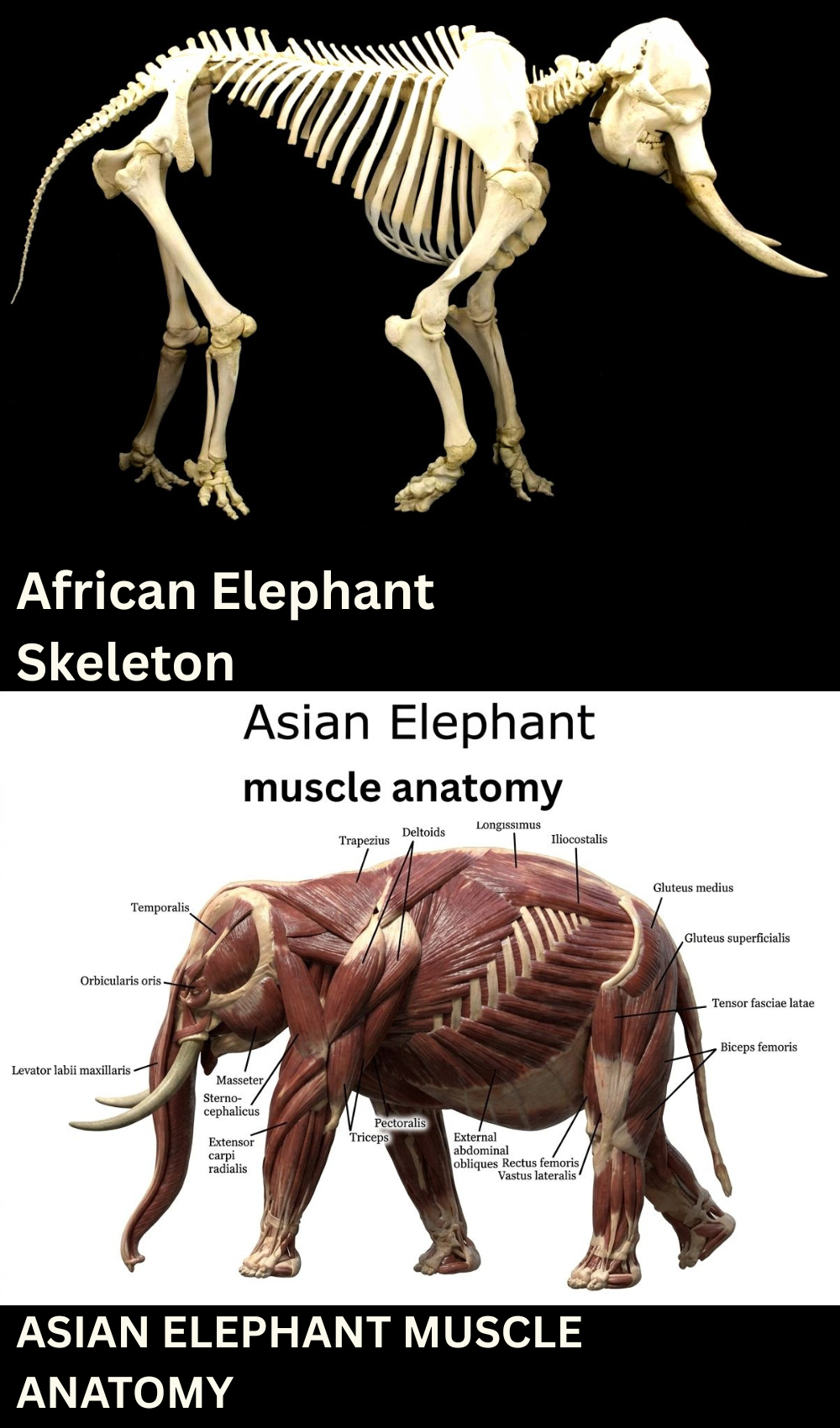
| Skeleton/Limbs | 326–351 bones; pillar legs, 5 toenails/foot; cannot jump; internal testes. | Similar; 22-month gestation. | Precocial: stands quickly; fatty foot pads for weight. |
| Other | Tusks: grow 17 cm/year, right/left dominant; brain 4.5–5.5 kg; skin 2.5 cm thick, mud baths essential. | Tusks smaller; intestines 35 m for hindgut fermentation. | Born after 22 months; suckle 2–4 min/hr first year; temporary tusks. |
Elephant Anatomy and Muscles: A Guide for 3D Animators
Elephants, the largest land mammals, possess a unique anatomy adapted for their massive size and versatile behaviors. This article focuses on the muscle systems of male elephants (bulls), female elephants (cows), and calves, highlighting key features, sexual dimorphism, and top muscles. For 3D animators in films and games, understanding these elements is crucial for realistic rigging, weight distribution, and motion—such as the pendulum-like walk or dexterous trunk movements. Data draws from scientific and artistic references, emphasizing differences across sexes and ages.

Overview of Elephant Muscle Anatomy
Elephants have approximately 394 skeletal muscles, but their trunk alone contains around 40,000 to 150,000 muscle fascicles (bundles), enabling incredible flexibility. Unlike humans with about 650 muscles, elephants prioritize strength in limbs for support and finesse in the trunk for manipulation. Muscle anatomy is broadly similar across African (Loxodonta africana) and Asian (Elephas maximus) species, with variations in size rather than structure. Bulls are larger (up to 6.9 tonnes), cows smaller (up to 3.5 tonnes), and calves start at ~120 kg, growing rapidly. Sexual dimorphism affects overall build: bulls have broader heads and thicker necks for musth-related aggression, while cows feature sloping abdomens for gestation. Calves show proportional differences, like larger heads and uncoordinated trunks initially.
In calves, musculoskeletal scaling is ontogenetic: limbs adapt quickly to weight, with smaller Achilles tendons compared to adults, aiding in playful, wobbly movements. Animators should rig for heavy overlap in motions—trunk leading, followed by body sway—and exaggerate squash/stretch on foot impacts for realism.
Top Muscles Explained
Elephants’ key muscles support their keystone role in ecosystems, from uprooting trees to delicate foraging. Here’s a breakdown of top muscles, with animator notes:
- Trunk Muscles (Musculus caninus): The trunk’s single muscle comprises ~40,000 fascicles in eight groups: longitudinal (for extension/retraction), transverse (twisting/spiral), and radial (fine control). Bulls use them for aggressive displays (e.g., high arching); cows for nurturing (e.g., guiding calves); calves start uncoordinated but master by 1 month. Animator tip: Rig in 3-5 sections with tip agility; add whiskers for sensory detail.
- Limb Muscles (e.g., Quadriceps, Gastrocnemius): Pillar-like legs distribute 60% weight to forelimbs, 40% to hind. Bulls’ robust forelimbs aid charging; cows’ coordinate herd protection; calves’ fatty pads cushion early steps. No jumping due to straight-locked knees. Animator tip: Emphasize slow lifts and heavy plants; use physics sim for ground shake.
- Neck and Shoulder Muscles (Trapezius, Deltoids): Support massive heads; stronger in bulls for tusk use. Cows’ aid in alloparenting; calves’ develop through play.
- Abdominal and Back Muscles: Concave back in African bulls, convex in Asian; provide stability for migration.

References for Animators
For 3D modeling and animation, these resources provide detailed muscle visuals:
- Gnomon Workshop: Tutorials on elephant skeletons and musculature by Terryl Whitlatch, ideal for creature design. (Website: https://wew.thegnomonworkshop.com/tutorials/elephant-anatomy-vol-1-drawing-skeletons-musculature)
- Jun’s Anatomy: Physical models of elephant muscles at 1/20th scale for reference. (Website: https://www.junsanatomy.com/collections/elephant-hippo-rhino)
- Sketchfab 3D Models: Interactive elephant anatomy models, including muscles and skeletons. (Examples: https://sketchfab.com/3d-models/elephant-anatomy-430751cb809b4d95a944feb3d8d3a4dc)
- Pinterest and Shutterstock: High-res muscle diagrams and illustrations. (Search “elephant muscle anatomy” on https://www.pinterest.com or https://www.shutterstock.com)
- Upali.ch and Tsavo Trust: Free diagrams of muscle systems. (Websites: https://en.upali.ch/anatomy-of-the-elephants/; https://tsavotrust.org/the-anatomy-of-the-african-elephant/)
These tools help animators create authentic poses, like a bull’s charge or a calf’s playful trunk swing, blending science with creativity.