Introduction
Creating a believable 3D animal requires more than just a good rig; it requires a deep understanding of natural sciences, biomechanics, and behavioral ecology. For indie game developers and 3D animators, bridging the gap between art and biology is what separates a stiff, robotic model from a living, breathing creature.
When it comes to quadruped animation, mastering the wolf is an essential rite of passage. This guide dives into the biomechanics, anatomy, and locomotion of Canis lupus to give you the ultimate reference sheet for your next project.
Watch animal documentaries and go to nature and pay close attention to details, shapes, curvatures, texture, colors, and motion. Mother Nature is the best artist.

The Importance of Animal Animation Cycles (and Why Wolf Cycles Are Gold for Animators)
Why start with wolves? The anatomy and locomotion of the gray wolf serve as a perfect baseline for understanding almost all digitigrade (toe-walking) mammals. Wolves are endurance runners built for efficiency. By studying their movement, animators learn the crucial mechanics of energy transfer, weight distribution, and spinal flexibility. Once you master the mechanics of a wolf’s trot or gallop, those same underlying principles can be easily adapted to dogs, foxes, big cats, and even fantasy creatures in your game engine.
Top 5 Most Useful Wolf Animation Cycles
To build a robust animation controller, you need these five foundational cycles:
The Walk (4-beat gait): Slow, purposeful, and energy-saving. The head drops slightly below the shoulder line, and the animal exhibits “direct registering” (the hind paw lands exactly in the footprint of the front paw).
The Trot (2-beat diagonal gait): The classic wolf traveling pace. The diagonal opposite legs move together. It’s highly efficient and can be maintained for hours.
The Gallop (4-beat asymmetrical gait): For high-speed chases. Wolves use a “rotary gallop,” featuring two suspension phases (one when legs are gathered under the body, one when fully extended).
The Pounce/Leap: Essential for hunting mechanics. Power is generated entirely from the hindquarters, with the spine acting as a coiled spring.
The Idle/Alert: Never leave a character perfectly still. Include weight shifting, ear twitching (independent ear movement), and panting or sniffing, which engages the chest cavity and neck.
Top wolf animations for a video game or film
a) Top Wolf Animations for Video Games and Film
Whether you are rendering a cinematic short in Maya or setting up an animation controller for an animal game, your wolf needs a comprehensive list of states. To make a quadruped feel alive, prioritize these core animations:
The Essential Locomotion Suite:
- Sneak/Stalk: Low center of gravity, slow weight transfers, and intense head tracking.
- Walk (In-Place and Root Motion): The standard 4-beat gait. (Game developers should always create both in-place and root motion versions to give the programming team flexibility).
- Rotary Gallop: High-speed sprint with fully extended and gathered suspension phases.
- Turns (90° and 180°): Animals don’t rotate on a dime like a tank. They lead with the head, followed by the neck, spine, and finally the hips.
Idles and Behavioral Animations:
- Standard Idle: Subtle breathing, slight weight shifting, and occasional ear flicks.
- Investigate/Sniff: Head lowered to the ground, taking small, irregular steps while the tail wags slowly at a low angle.
- Howl: The chest expands, the head tilts sharply upward, and the muzzle forms an “O” shape.
- Resting Transitions: Stand-to-sit, sit-to-lay, and sleeping idles.
Combat and Action (Vital for Games):
- Aggressive Display (Snarl): Ears pinned back, lips curled exposing the canines, stiff-legged stance, and raised hackles.
- Pounce/Bite: A quick, explosive lunge powered by the hind legs.
- Hit Reactions/Stagger: Flinches from the left, right, and front to register taking damage.
- Death/Incapacitation: A ragdoll-like collapse or a staged fall.
- Wolf kisses.
Top Techniques to Create the Rig in Blender and Maya
Quadruped rigging is notoriously tricky because of the digitigrade legs and the floating shoulder blade. Here are the top techniques to ensure your rig moves biologically correctly in Blender or Maya:
1. The Digitigrade “Reverse Foot” Setup A wolf walks on its toes, meaning the heel (hock) is high up the leg.
- Maya: Utilize an IK Spring Solver or a standard IK handle from the hip to the ankle, and another from the ankle to the ball of the foot. Create custom attributes to drive the “toe roll” and “heel lift.”
- Blender: Use an IK Bone Constraint with a Pole Target for the knee. Set up a reverse foot mechanism using a series of parented bones at the toe, ball, and heel to allow the animator to easily roll the foot off the ground during a walk cycle.
2. The Sliding Scapula (Shoulder Blade) Because wolves lack a collarbone, the front legs do not pivot from a fixed socket. The scapula slides along the ribcage.
- Technique: Do not parent the front leg straight to the spine. Create a dedicated scapula bone. In both Maya and Blender, you can use a Shrinkwrap constraint (or Maya’s Geometry constraint) to force the scapula bone to slide across a proxy mesh of the ribcage, keeping the shoulder movement grounded in anatomical reality.
3. Spline IK for the Spine and Neck A wolf’s power comes from the flexion and extension of its back.
- Maya: Use a Spline IK Handle down the length of the spine and neck. Bind the curve to a few control curves (chest, mid-back, pelvis) so the animator can easily create the “S-curve” of a galloping wolf without rotating individual vertebrae.
- Blender: Use Bendy Bones (B-Bones) or a Spline IK constraint. Bendy bones are excellent for distributing a smooth curve across the back and neck, making it easy to create overlapping action when the wolf stops suddenly.
4. Hybrid Facial Rigging (Bones + Blendshapes/Shape Keys)
- Technique: Use bones for the main jaw rotation and the base of the ears to ensure smooth, large-scale movements. For the fleshy parts—like the lips pulling back into a snarl, the nose wrinkling, or the brow furrowing—use Blendshapes (Maya) or Shape Keys (Blender). This hybrid approach keeps the rig lightweight for game engines while allowing for expressive, terrifying snarls.
Animation Workflow Tips for 3D Artists
Baking for the Game Engine: If you are exporting to a game engine like Unity or Unreal, ensure your IK constraints, Spline IKs, and complex constraints are baked down to the raw deformation bones before exporting your FBX file.
Always use Video Reference: Frame-by-frame analysis of real wolves is non-negotiable. Software like SyncSketch or pure ref boards are invaluable.
Master Overlapping Action: A wolf’s tail and ears are secondary animations. When the hips drop, the base of the tail drops, but the tip of the tail follows a few frames later. This “drag” is what gives the model a sense of weight and organic life.
a) Top Wolf Poses and Locomotion Animation References
When building your keyframes, focus on the line of action running from the tip of the nose, through the spine, down to the tail. In a resting pose, a wolf’s head is generally level with or slightly below its back, unlike a domestic dog which often holds its head high. For locomotion, pay close attention to the shoulders: because wolves lack a collarbone, the shoulder blade (scapula) rotates heavily along the ribcage, extending their stride length dramatically.
b) Female Wolf, Male Wolf, and Wolf Cubs: Anatomy Facts and Core Features
Understanding biological variance is key to creating diverse NPCs or dynamic pack mechanics.
- Maximum Weight: * Male: Can reach up to 80 kg (175 lbs) in northern subspecies, though 45 kg (100 lbs) is average.
- Female: Generally max out around 55 kg (120 lbs), averaging 36-40 kg (80-90 lbs).
- Sexual Dimorphism: Are males and females sexually dimorphic? Yes, but it is subtle. Males are typically 15% to 20% larger. From a modeling perspective, adult males have blockier, broader skulls, thicker necks, and longer legs. Females tend to have narrower muzzles and a slightly more streamlined silhouette.
- Pregnancy & Cubs: The gestation period for a female wolf is about 60 to 63 days. They typically give birth to a litter of 4 to 6 pups. For animators, wolf pups require completely different proportions: proportionally larger heads, shorter and thicker legs, and a clumsy, uncoordinated gait due to underdeveloped stabilizing muscles.
c) Adult Male and Female Wolf Skeletal Anatomy

Note: While the heading mentions muscle, these metrics focus on the skeletal framework that dictates your armature.
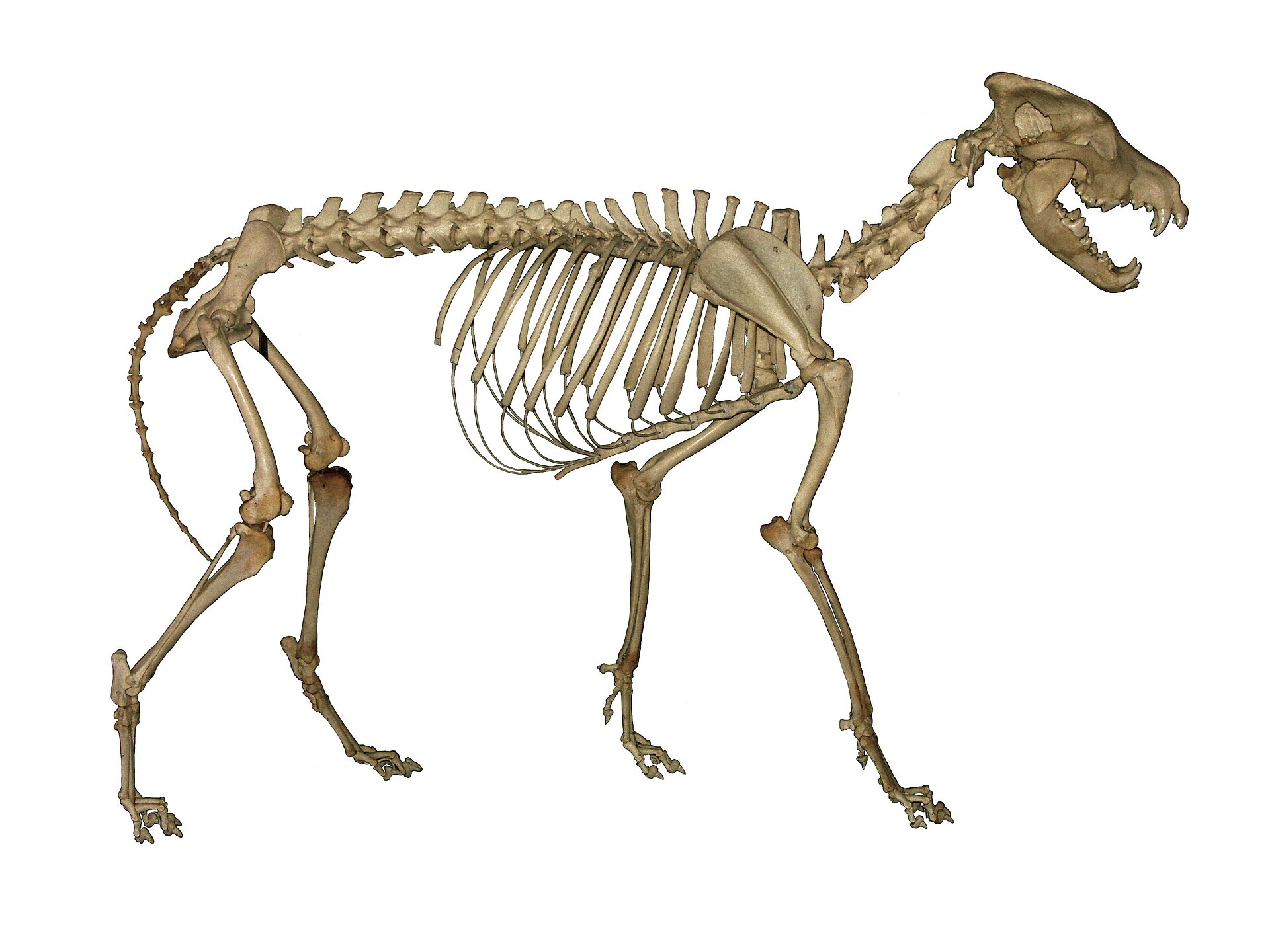
- How many bones: Wolves have approximately 319 bones (this can vary slightly by a few tail vertebrae).
- Male vs. Female Bone Differences: The skeletal structure is fundamentally the same, differing mainly in scale and bone density. The most notable difference is the sagittal crest (the ridge of bone on the top of the skull). It is more pronounced in males, providing a larger surface area for the attachment of their massive jaw muscles.
- Main Bones & Importance:
- Scapula (Shoulder Blade): Crucial for the front leg IK rig. It moves freely along the thorax.
- Humerus, Radius, & Ulna: The front limb bones.
- Pelvis & Femur: The powerhouse of the wolf’s thrust.
- Calcaneus (Heel bone): Elevated off the ground due to their digitigrade stance.
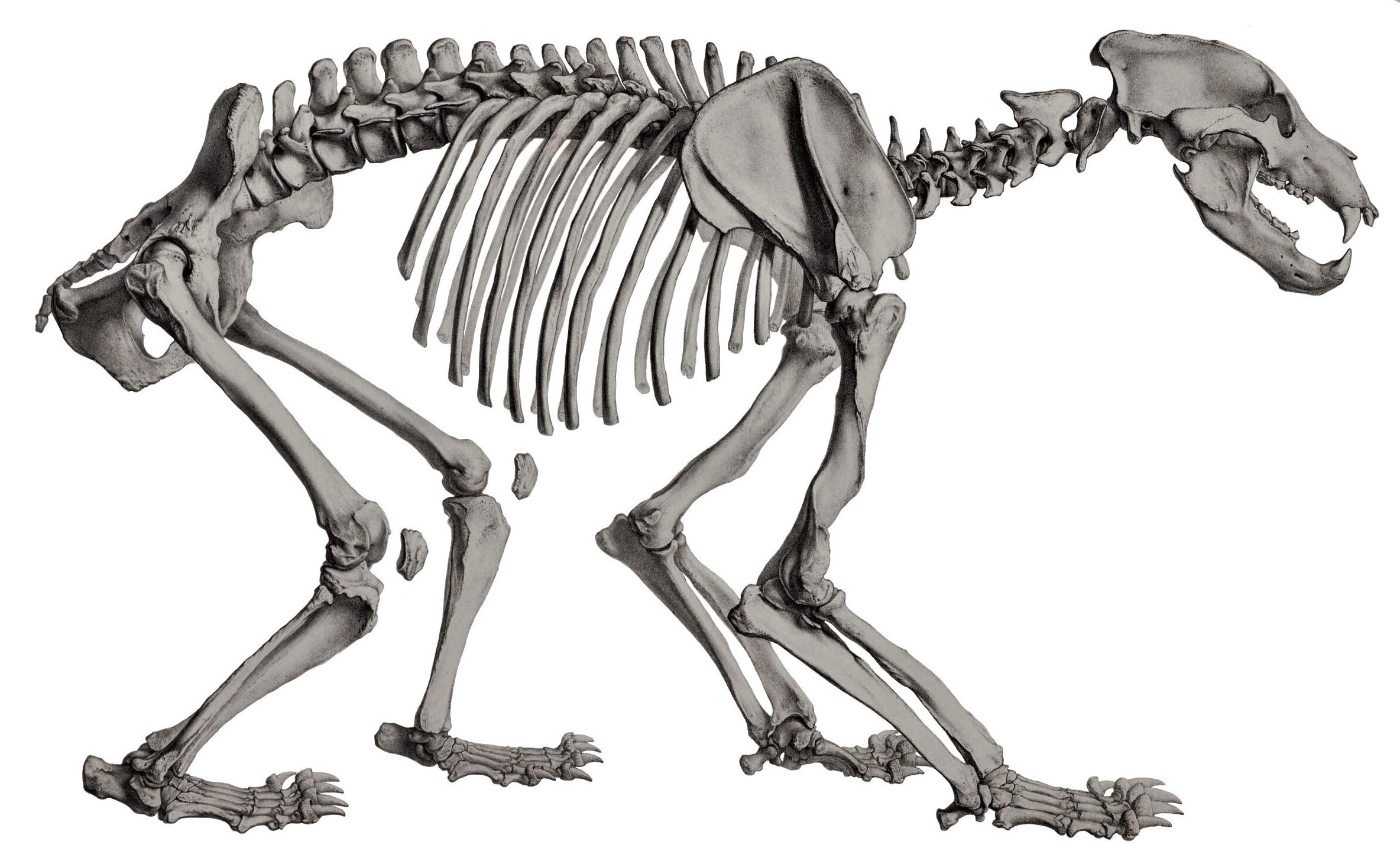
- Structure and Locomotion: The skeletal structure maintains stability through tension. The absence of a clavicle (collarbone) allows the scapula to pivot forward, maximizing stride reach. The spine acts as a flexible bridge, bowing upward when the legs gather and flexing downward when the legs extend during a run.
- Recommended Sources for Learning: For scientifically accurate reference material, look to works by L. David Mech (a leading wolf biologist), the “Animal Locomotion” plates by Eadweard Muybridge, and veterinary anatomy textbooks like Miller’s Anatomy of the Dog (which is structurally near-identical to a wolf for rigging purposes).
d) Muscle Anatomy of Wolves
- How many muscles: Like most canids, wolves possess over 700 skeletal muscles.
- Top 5 Wolf Muscles and Their Importance (For Animators):
- Biceps femoris (Hind legs): The massive muscle driving the hind legs. It extends the hip, stifle (knee), and hock, providing the explosive forward thrust for jumping and galloping.
- Latissimus dorsi (Back/Ribcage): Retracts the forelimb. When the wolf’s front paw plants, this muscle pulls the body forward over the leg.
- Brachiocephalicus (Neck/Shoulder): Runs from the back of the head down to the arm. It pulls the front leg forward to initiate a new stride and dictates the heavy head-bob during a walk cycle.
- Triceps brachii (Front legs): Extends the elbow joint. It takes the massive impact of the wolf’s weight landing on its front legs during a run.
- Masseter (Jaw): The primary chewing muscle. It is exceptionally thick in wolves, giving them their massive bite force. Animators need to properly weight this area for snarling, barking, and combat animations.
e) Wolf Social Structure and Pack Dynamics for NPC AI
Monogamous or Polygamous? The Science of the Pack doesn’t matter if you are building a video game, a film, or your art portfolio; getting the social dynamics right is just as important as perfecting the walk cycle.
A common myth in pop culture is that wolf packs are aggressive, polygamous groups of unrelated adults constantly fighting for an “alpha” position. In reality, wild wolves are strictly monogamous.
A wild wolf pack is fundamentally a nuclear family. It is built around a single breeding pair (modern wildlife biologists prefer the term “breeding male and female” or “parents” rather than “alphas”) and their offspring from the current and previous years.
Core Features of Wolf Social Structure:
- The Breeding Pair (Monogamy): Only this core pair reproduces. They form lifelong bonds and lead the pack. If you are coding mating behaviors, denning mechanics, or pack-spawning logic, reproduction should be strictly restricted to these two specific entities.
- Sub-adults and Yearlings: The subordinate members of the pack are almost entirely the couple’s older children. They act as cooperative helpers, assisting in hunts and guarding the newest litter of cubs.
- Dispersal Mechanics: Between 1 and 3 years of age, young wolves naturally leave the pack to become “dispersers” (lone wolves). They travel to find a mate of their own and establish a new territory. In a game engine, this biological fact provides a perfect natural mechanic for triggering migration events, controlling population density, or spawning new NPC packs across the map.
Animation and Rigging Takeaways for Pack Interactions: Because the pack is a close-knit family, their social animations are highly nuanced. To make a virtual pack feel like a cohesive, living unit rather than a group of independent AI agents, animators need to create distinct behavioral states:
- Confidence/Leadership (Breeding Pair): The parents typically stand taller, with ears pricked forward and the tail held horizontal or slightly raised. They generally initiate travel and hunting phases.
- Active Submission/Greeting (Offspring): When subordinates interact with the breeding pair, they exhibit specific submissive animations: lowered body posture, ears pinned flat against the head, a tucked tail, and active muzzle-licking. Blending these greeting animations into your idle states is crucial for believable pack AI.

Recommended Websites and Sources for Learning: Top 3 Quality References
As a 3D animator and game developer, your internal reference library and your external research sources are your greatest tools for creating believable motion in your ecosystem simulators. While generic stock footage and creative inspiration have their place, mastering realistic quadruped animation requires deep dives into biological accuracy and specific, high-quality visual reference. Here are three authoritative, science-based sources that should be cornerstone resources for perfecting your wolf mechanics and behavior:
1. The Wolf Conservation Center (WCC) – Live Cams
- Why it’s essential for animators: Get real-time, high-definition motion reference of wolves exhibiting varied behaviors in expansive, natural enclosures. The WCC hosts gray, Mexican gray, and red wolves, offering a spectrum of species and individual variations. Their live cams provide countless opportunities to observe complex social interactions—including the subtle ear twitches, specific tail postures, and powerful muscle movements of active submission greetings—dynamic hunting simulations, and pure locomotion gaits from multiple angles.
- Animator’s Workflow: Utilize WCC footage for frame-by-frame analysis of gait transitions, weight distribution during leaps and turns, and the nuances of secondary overlapping actions like tail drag and breathing-induced chest movements.
- Link: WCC Live Cams
2. Miller’s Anatomy of the Dog (Textbook)
- Why it’s essential for animators: Consider this the definitive scientific resource for quadruped rigging and understanding dynamic muscle deformation. Anatomical structures can be misleading on the surface; you need the under-the-hood precision. Because wolves and domestic dogs are homologous (structurally and biomechanically near-identical), this veterinary textbook is universally accepted as the gold standard for creature artists. It features incredibly detailed, accurate illustrations of skeletal topology, joint articulation limits, and the exact origin and insertion points for core muscle groups.
- Animator’s Workflow: Refer directly to these diagrams when building your technical rigs in Blender or Unity, particularly for complex systems like the floating shoulder blade (scapula) and the unique digitigrade hock (heel) joint mechanics. Understanding where muscles attach ensures they deform realistically over the underlying bone structure.
- Link: Miller’s Anatomy of the Dog (Elsevier)
3. Wolf.org (The International Wolf Center) & The Publications of L. David Mech
- Why it’s essential for animators: Gain factual, science-based context for wolf behavioral logic and pack dynamics. Realistic animation isn’t just about how an animal moves, but why it moves that way. Dr. L. David Mech is the world’s preeminent wolf biologist, and his extensive body of research provides definitive documentation on wolf ethology (behavior). His work famously clarified that wild wolf packs function as cooperative nuclear families led by a breeding pair, rather than aggression-driven, linear hierarchies led by an ‘alpha’—crucial information for designing realistic pack AI and interaction sequences in your game engine.
- Animator’s Workflow: Dive into Mech’s research to inform your behavioural state machines and interaction logic. Define entity states (e.g., confident parent vs. submissive yearling) based on biological reality, ensuring your virtual pack members respond and move in ways that feel authentic to actual wolf pack interactions, denning, and hunting strategies.
- Links:
Introduction to the Wolf Conservation Center This video provides a great overview of the Wolf Conservation Center’s enclosures, showing the type of natural environment and terrain variations you can observe when studying their animals for reference.
Next Up: Animate the Jungle!
🐾 Ready to master big cats? If you’ve nailed the digitigrade mechanics of the wolf, it’s time to tackle the sheer power and flexibility of a feline. Check out our deep dive here: 🐅 The Ultimate Tiger Reference for Animators ⚡