The Ultimate Lion Reference for Animators

This is the lion reference I wish I had when I started. It collects the behavior, anatomy, locomotion, mesh deformation and texture details you need to pose, rig and animate a believable lion — so you can spend your time on beauty, not guesswork.
Why Lions Are Hard (but Rewarding) to Animate
The plan is simple: build the ultimate article for lion animators. Every reference here helps you replicate real poses with technical accuracy, then add beauty to your 3D pipeline — from behavior and anatomy to locomotion, mesh deformation and texture.
Lions look easy because we see them everywhere. But audiences know them so well that small mistakes feel wrong right away. A stiff spine, a mane that moves like a helmet, or paws that slide on contact will break the illusion. So pay close attention to details, curves, shapes, colors and textures.
Here is what this guide covers, in the order you will need it:
Skeleton & muscles
Muscle groups that shape the silhouette, paw pads, shoulder blade travel and spine flexibility.
Proportions & mass
Real measurements for males, lionesses and cubs, plus how weight shifts from walk to run.
Fur & skin behavior
How skin slides over the shoulders, whisker pads, ear tension and the tail tuft.
Behavior library
Video references for every gait and behavior — study them frame by frame.
If you animate other big cats, compare this guide with the Ultimate Tiger Reference for Animators and the Ultimate Jaguar Reference. The differences in build and gait are a great way to train your eye.
Lion Gait Cheat Sheet: Walk, Trot, Gallop
Before you open the videos, learn the footfall patterns. Lions are quadrupeds, so each gait has its own rhythm. The diagrams below are schematic: they show when each foot is on the ground during one full cycle. Use them to block your keys, then refine the timing against real footage.
Walk (slow patrol) 4-beat · lateral sequence · always 2–3 feet down
Trot 2-beat · diagonal pairs move together
Rotary gallop (sprint) 4-beat · two flight phases · spine flexes & extends
■ Hind feet ■ Front feet · LH = left hind, LF = left front, RH = right hind, RF = right front. Gaps with no bars = the lion is airborne.
| Gait | Beats & pattern | What sells it | Starting timing (24 fps)* |
|---|---|---|---|
| Walk | 4-beat, lateral sequence (hind → front on the same side) | Rolling scapulae, head bob, tail sway, belly skin lag | ~30–40 frames per full cycle |
| Stalk | Slow walk with a very low center of mass | Elbows above the spine line, head level, long holds between steps | Irregular — use long holds |
| Trot | 2-beat, diagonal pairs | Level back, short suspension, steady head | ~16–22 frames per cycle |
| Canter | 3-beat, one flight phase | Rocking-horse spine, lead leg change | ~12–16 frames per cycle |
| Rotary gallop | 4-beat, two flight phases | Big spine flex/extension, hind feet land ahead of front prints | ~8–12 frames per cycle |
*Timing ranges are practical starting points for blocking, not measured values. Always time your final cycle against slow-motion footage of the lion size you are animating. For a deeper look at footfall logic, see the Ultimate Horse Reference for Animators, then set up your cycles in a state machine with idle, walk, run and jump in Unity’s Animator Controller.
Lion Animation Locomotion References
Here is a complete behavior library, organized from calm to explosive. Each reference includes what to watch, so you know exactly where to scrub. Pro workflow: watch once at full speed for feeling, then step frame by frame for contacts and overlap.
Running
Watch: the spine bunching and stretching, hind paws landing ahead of the front prints, and the tail acting as a counterweight.
Resting / Sleeping Poses (5–8 Variations)
Watch: belly and ribcage breathing, how weight flattens the soft tissue on contact, and small ear flicks that keep an idle alive. Lions rest for most of the day, so strong idles matter.
Sitting / Scanning
Watch: the head moves first, then the neck, then the shoulders. The eyes lead every look.
Lying on Side
Watch: how the mane and belly spread on the ground and how the top legs relax. Great for testing collision and skin sliding in your rig.
Sphinx Pose
Watch: the elbows pushed out, the high shoulder blades and the slight head tilt that breaks perfect symmetry.

Walk (Slow Patrol) + Contact Positions
Watch: the shoulder blade rising as each front leg passes under the body, the head dipping on front contact, and the hind paw stepping close to the front print.

Lion Trot
Watch: diagonal legs landing together, a flatter back than the walk, and less head bob.
Lion Canter / Gallop
Watch: the moment all four feet leave the ground, and how the mane and belly skin keep moving after the body lands.
Lion Stalk / Crouch Walk
Watch: the shoulder blades poking above the spine line, the level head, and the long “freeze” holds before each careful step.
Pounce & Kill Bite
Watch: the hind feet shuffling for grip (anticipation), the forelimbs reaching and hooking, and the head turning to bite.
Roaring (Mouth Shapes, Neck Tension) & Attacking Prey
Watch: a roar is a full-body action. The belly contracts, the neck stretches forward and the mouth moves through several shapes. Recent collar research even detects roars from body acceleration alone (see the science section below).
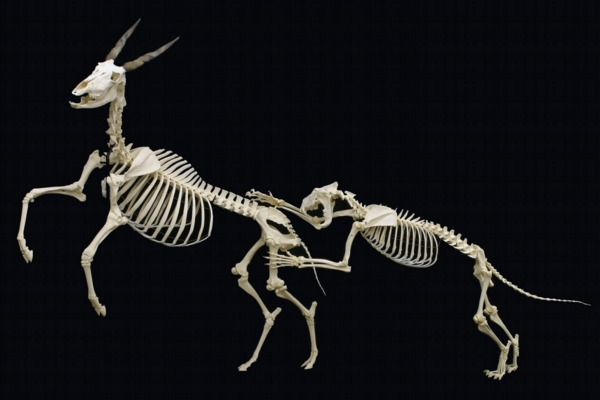
Social Behaviors (Greeting Rub, Play Fighting, Cub Carrying)
Watch: head rubs start at the cheek and slide along the body. In play fights, watch how claws stay mostly sheathed and bites are soft.
Climbing Trees (Yes, Lions Do This Sometimes)
Watch: lions are heavy and clumsy climbers compared with jaguars. Look for the hind legs pushing in bursts, the claws extended, and the careful, awkward descent.
A Lioness Bitten by a Black Mamba
Watch: the startle reflex — an instant jump back, weight thrown onto the hind legs, and ears pinned flat. Rare, raw reference for fast reactions.
The Latest Science on Lion & Animal Locomotion (2026)
Science keeps changing how we understand movement. The studies below are the most useful for animators right now. Each card ends with a practical takeaway you can use in your next shot.
GPS collars show lions chase off hyenas — not the other way around
Researchers led by Nancy Barker (University of KwaZulu-Natal) tracked 17 lions and 14 spotted hyenas for four years in Etosha (Namibia) and Chobe and Linyanti (Botswana). Collars logged positions every five minutes. Across roughly 1,000 simultaneous interactions, male lions tended to move toward hyenas, while hyenas moved away.
Animator takeaway: when you stage a lion–hyena scene, the male lion is the one closing distance. Animate confident, direct approaches and hyenas that keep a safe buffer.
Sources: Frontiers news · Study (Frontiers in Ethology)
AI detects lion roars from collar motion data — no audio needed
The Leibniz Institute for Zoo and Wildlife Research (Leibniz-IZW) trained a U-Net neural network on 1,333 roaring events from seven collared lions in Etosha National Park. Using only acceleration data, it identified roars with 90–96% accuracy, for both males and females, even while the lions were moving.
Animator takeaway: a roar has a clear body-motion signature. Don’t animate only the jaw — add rhythmic contractions through the chest, belly and neck.
Sources: Leibniz-IZW press release · DOI: 10.1016/j.ecoinf.2026.103761
Spine timing is the secret to fast running in cats
Kamimura, Aoi and colleagues modeled a cheetah with a spine that is stiffer when extended than when flexed. They found that the timing between spine motion and foot contact strongly affects high-speed performance. The cheetah-like pattern — the spine extending after the hind legs leave the ground — reduced the forces on the legs.
Animator takeaway: in your gallop, don’t sync spine extension with hind contact. Let the back extend just after hind lift-off for a smoother, more powerful stride.
Source: arXiv:2604.00329 · related: spinal stiffness in simulated cheetah and horse galloping (PubMed)
How cat front and hind legs change with speed
A new study compares forelimb and hindlimb movements in adult cats moving on a treadmill versus over ground at different speeds. It is a helpful reminder that treadmill footage and natural ground footage are not always interchangeable.
Animator takeaway: prefer natural, over-ground footage for your lion cycles, and treat front and hind legs as separate timing problems.
Source: Journal of Neurophysiology (doi:10.1152/jn.00240.2026)
The real numbers behind a lion hunt
Alan Wilson’s team at the Royal Veterinary College fitted high-speed GPS and motion collars to nine lions in northern Botswana. They analyzed 2,726 runs and more than 111,000 strides. This is still the best measured data on how wild lions actually run.
| Measured value | Result |
|---|---|
| Top speed recorded | 20.6 m/s (~74 km/h / 46 mph) |
| Typical fast run (98th percentile) | 13.9 m/s (~50 km/h) |
| Acceleration vs. zebra | 37% greater |
| Deceleration vs. zebra | 72% greater |
| Muscle fibre power | ~108 W/kg (20% higher than prey) |
Animator takeaway: lions win with acceleration and braking, not endurance. Make the first three strides explosive and let the stop be sharp and heavy.
Source: Wilson et al., Nature 554 (2018)
Lion, Lioness and Cub Anatomy Facts and Core Features
Use these tables as your model sheet. Scale your rig to real measurements first, then exaggerate on purpose — never by accident. Lions show one of the strongest size differences between the sexes of any big cat, so a male and a lioness need different rigs, not just a mane swap.
| At a glance | Adult male | Lioness | Cub (1 year) |
|---|---|---|---|
| Head-body length | 170–250 cm | 140–185 cm | ~100–120 cm |
| Shoulder height | 100–124 cm | 90–110 cm | ~60–70 cm |
| Weight | 150–225 kg | 110–180 kg | 40–80 kg |
| Silhouette key | Front-heavy, mane mass | Long, lean, athletic | Big head, paws & ears |
| Motion feel | Slow, heavy, deliberate | Fluid, fast, coordinated | Bouncy, clumsy, curious |
Adult Male Lion (Panthera leo)
| Category | Details (Scientific Averages & Notes) |
|---|---|
| a) Dimensions | Head-body length: 170–250 cm (5.6–8.2 ft) Shoulder height: 100–124 cm (3.3–4.1 ft) Tail length: 90–105 cm Total length: up to 3.5 m |
| b) Weight | Average: 150–225 kg (330–500 lb) Record specimens: up to 272 kg (600 lb) |
| c) Top Roles & Behavior | • Pride defender: patrols territory, roars to warn rivals, fights invading males • Protects the pride from external threats (hyenas, rival coalitions) • Hunts less often than lionesses in open habitats, but still hunts, especially large prey and in dense cover; eats first at kills • May commit infanticide when taking over a new pride to bring females into estrus |
| d) Fur Color Variations | Body: tawny yellow to reddish-brown, lighter underparts Mane: blond → reddish → dark brown → black (darkens with age & testosterone) Rare variants: white lions (leucism, not albino) |
| e) Sexual Dimorphism | Among the most pronounced in big cats: males ~50% heavier and 15–20 cm taller at the shoulder Only males have a thick mane (protects the neck in fights, signals health and testosterone) Males have a broader head, heavier skull and more massive forequarters |
| f) Top Traits for 3D Animators | • Heavy, powerful build – massive shoulders, thick neck • Mane adds huge volume (flows, compresses, reacts to wind and motion) • Walk: slow, deliberate, rolling shoulders; short bursts of speed (max. measured ~74 km/h) • Secondary motion: mane jiggle, tail tuft, loose belly skin • Intimidation poses: head low, mane flared, slow stalking |
| g) Top Anatomy Facts | • Pronounced scapula (shoulder blade) creates a high “hump” when walking • Very muscular forequarters (for fighting and takedowns) • Retractable claws, rough tongue with backward-facing papillae • Short lumbar region = less flexible spine than smaller cats • Large nasal openings and a very powerful bite (published psi estimates vary widely) |
Adult Lioness
| Category | Details (Scientific Averages & Notes) |
|---|---|
| a) Dimensions | Head-body length: 140–185 cm (4.6–6.1 ft) Shoulder height: 90–110 cm (3–3.6 ft) Tail length: 70–100 cm Total length: up to 2.8 m |
| b) Weight | Average: 110–180 kg (240–400 lb) Regional max: up to 200 kg |
| c) Top Roles & Behavior | • Primary hunters (cooperative group hunts, roughly 20–30% success rate) • Communal cub rearing (synchronized births, allomothering) • Core of the stable pride (related females stay for life) • Defend territory and cubs together |
| d) Fur Color Variations | Body: tawny to light buff, slightly lighter than males No mane; short fur on neck and shoulders Rare white variants exist |
| e) Sexual Dimorphism | Smaller and lighter than males (no mane, slimmer neck and head) More agile build for sustained hunting Less massive forequarters, longer lumbar region for flexibility |
| f) Top Traits for 3D Animators | • Sleeker, athletic silhouette – visible muscle definition • Faster, more fluid motion (better for longer chases) • Group coordination in hunts: flanking, ambushing • Tail used heavily for balance and communication • Subtle ear and whisker movements show alertness |
| g) Top Anatomy Facts | • Longer back relative to males = better spinal flexion for turns • Proportionally longer legs for endurance hunting • Same retractable claws and rough tongue • More pronounced abdominal muscles (visible when lean) • Slightly narrower ribcage |
Lion Cub (0–2 Years)
| Category | Details (Scientific Averages & Notes) |
|---|---|
| a) Dimensions | Newborn: ~30–40 cm long, ~10 cm shoulder height At 1 year: ~100–120 cm head-body, ~60–70 cm shoulder height At 2 years (sub-adult): approaching adult female size |
| b) Weight | Birth: 1.2–2.1 kg (2.6–4.6 lb) 3 months: 10–15 kg 1 year: 40–80 kg 2 years: males ~120–150 kg, females ~100–130 kg |
| c) Top Roles & Behavior | • Play-fighting to learn hunting and fighting skills • Dependent on mothers and the pride for food and protection • High mortality (up to 80% before age 2 from infanticide, starvation, predators) • Learn social rules through play and observation |
| d) Fur Color Variations | Born with rosettes/spots (camouflage) that fade by 1–2 years Light brown/grayish coat; darker spots on legs and belly may remain faintly Small fuzzy mane starts around 6 months in males |
| e) Sexual Dimorphism | Minimal until ~1–2 years (males start growing mane fuzz and get slightly bulkier) |
| f) Top Traits for 3D Animators | • Oversized paws, head and ears → adorable proportions • Clumsy, bouncy movements (high center of gravity) • Lots of play poses: pouncing, wrestling, stalking • Fast growth = visible size changes over time if showing progression • Exaggerated secondary motion (loose skin, fluffy fur) |
| g) Top Anatomy Facts | • Proportionally larger head and shorter legs than adults • Spots/rosettes on coat for camouflage • Weaker musculature, softer bones (still growing) • Deciduous (baby) teeth until ~1 year • Eyes blue-gray at birth → amber by adulthood |
Lion, Lioness, and Lion Cub Anatomy: Essential Muscle References for Animators
Lions (Panthera leo) are powerful big cats built for explosive strength, short bursts of speed (up to ~74 km/h, or 46 mph, measured in the wild) and agile hunting. Accurate muscle knowledge is crucial for realistic movement — whether you animate a male’s dominant charge, a lioness’s stealthy stalk or a cub’s playful pounce.
Key Differences Across the Pride
Power & mass
Heavier build (large males can pass 225 kg / 500 lb). The thick mane hides the neck muscles but emphasizes massive shoulders and chest.
Clean lines
Leaner (110–180 kg / 240–400 lb) with no mane. Muscles look sharper and more defined — ideal for studying clean anatomy.
Soft & wobbly
Oversized head, short legs and baby fat soften muscle visibility. Movements stay wobbly and exaggerated until maturity.
All three share a digitigrade stance (they walk on their toes), a flexible spine and retractable claws. Note that a lion has no collarbone joint anchoring the shoulder: the shoulder blade is held by muscle, which is why it slides so visibly under the skin.
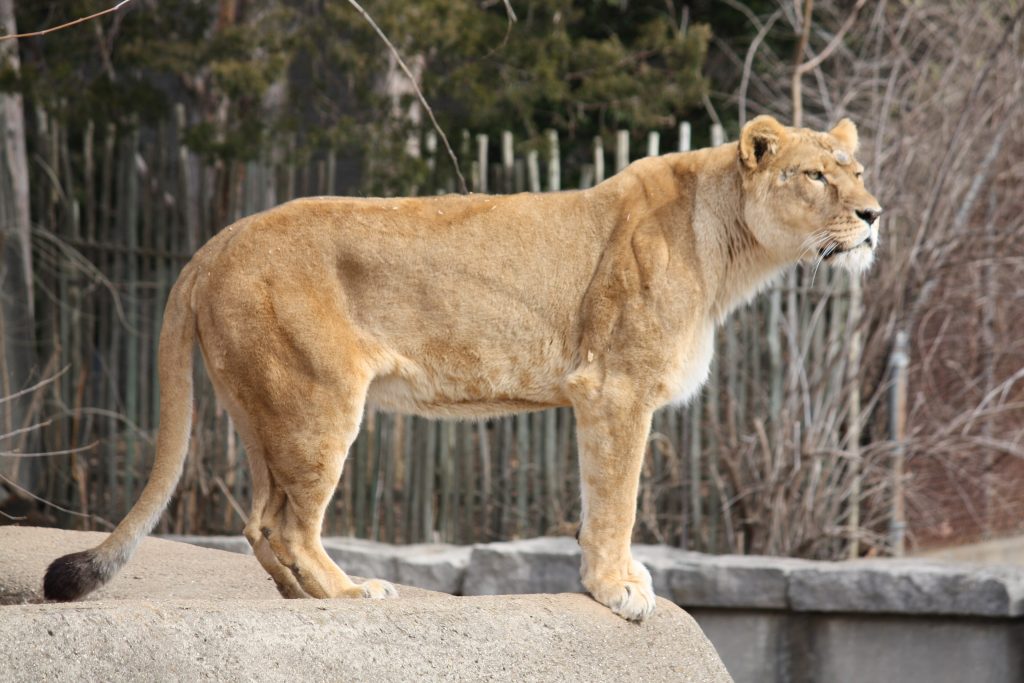
Top Muscles Explained for Animators (with Visual References)
These superficial muscles create the key “landmarks” that shift under skin and fur during motion:
- Trapezius & Latissimus Dorsi (neck/upper back): Pull the scapula; create shoulder ridges in strides and pounces.
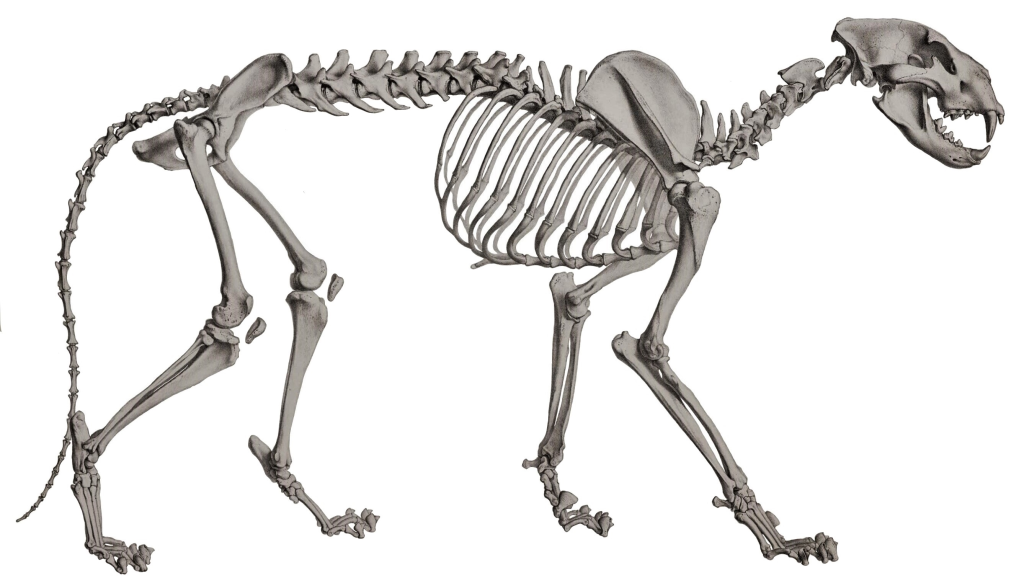
- Deltoid & Triceps Brachii (shoulder/forelimb): Drive powerful swipes and leaps; bulkier in males.
- Pectoralis Major/Minor (chest): Form a deep “V” shape; bulge during a crouch or lunge.
- Gluteus Medius & Biceps Femoris (hindquarters): Massive propulsion muscles — watch them flex in jumps.
- Quadriceps Femoris (front of thigh): Prominent in stretched poses and at sprint kick-off.
- Gastrocnemius (calf): Powers the springy “reverse knee” (really the heel/hock) for explosive push-off.
- Masseter & Temporalis (jaw): Enormous muscles for a crushing bite; animate jaw jiggle in roars.
- Serratus Ventralis & External Oblique (flanks): Ripple during twists and breathing — great for secondary fur motion.
In cubs, these muscles are underdeveloped and rounded, so exaggerate squash-and-stretch for cuteness.
| Muscle group | Visible when… | Rig / deformation tip |
|---|---|---|
| Trapezius & latissimus | Front leg passes under the body | Drive a scapula helper bone that slides up and back |
| Deltoid & triceps | Front contact, swipes | Corrective shape keys to bulge the triceps on weight bearing |
| Pectorals | Crouch, lunge, landing | Preserve volume between the forelegs to avoid a pinched chest |
| Gluteals & biceps femoris | Push-off, jumps | Jiggle or muscle sim on the haunch; keep the tail root stable |
| Gastrocnemius | Push-off, standing up | Hock IK with a calf flex driven by ankle angle |
| Masseter & temporalis | Roaring, chewing, biting | Jaw bone + cheek bulge shape driven by jaw open |
| Serratus & obliques | Breathing, twisting | Breathing shape key on a loop; ribs slide under skin |
Skin, Fur and Mesh Deformation: Where Realism Lives
Great lion animation is often decided by the surface, not the skeleton. The skin is loose, so it lags behind the bones and then catches up. Build that delay into your rig early.
Skin slide
Skin over the scapula slides visibly with each step. Use a sliding-skin or cloth-style layer, or a helper bone with delayed follow.
Mass, not strands
Animate the mane as a heavy volume first. It compresses on landing, lifts in wind and settles after a head shake. Add strand detail last.
Primordial pouch
The loose belly flap swings in the walk and slaps at the gallop landing. It is a key secondary motion — especially on lionesses.
Whiskers & ears
Whisker pads push forward when curious and flatten when snarling. Ears rotate independently and pin flat under threat.
Tuft & balance
The tail counterbalances turns and signals mood. The black tuft reads like a brush stroke — give it overlap and a slight delay.
Soft contacts
Pads spread on contact and toes splay under load. Claws stay retracted while walking, so prints show no claw marks.
Want to build that rig? Start with Blender Rigify for rigging animals, compare tools in Blender vs Maya for creature animation, and plan your full workflow with the 3D production pipeline guide.
Lion Ancestors and Extinct Relatives: Skeleton and Skull Gallery
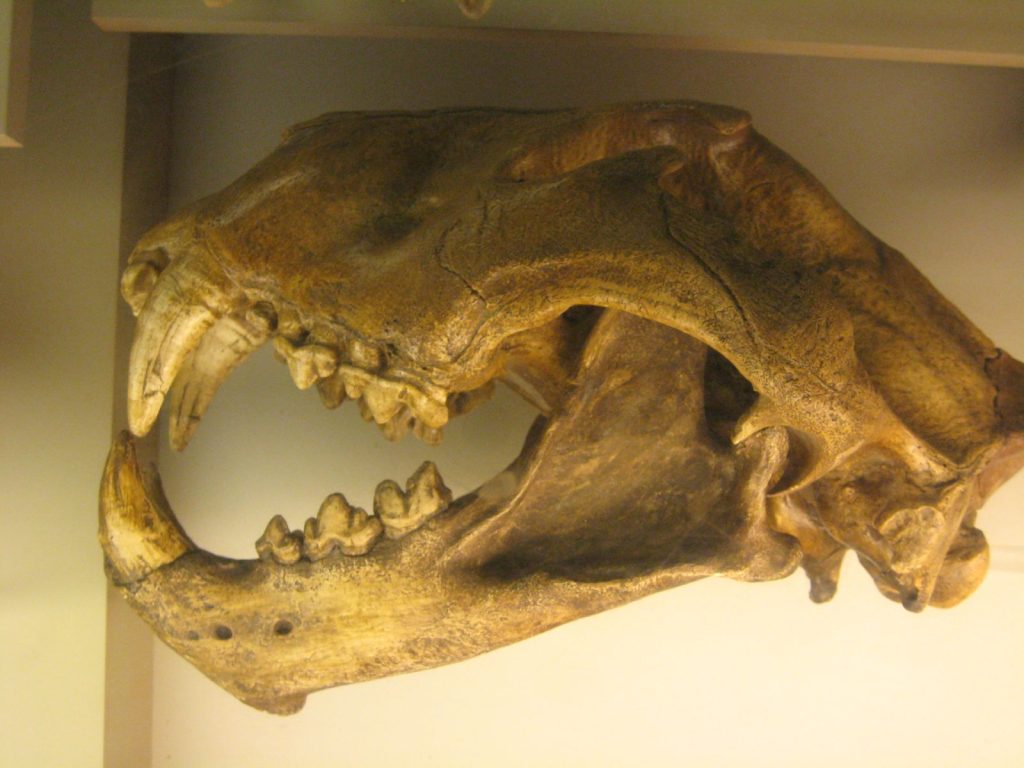
Ice Age lions are gold for creature designers. Their skeletons show the same core blueprint as modern lions, with different proportions. One note for accuracy: the cave lion and the American lion are best described as close extinct relatives of today’s lion, not its direct grandparents. They branched off from a shared ancestor.
| Lion | Where & when | Design notes for artists |
|---|---|---|
| Panthera fossilis | Middle Pleistocene Eurasia | An early, very large lion. Great base for “prehistoric giant” designs. |
| Cave lion (Panthera spelaea) | Eurasia & Beringia; extinct at the end of the last Ice Age | Robust build, likely a dense winter coat. Cave art suggests little or no visible mane. |
| American lion (Panthera atrox) | North America; extinct at the end of the last Ice Age | Larger and longer-limbed than modern lions. Hundreds of specimens come from the La Brea Tar Pits. |
| Barbary lion (North African P. leo leo population) | North Africa; gone from the wild in the 20th century | Famous for heavy manes in historical photos. A great bridge between modern and “historic” lion designs. |
For a very different big-cat skull and bite, compare these with Smilodon references for 3D sculptors. Smilodon was a saber-toothed cat, not a lion, but the contrast will sharpen your eye.


Browse more in the Lion anatomy, Panthera skulls and Panthera spelaea categories on Wikimedia Commons, and in Muybridge’s motion studies.
Best Free + Paid Lion Anatomy References & Websites
Monika Zagrobelna – Lion Anatomy for Artists
Free layered skeleton and muscle diagrams. The best place to start.
Open the diagrams →Maria Panfilova – Lion Anatomy Tool
Interactive 3D écorché with 96 labeled muscles. Rotate it next to your model.
Gumroad → · FlippedNormals →Jun’s Anatomy – 1/6 Scale Lion Model & Chart
A physical figurine and poster. Great for lighting studies on your desk.
Model → · Chart →Eliot Goldfinger – Animal Anatomy for Artists
The definitive book for artists, with detailed big-cat plates.
ArtStation Lion Écorché Models
Various 3D muscle and skeleton references you can import into your scene.
See example →Wilson et al. (2018), Nature
Measured speed, acceleration and muscle power of wild hunting lions.
Read the study →Combine these diagrams with slow-motion lion footage, and your animations will roar with anatomical accuracy!
Lion Animation FAQ
How fast can a lion run?
The fastest lion measured with GPS collars in Botswana reached 20.6 m/s, about 74 km/h (46 mph). Most hunting runs are much slower: the 98th-percentile speed was about 13.9 m/s (50 km/h). Lions rely on acceleration over short distances, not long chases.
What gait does a lion use when it runs?
Like other cats, lions sprint with a rotary gallop: a four-beat gait with strong spine flexion and extension and two airborne phases. At slow speeds they walk with a four-beat lateral-sequence walk.
Are lions digitigrade?
Yes. Lions walk on their toes. The joint that looks like a backward knee on the hind leg is really the ankle (hock). Place it correctly in your rig or the walk will look wrong.
How should a male lion move differently from a lioness?
Males are heavier in front, with a big mane, so they move slowly and deliberately and roll their shoulders. Lionesses are leaner, with a longer, more flexible back, so their motion is faster, smoother and better for chase scenes.
Were cave lions the ancestors of modern lions?
Not directly. The cave lion (Panthera spelaea) and the American lion (Panthera atrox) were close relatives that split from a shared ancestor. They are still excellent references for prehistoric lion designs.
What is the best way to study lion reference footage?
Use natural, over-ground footage, ideally in slow motion. Step through it frame by frame, mark the contact poses and count frames between them. Then block your animation with those numbers before adding overlap and secondary motion.
Keep Learning: More Animal References
The Ultimate Tiger Reference for Animators
Compare stripes, bulk and gait with the lion.
BIG CATSThe Ultimate Jaguar Reference for Animators
A compact, powerful climber and ambusher.
PREHISTORICSmilodon References for 3D Sculptors
The saber-toothed cat, skull to silhouette.
PREDATORSTop 10 Predators to Elevate Your 3D Animation Skills
Your next challenge after the lion.
AFRICAThe Ultimate African Elephant Reference
Weight, balance and expressive key poses.
FREE ASSETFree AI-Animated Giraffe: Idle, Walk & Run
Game-ready quadruped locomotion to study.
Want the video version?
I break down rigs, anatomy and locomotion like this on Ascendance Institute.
Subscribe on YouTube → More big cat referencesDisclaimer: For educational purposes only. Videos belong to their original creators. Measurements are published averages and ranges; individual animals vary. Last reviewed: September 16, 2026.