Hummingbird Reference for Animators: Species, Anatomy & Rig

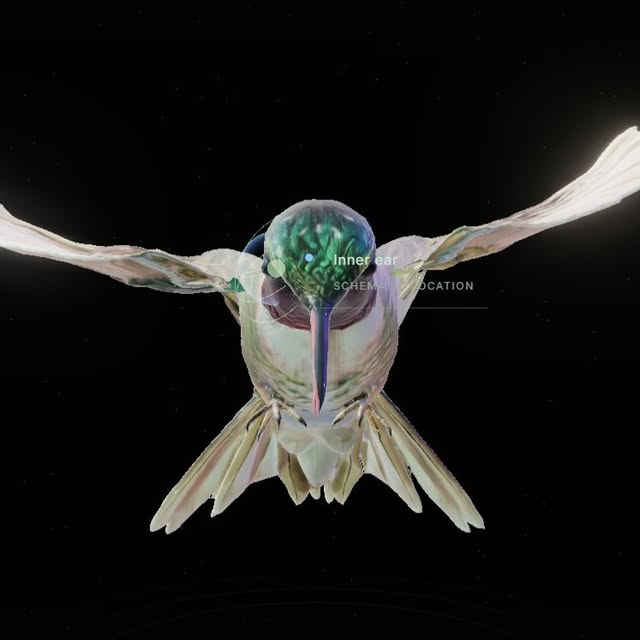
▶ See the 3D hummingbird: current state & v2 progress
Work in progress · v2 coming
Watch the six core animations, see the rig and weight paint, and download the clean Blender file.
Open the hummingbird project page →Animal reference · Birds · Updated October 2026
A hummingbird weighs less than a coin and beats its wings faster than a camera can see. It hovers, flies backwards and lands on twigs thinner than a pencil lead. This hummingbird reference for animators puts the whole family in one place. It covers the nine DNA clades, the species worth animating, and the skull, bill, tongue and feet you have to rig. It also covers males, females, nests and chicks, and the newest flight science. To finish, we show step by step how we rigged and animated a scanned ruby-throated hummingbird in Blender.
- ~363species
- 9DNA clades
- 1.95–20 gsmallest to largest
- 58 bones6 clips in our rig

Quick answer: what do animators need to know about hummingbirds?
Hummingbirds (family Trochilidae) are about 363 species of nectar-feeding birds found only in the Americas. DNA sorts them into nine clades, from the drab, curved-billed hermits to the tiny, glittering bees. For animation, four facts matter most. First, the wing is mostly hand and turns upside down on every upstroke. Second, the wingbeat is far faster than any frame rate, so you must slow it down or blur it. Third, the bill is rigid but bends at set zones, and the tongue is a forked, stretching pump. Finally, the feet only grip: hummingbirds perch, but they almost never walk.
Hummingbirds at a glance
Start every shot with scale and timing. The numbers in this hummingbird reference come from measurements, mostly of the ruby-throated hummingbird, because our model is based on that species. For the hover itself, see our companion article, Hummingbird Flight: Anatomy of the Hover.
| Trait | Value | Why it matters in a shot | Source |
|---|---|---|---|
| Species in the family | ~363 | Hundreds of looks share one body plan: build one good rig and re-skin it. | Williamson 2024 |
| Ruby-throated length | 7.5–9 cm | Set scene scale first. Our model is about 10× life size. | ADW |
| Ruby-throated mass | 3.4–3.8 g | Almost no inertia: stops and turns take only a few frames. | ADW |
| Hover wingbeat | ~53 Hz (ruby-throated) | At 24 fps that is more than 2 beats per frame: blur it or slow it down. | ADW |
| Weight support in hover | 75 % down / 25 % up | Give the downstroke more drive than the upstroke. | Warrick 2005 |
| Courtship dive (Anna’s) | 27.3 m/s, 385 body lengths/s | The fastest body-length speed of any vertebrate: smear frames are fine. | Clark 2009 |
| Tongue tips | Open in nectar, close on exit | The forked tips splay underwater and zip shut as the tongue retracts. | Rico-Guevara 2011 |
| Clutch / incubation | 2 eggs / 12–14 days | Nest scenes have two chicks, never a big brood. | Cornell Lab |
| Deepest torpor | 3.26 °C body temperature | At night some Andean species go cold and stiff on the perch. | Wolf 2020 |
The hummingbird family tree: 9 DNA clades
Old field guides grouped hummingbirds by looks. DNA did it better. In 2014 McGuire and colleagues built a dated tree for 284 species. It shows that hummingbirds reached South America by about 22 million years ago and then split into nine principal clades (McGuire et al. 2014). Each clade is a “cluster” of close relatives. As a result, members of a clade share a body plan, a habitat and often a way of moving. So pick your reference from the right clade, not just from the right colour.
Click a clade in the tree, or use the tabs below. Each panel lists what the clade looks like, where it lives, its bill and one animation note.
Clade explorer

Topazes Topazini
- Examples
- Crimson topaz, white-necked jacobin (4 species)
- Where
- Lowland Amazon and Central America
- Look
- Large and long-tailed; the crimson topaz has two crossed tail streamers. Jacobins are blue, white and green.
- Bill
- Medium, straight
- In the tree
- Sister to the hermits; together they form the oldest split in the family.
Animation note. Big bodies and long tails mean slower, heavier turns. Let the tail streamers lag a few frames behind body rotations.


Hermits Phaethornithinae
- Examples
- Long-billed and green hermits, sicklebills
- Where
- Tropical forest understory
- Look
- Dull brown and green, with long white tail tips. Males and females look alike.
- Bill
- Long and curved; males of some species have dagger tips for fighting (Garzon-Agudelo et al. 2025)
- In the tree
- Sister to the topazes.
Animation note. They trapline: they fly the same route between scattered flowers. Hermit flight in forest shade is low and direct, and the tail bobs.

Mangoes Polytminae
- Examples
- Violetears, mangos, carib
- Where
- Open country and forest edge, Mexico to Argentina
- Look
- Big, heavy, often violet or dark green. Violetears flare their ear patches when they sing.
- Bill
- Medium; slightly curved in mangos
- In the tree
- Branches after topazes and hermits.
Animation note. Aggressive and loud. Good for territorial chases: big wing amplitude and fanned tails.


Brilliants Heliantheini
- Examples
- Incas, coronets, sword-billed hummingbird
- Where
- Andes, mostly 1,500-3,500 m
- Look
- Large, long-winged, often dark with bright patches. Many cling to flowers while they feed.
- Bill
- Long and straight, up to 8-12 cm in the sword-billed
- In the tree
- Sister to the coquettes; together they dominate the Andes.
Animation note. A long bill shifts the centre of mass forward. The sword-billed rests with its bill pointing up to stay balanced.

Coquettes Lesbiini
- Examples
- Coquettes, sylphs, spatuletails, racket-tails, hillstars, metaltails
- Where
- Andes and lowland South America
- Look
- The most ornamented clade: crests, racket tails, leg puffs, very long tails.
- Bill
- Short to medium
- In the tree
- Sister to the brilliants.
Animation note. Ornaments are secondary motion. Racket tails and sylph tails need their own spring chains; crests flip up in display.


Giant hummingbird Patagonini
- Examples
- Southern and northern giant hummingbirds (Patagona gigas, P. peruviana)
- Where
- Andes, Chile to Ecuador
- Look
- Dull brown and cinnamon, about 20 g, with long wings.
- Bill
- Long and straight
- In the tree
- A clade of its own (two species since 2024).
Animation note. Slow, deep wingbeats with short glides, almost swift-like. Do not reuse a small-species hover cycle on it.

Mountain gems Lampornithini
- Examples
- Mountain-gems, Rivoli’s hummingbird, starthroats
- Where
- Mountains of Mexico and Central America
- Look
- Large; males have coloured throats and white face lines.
- Bill
- Long and straight
- In the tree
- Sister to the bees.
Animation note. Heavier and slower than bees. Good reference for a big North American hover.


Bees Mellisugini
- Examples
- Ruby-throated, Anna’s, rufous, Costa’s, calliope, bee hummingbird
- Where
- North America, the Caribbean and the Andes
- Look
- Small, with big iridescent gorgets in males. Includes the smallest bird alive.
- Bill
- Short to medium, straight
- In the tree
- Sister to the mountain gems.
Animation note. Courtship dives and shuttle displays. Males chirp with their tail feathers at the bottom of the dive (Clark & Feo 2008).


Emeralds Trochilini
- Examples
- Amazilias, sapphires, emeralds, broad-billed hummingbird
- Where
- All of the Neotropics; the largest clade
- Look
- Mostly green, often with red bills, blue throats or rufous tails.
- Bill
- Short to medium; often red with a black tip
- In the tree
- The largest and youngest clade, still diversifying.
Animation note. The ‘default’ tropical hummingbird. Quick, darting feeding visits with frequent short hovers.

Top hummingbird species for animators
These are the species you will be asked to animate most often, plus a few extremes that make great reference. In addition, the table shows which clade each one belongs to. That way, you can borrow motion from its closest relatives.
| Species | Clade | Signature trait | Animation cue |
|---|---|---|---|
| Ruby-throated (Archilochus colubris) | Bees | Only breeding hummingbird in eastern North America; crosses the Gulf of Mexico | Our model. Short, fast, straight-line flights. |
| Anna’s (Calypte anna) | Bees | 27.3 m/s courtship dive; tail chirp | J-shaped dive, wings tucked, gorget flashed at the bottom. |
| Rufous (Selasphorus rufus) | Bees | Very aggressive at feeders | Chases, tail fanning, wing buzz. |
| Bee hummingbird (Mellisuga helenae) | Bees | Smallest bird: males 1.95 g, 5.5 cm | Insect-like timing; easy to mistake for a bee in a wide shot. |
| Giant hummingbird (Patagona gigas) | Patagona | Largest: about 20 g | Slow, deep wingbeats and glides. |
| Sword-billed (Ensifera ensifera) | Brilliants | Bill 8–12 cm, longer than the body | Perches with the bill pointed up; grooms with its feet. |
| Long-billed hermit (Phaethornis longirostris) | Hermits | Lekking males with dagger bill tips | Tail wagging in the lek, bill-stabbing fights. |
| White-necked jacobin (Florisuga mellivora) | Topazes | Many females look like males | White tail fanned like a parachute in display. |
| Marvelous spatuletail (Loddigesia mirabilis) | Coquettes | Two racket-tipped tail shafts | Rackets swung independently in display. |
| Black metaltail (Metallura phoebe) | Coquettes | Coldest bird torpor on record: 3.26 °C | A night pose: fluffed, still, bill up. |
| Rivoli’s (Eugenes fulgens) | Mountain gems | Large, dark, long-billed | Heavier hover, slower turns. |
| Rufous-tailed (Amazilia tzacatl) | Emeralds | Red bill, rufous tail | Quick feeding visits, frequent short hovers. |
Sizes: ADW (bee hummingbird), Fernandez et al. 2011 (giant), Wikipedia, citing Birds of the World (sword-billed). Behaviour: Clark 2009, Garzon-Agudelo et al. 2025, Falk et al. 2021, Wolf et al. 2020.


Size and scale
Hummingbirds span a tenfold range in mass. For example, the bee hummingbird is the smallest bird alive. In contrast, the giant hummingbird weighs about as much as a house sparrow, yet it is still a hummingbird in every bone. Because mass changes timing, a giant hummingbird should never move like a bee.


Hummingbird anatomy for riggers
Under the feathers, a hummingbird is a small set of extreme parts. First, the keel is huge because it anchors the flight muscles. Second, the arm bones are short while the hand is long. Finally, the tongue is longer than the bill, and the feet are tiny. Here is what each part does and what it means for your rig.

| Part | What it does | Rig implication |
|---|---|---|
| Wing (hand-wing) | Short humerus, long hand; the wing turns upside down on the upstroke and stays almost rigid | Drive the stroke from the shoulder; roll the humerus 50°+; treat the primaries as one stiff fan |
| Flight muscles | The pectoralis and supracoracoideus fill a deep keel; muscle size, not wing speed, best predicts top speed | Big chest volume; breathing shows in the chest, not the belly |
| Skull and bill | A light skull; the bill is keratin over bone, with flexible zones in the upper and lower bill | Separate bill, bill-tip, jaw and jaw-tip bones; bending needs weights that fade along the bill |
| Tongue | Two grooved tubes with fringed tips; pumps and traps nectar up to about 20 times a second | A stretchy chain plus two fork bones; keep it inside the bill when closed |
| Eyes | Large; four colour cones, including ultraviolet | Eye darts and head saccades matter more than eyelids |
| Feet | Tiny, anisodactyl (3 toes forward, 1 back), for perching only | Two bones per toe and a grip pose; legs tuck in flight |
| Gorget and crown | Structural colour from stacked melanosomes; flashes only at certain angles | Use a view-angle-dependent shader, not a flat red |
| Tail (10 feathers) | Steering, braking and, in some species, courtship sound | A fan rig with spread and twist, plus outer-feather bones |
Sources: Warrick et al. 2005, Tobalske et al. 2007, Najar et al. 2026, Rico-Guevara et al. 2024, Rico-Guevara & Rubega 2011, Stoddard et al. 2020, Giraldo et al. 2021, Clark & Feo 2008.
Wings: a hand that sweeps a figure-eight
The humerus is short and hidden in body feathers. As a result, most of the wing you see is hand and primaries. During the hover, the shoulder swivels so the wing turns upside down on the upstroke. That upstroke still lifts, but only about a quarter of the weight (Warrick et al. 2005). The wing is also nearly rigid: the wingtip span stays at about 93 % through the stroke. In other words, you need no elbow fold during flight.


Skull, bill and tongue
The bill looks like one rigid needle, but it is not. For instance, during licking, the distal part of the upper bill bends upward while the lower bill stays still (Rico-Guevara et al. 2024). The tip and the base open out of phase (Rico-Guevara et al. 2023). When catching insects, the lower bill can flex 15–20° along its outer half (Yanega & Rubega 2004). Meanwhile, the tongue inside is not a straw. Its forked, fringed tips open in the nectar and trap it as they close (Rico-Guevara & Rubega 2011).


Feet: grip, not walk
Hummingbirds belong to the order Apodiformes, “the footless ones”. Their feet are real, but tiny. They perch, scratch and shuffle sideways along a twig. However, to move even a few centimetres, they fly. So a walk cycle is wrong for a hummingbird; instead, you need a grip pose and a toe release.

Bill variations
Bill shape follows flowers and fights. For example, long, curved hermit bills match curved Heliconia flowers, while straight bills reach into tubes. In some lekking hermits, males evolved sharper, straighter bill tips for stabbing rivals (Garzon-Agudelo et al. 2025). Bills can even change within a century. For instance, Anna’s hummingbirds that use backyard feeders now have longer, more tapered bills (Alexandre et al. 2025).


| Bill type | Example | Feeding / use | Rig note |
|---|---|---|---|
| Extremely long, straight | Sword-billed | Long-tubed Passiflora and Datura flowers | Counterbalance the head; 3+ bill bones for flex |
| Strongly curved | White-tipped sicklebill | Curved Heliconia; perches to feed | Bend the bill bones along the curve, not straight |
| Long, decurved | Hermits | Traplining forest flowers; males stab rivals | Sharp tip pose for fights |
| Medium, straight | Ruby-throated, Anna’s | Generalist flowers, feeders, insects | bill + bill_tip + jaw + jaw_tip (our rig) |
| Short, broad-based, red | Broad-billed, many emeralds | Short flowers, gnats in the air | Wide gape for flycatching |
Males, females, nests and chicks
In most species, males carry the gorget and the colour, while females are plainer, with white-tipped tails. Yet there are surprises. In the white-necked jacobin, every juvenile looks like an adult male, and nearly 30 % of adult females keep that look. The reason is social, because male-like females are harassed less at flowers (Falk et al. 2021). So plumage alone does not tell you the sex.


Males play no part in nesting. Instead, the female builds, incubates and feeds alone. The tabs below follow her from an empty nest to a fledgling.
From nest to fledgling (ruby-throated hummingbird)

Nest
The female builds alone. The cup is about 5 cm (2 in) across, made of plant down, bound with spider silk and covered with lichen. The silk lets it stretch as the chicks grow.
Source: Cornell Lab

Eggs
Usually 2 white eggs (1-3), each only 1.2-1.4 cm long. Incubation takes 12-14 days.
Source: Cornell Lab

Chicks
Chicks hatch blind and almost naked, with a short, soft bill. At first they are blobs that only open their mouths; within three weeks they are feathered and fill the nest.
Source: Cornell Lab

Feeding
The mother hovers or perches on the rim and pushes her bill deep into each chick’s throat. Animate it as a fast pumping motion of her head.
Source: ADW
Fledging
Young leave the nest 18-22 days after hatching. They look like females, so a juvenile male in a scene has a plain or streaked throat.
Source: ADW


DNA facts that explain behaviour
Genome studies now explain why hummingbirds act the way they do. So these six findings are worth knowing before you write an action beat, because each one changes how the character should move or rest.
Taste genes
Sweet taste from an umami receptor
Birds lost the usual sweet receptor. In hummingbirds, the old savoury (umami) receptor changed so that it now detects sugar. That shift explains a life spent flower to flower.
Baldwin et al. 2014, ScienceMuscle genes
A lost enzyme powers the hover
The ancestor of all hummingbirds lost the muscle enzyme FBP2 around the time hovering evolved. The loss boosts sugar burning and mitochondria in flight muscle. It fits a life of almost non-stop feeding.
Osipova et al. 2023, ScienceBlood genes
Hemoglobin tuned for the Andes
Andean hummingbirds changed hemoglobin oxygen affinity again and again as lineages moved up and down the mountains. That is how brilliants and coquettes can hover in thin air at 4,000 m.
Projecto-Garcia et al. 2013, PNASPopulation genomics
The giant is two species
Tracking and genomes split the giant hummingbird in two. The southern species flies an 8,300 km loop and climbs to about 4,100 m on the way. The northern species stays in the high Andes all year. Their songs also differ.
Williamson et al. 2024, PNASTree of life
Nine clades, still splitting
The dated tree shows nine principal clades and species still forming quickly, helped by the rise of the Andes. Close relatives share body plans, so you can borrow motion within a clade.
McGuire et al. 2014, Current BiologyInherited physiology
Torpor depth runs in families
In six Andean species, the coldest night-time body temperature showed a phylogenetic signal. Related species chill to similar depths, and one black metaltail reached 3.26 °C.
Wolf et al. 2020, Biology LettersHow hummingbirds move
Hummingbirds have five motion modes worth animating: hover, forward flight, take-off and landing, display dives, and stillness. Better still, each one has measured numbers.
Hover and forward flight
In a hover, the wingtip traces a flat figure-eight and the body hangs at an angle. In forward flight, rufous hummingbirds keep the same wingbeat frequency from 0 to 12 m/s. Instead, they change body angle and stroke-plane angle (Tobalske et al. 2007). So never speed up the flap to show speed; tilt the body and the stroke instead.
Wingbeat slow-motion calculator
Presets:
Frames per wingbeat at real speed
0.45 frames
Presets: ruby-throated from ADW; Anna’s from Wolf, Ortega-Jimenez & Dudley 2013.
Take-off, landing and tight gaps
Unlike most birds, hummingbirds flap during the leg push. In a calm take-off, the legs give about 59 % of the take-off speed, much less than in other birds (Tobalske et al. 2004). Landings run in three phases: approach, descent and docking (SICB abstract). To get through gaps narrower than their wingspan, wild ruby-throated hummingbirds use two styles. One is a fast, swept-wing ballistic dive with flapping paused. The other is slower, sideways flight with short, quick wingbeats (Zhang, Konow & Biewener 2025).
Displays and sound
A male Anna’s hummingbird dives at 27.3 m/s, then pulls out at nearly nine times gravity (Clark 2009). At the bottom, air flutters his outer tail feathers and makes a loud chirp (Clark & Feo 2008). In other words, the tail spread is a sound cue as well as a pose.
Stillness: torpor
At night, hummingbirds can also drop into torpor: a cold, slowed state that saves energy. Rufous and calliope hummingbirds use it when their evening fat falls below a threshold (Halter et al. 2025). A bird in torpor is fluffed, motionless and slow to react, which makes a great “is it dead?” story beat.


Latest hummingbird locomotion science (2025–2026)
Here is what changed recently, with what each finding means for animation. Preprints are marked; they have not yet been peer reviewed.
- Preprint
Hummingbirds pause mid-hover
In slow-motion video of 86 species from all nine clades, 45 species briefly stopped flapping while hovering. They held the wings fully extended at the end of the upstroke. Pauses were more common in bigger, longer-winged species. Hurme et al. 2026, bioRxiv
For animators: a held wing pose for a frame or two inside a hover cycle is real, not a mistake.
- Biology Open
Computer vision finds the pauses
An automated method spots these flap pauses in high-speed field video of 11 species, with 74 % precision. Bastidas-Rodriguez et al. 2026
For animators: the same tracking approach works on your own reference footage.
- J. Exp. Biol.
Muscle, not wing speed, sets top speed
Across four species, flight-muscle size predicted maximum forward speed and burst capacity better than wingtip velocity. The two measures were not correlated. Najar, Wilcox, Fernandez & Clark 2026
For animators: a faster character needs a deeper chest, not a faster flap.
- Integr. Comp. Biol.
Hummingbird and hawkmoth wings converge
Hummingbirds and hummingbird hawkmoths evolved similar wing outlines for the same job: hovering at flowers. Walters et al. 2026
For animators: hawkmoth footage is useful hover reference. See our monarch butterfly reference for insect wings.
- Anat. Rec.
Flight muscle changes with altitude
Pectoralis microanatomy differed among hummingbirds sampled across about 1,500 m of Colombian Andes. Rios-Orjuela et al. 2026
For animators: high-altitude species are built differently; do not copy a lowland hover for a hillstar.
- J. Exp. Biol.
Two ways through a tight gap
Wild ruby-throated hummingbirds crossed a chain-link fence with holes smaller than their wingspan, either swept-wing and ballistic or sideways with quick, small strokes. Zhang, Konow & Biewener 2025
For animators: pick one style per shot; the swept-wing pass is faster.
- J. Exp. Biol.
Bills built for stabbing
Finite-element models show that male green hermits’ straighter, dagger-tipped bills stab more efficiently and break less. Garzon-Agudelo et al. 2025
For animators: lek fights are real combat; give males a sharper bill tip.
- Global Change Biol.
Feeders reshaped Anna’s bills
Museum specimens show that bills became longer and more tapered where feeders spread. Alexandre et al. 2025
For animators: modern urban birds can look slightly different from century-old plates.
- Proc. R. Soc. B
A simple rule for torpor
Migrating calliope and rufous hummingbirds enter torpor when evening fat drops below a threshold, and time it to keep a minimum reserve for the morning. Halter, Wolf & Martinez del Rio 2025
For animators: a hungry bird at dusk is the one that goes still overnight.

Ancestors and relatives: swifts, treeswifts and fossils
Hummingbirds’ closest living relatives are the swifts and treeswifts. Together they form the order Apodiformes. They share the short humerus, long hand and tiny feet. However, swifts used that kit to glide, while hummingbirds used it to hover.
Fossils also show the steps. Eocypselus rowei, from the Early Eocene Green River Formation of Wyoming, had wings in between a hummingbird’s and a swift’s, and longer toes for perching (Ksepka et al. 2013). Later, tiny skeletons of Eurotrochilus from the early Oligocene of Germany already looked modern, with specializations for nectar feeding and hovering. They show that hummingbirds once lived in the Old World too (Mayr 2004).


Our hummingbird rig, step by step
We started from a photogrammetry scan of a ruby-throated hummingbird. Then we retopologised it to a light mesh, rigged and animated it in Blender, and exported to Sketchfab (GLB) and Unity (FBX). For the full concept-to-game workflow, read our 3D production pipeline guide.
- 1,952,386scan triangles
- 17,328faces after retopology
- 99.7 %quads
- 61mesh shells
- 58bones
- 0tears in all 6 clips
- 10.9 MBGLB


The seven plates below cover the hard parts: the bones, the weights, the bill, the mouth, the tongue and the toes. Swipe, use the arrows or click an image to open it full size.


How the rig is organised
- Root, hips, spine, chest4
- Neck, head, bill, bill_tip, jaw, jaw_tip + 7 tongue bones (root, 4-bone chain, 2 fork tips)13
- Wings: humerus, ulna, hand, prim1, prim2, shoulder fold, covert (x2)14
- Tail: tail_base, tail_mid, tail_tip, rect.L/R5
- Legs: leg, foot and 4 two-bone toes (x2)20
- Props: prop_perch, prop_flower (scale-keyed)2
- Total (56 bird + 2 prop), max 4 influences per vertex58
We weighted the skin with anchored diffusion instead of automatic bone heat, because that gives smooth falloffs around the mouth and tongue. The scan’s 61 shells meet edge to edge in 5,948 places. Therefore every one of those seams had to share identical weights; otherwise the mesh opens like a zipper in motion. As a result, the original rig tore in up to 92 places, while ours tears in none. Read how this compares with an automatic setup in Blender Rigify for animals, and how to choose software in Blender vs Maya for creature animation.
The 6 core hummingbird animations
This is where the hummingbird reference becomes production work. Each clip plays when it scrolls into view. Below every video you will find its numbers, a timeline of its phases (the white line follows the video), the bones it drives and the logic behind it. All six clips chain together: takeoff ends on the hover’s first frame, and landing ends on the perch’s first frame. To drive them in a game, see our Unity Animator Controller tutorial.
01 Hover Idle Loop
The signature hummingbird pose: body tilted up, wings sweeping a flat figure-eight, tail working as a rudder.
- 120frames @ 60 fps
- 2 sseamless loop
- 10 fper wingbeat
- 124°stroke sweep
Animation logic
- 12 wingbeats in 120 frames: 1 beat = 10 frames (6 Hz on screen, about 1/7 of a 45 Hz hover).
- Shoulder sweep ±62° (124°), inside the 113-154° measured in Anna’s hummingbirds.
- The humerus rolls 52° along its long axis so the wing turns upside down on the upstroke.
- The downstroke is slightly slower: it carries about 75 % of the weight (Warrick et al. 2005).
- The head stays still in space while the body bobs; toes tucked at 25-30°.
Bones and controls
rootchestneckheadhumerus.L/Rulnahandprim1prim2covert.L/Rtail_base-tail_tiprect.L/Rtoes (tucked)Reference frames

Science: Warrick, Tobalske & Powers 2005
02 Forward Flight Loop
Cruising flight: the same wingbeat rate as the hover, but the body levels out and the stroke tilts.
- 120frames @ 60 fps
- 2 sseamless loop
- 10 fper wingbeat
- -22°body pitch vs hover
Animation logic
- Wingbeat frequency stays the same as in the hover: rufous hummingbirds keep it constant from 0 to 12 m/s (Tobalske et al. 2007).
- The body pitches down: chest 11.9° above horizontal instead of 33.9° in the hover.
- Smaller sweep (±55°) and less wing roll (30°): the wing flips less at speed.
- Tail closed and trailing, feet tucked under the belly.
Bones and controls
rootchesthumerusulnahandprim1prim2 (x2)tail chainlegs + toes tuckedReference frames

Science: Tobalske et al. 2007
03 Perched Idle Loop
Wings folded along the flanks, toes locked on the twig, quick head turns and breathing.
- 240frames @ 60 fps
- 4 sseamless loop
- 16toe bones
- 0verts in the twig
Animation logic
- Wings are laid on a path along the flank, outside the outermost feather layer, so they never sink into the body.
- Head turns are fast saccades with holds in between: birds move their heads like we move our eyes.
- The palms are planted on the twig and each toe is locked in world space, so breathing never slides the feet.
- Twig radius 0.035 units (about 3 mm in life); toe curls were solved on the mesh, so no vertex is inside the bark.
Bones and controls
chest (breath)neckheadwing fold chain (5 bones x2)legfoottoe1-4 .01/.02 (x2)prop_perchReference frames

04 Takeoff
From the twig to the hover: a crouch, a leg push with the wings already beating, then a climb.
- 90frames @ 60 fps
- 1.5 sperch to hover
- 59 %speed from legs
- f30feet leave
Animation logic
- Wings unfold from f4 and start beating at f8, before the feet leave: hummingbirds flap while they push (Tobalske et al. 2004).
- Legs extend f12-28; in a calm takeoff they give about 59 % of the takeoff speed.
- Toes stay locked through the crouch, open as the legs push (f16-26), then tuck (f30-60).
- The last frame matches Hover f0 exactly, so it chains straight into the loop.
Bones and controls
roothipslegfoottoes (grip → open → tuck)full wing chaintail chainReference frames

Science: Tobalske, Altshuler & Powers 2004
05 Landing
Approach, descent and docking, the three phases measured in Anna’s hummingbirds, ending on the perched pose.
- 150frames @ 60 fps
- 2.5 shover to perch
- f92touchdown
- 3landing phases
Animation logic
- The palms, not the body, fly the path: the feet come down on top of the twig and the body never crosses it.
- Legs reach forward from f40; toes go from tucked to open and straight over f40-70.
- Sole on the twig at f92, toes close f92-103, wingbeat stops at f104.
- From contact on, the toes are locked to the twig, so the tarsus rotates around them while the legs give.
- Wings fold f96-128; the tail sweeps back and spreads for balance.
Bones and controls
root (path driven by the palms)legfoottoeswing chain + foldtail spreadReference frames

06 Flower Feeding
Hovering at a trumpet flower: three licks with the bill inside, then a withdraw, an open V gape and two tongue flicks.
- 180frames @ 60 fps
- 3licks
- 12°+4°V gape
- 2tongue flicks
Animation logic
- One lick every 30 frames (real licks run at about 15 Hz; same slow-motion factor as the wings).
- The upper-bill tip lifts up to 6° to let the tongue out; the base opens 1.2° slightly later, out of phase (Rico-Guevara et al. 2023).
- The tongue reaches 0.20 units; its forked tips splay 9° at full reach and close before it retracts.
- Outside the flower the bill opens in a straight V: 12° at the jaw plus a 4° upper-bill lift.
- The mouth-corner skin stretches across the gape instead of tearing.
Bones and controls
billbill_tipjawtongue_roottongue.01-04tongue_fork.L/Rheadneck + the hover wing cycleprop_flowerReference frames

Science: Rico-Guevara & Rubega 2011
Animator checklist
Do
- Pick reference from the right clade.
- Slow the wingbeat to 8–10 frames per beat, or blur it.
- Keep the wingbeat rate constant; tilt the body for speed.
- Hold the head still while the body moves.
- Flip the wing on the upstroke (humerus roll).
- Grip twigs with the toes; tuck the feet in flight.
- Shade the gorget by view angle.
Don’t
- Animate a walk cycle.
- Bend the wing at the elbow mid-stroke.
- Speed up the flap to show speed.
- Open the bill like a hinge for every lick.
- Push the tongue through a closed bill.
- Give a giant hummingbird a bee’s timing.
- Assume a male-looking bird is a male.
Hummingbird reference FAQ
What is the best hummingbird reference for animators?
Use measured sources: high-speed flight studies for timing, museum skeletons for proportions, and photos from the right DNA clade for looks. This page collects all three, plus a rigged ruby-throated hummingbird with six animation clips.
How many hummingbird species are there?
About 363 species, all in the Americas. DNA groups them into nine clades: topazes, hermits, mangoes, brilliants, coquettes, the giant hummingbird, mountain gems, bees and emeralds.
What is the smallest and the largest hummingbird?
The bee hummingbird of Cuba is the smallest bird alive; males weigh about 1.95 g. The giant hummingbird of the Andes is the largest, at about 20 g.
How fast does a hummingbird flap its wings?
A ruby-throated hummingbird beats its wings about 53 times a second when hovering, and Anna's hummingbirds about 38 to 46. Big species such as the giant hummingbird beat much more slowly.
How do I animate hummingbird wings at 24 or 30 fps?
Real wingbeats are faster than the frame rate. Either slow the action so each beat gets 8 to 10 frames, or draw the wing as a motion-blur arc. Our clips use 10 frames per beat at 60 fps.
Can hummingbirds walk?
Hardly. Their feet are tiny and made for gripping. They perch, scratch and shuffle sideways on a twig, but they fly to move even short distances.
How does a hummingbird tongue work?
The tongue is forked and fringed. The tips open inside the nectar and close as the tongue is pulled back, trapping liquid. The grooves also act as an elastic pump.
Where can I use the hummingbird animations in this article?
The six clips were built for a Sketchfab model and a Unity package by animalanimator.com. Contact animalanimator.com for licensing and downloads.
Quick quiz
1. How much of the hover’s weight support comes from the downstroke?
75 % down, 25 % up (Warrick et al. 2005).
2. How should a hummingbird fly faster in your shot?
Wingbeat frequency stays constant across speeds (Tobalske et al. 2007).
3. What do the tongue tips do in nectar?
A fluid trap, not a capillary tube (Rico-Guevara & Rubega 2011).
4. How many principal DNA clades do hummingbirds form?
Nine (McGuire et al. 2014).
Sources
Every number above links to its source. Papers were checked against Europe PMC in October 2026. Photos are from Wikimedia Commons and are credited under each image; renders and videos are © animalanimator.com.
- McGuire JA et al. 2014. Molecular phylogenetics and the diversification of hummingbirds. Current Biology 24: 910-916. doi
- Williamson JL et al. 2024. Extreme elevational migration spurred cryptic speciation in giant hummingbirds. PNAS 121: e2313599121. doi
- Robinson BW et al. 2025. Songs distinguish the cryptic giant hummingbird species and clarify range limits. bioRxiv (preprint). doi
- Warrick DR, Tobalske BW, Powers DR 2005. Aerodynamics of the hovering hummingbird. Nature 435: 1094-1097. doi
- Tobalske BW et al. 2007. Three-dimensional kinematics of hummingbird flight. J. Exp. Biol. 210: 2368-2382. doi
- Tobalske BW, Altshuler DL, Powers DR 2004. Take-off mechanics in hummingbirds. J. Exp. Biol. 207: 1345-1352. link
- Clark CJ 2009. Courtship dives of Anna's hummingbird offer insights into flight performance limits. Proc. R. Soc. B 276: 3047-3052. doi
- Clark CJ, Feo TJ 2008. The Anna's hummingbird chirps with its tail. Proc. R. Soc. B 275: 955-962. doi
- Rico-Guevara A, Rubega MA 2011. The hummingbird tongue is a fluid trap, not a capillary tube. PNAS 108: 9356-9360. doi
- Rico-Guevara A, Hurme KJ, Rubega MA, Cuban D 2023. Nectar feeding beyond the tongue: hummingbirds drink using phase-shifted bill opening, flexible tongue flaps and wringing at the tips. J. Exp. Biol. 226: jeb245074. link
- Rico-Guevara A et al. 2024. Upper bill bending as an adaptation for nectar feeding in hummingbirds. J. R. Soc. Interface 21: 20240286. link
- Yanega GM, Rubega MA 2004. Hummingbird jaw bends to aid insect capture. Nature 428: 615. link
- Baldwin MW et al. 2014. Evolution of sweet taste perception in hummingbirds by transformation of the ancestral umami receptor. Science 345: 929-933. doi
- Osipova E et al. 2023. Loss of a gluconeogenic muscle enzyme contributed to adaptive metabolic traits in hummingbirds. Science 379: 185-190. doi
- Projecto-Garcia J et al. 2013. Repeated elevational transitions in hemoglobin function during the evolution of Andean hummingbirds. PNAS 110: 20669-20674. doi
- Wolf BO et al. 2020. Extreme and variable torpor among high-elevation Andean hummingbird species. Biology Letters 16: 20200428. doi
- Halter SR, Wolf BO, Martinez del Rio C 2025. The hummingbird's adipostat. Proc. R. Soc. B 292: 20242489. doi
- Falk JJ, Webster MS, Rubenstein DR 2021. Male-like ornamentation in female hummingbirds results from social harassment rather than sexual selection. Current Biology 31: 4381-4387. doi
- Stoddard MC et al. 2020. Wild hummingbirds discriminate nonspectral colors. PNAS 117: 15112-15122. doi
- Giraldo M, Sosa J, Stavenga D 2021. Feather iridescence of Coeligena hummingbirds. Biology Letters 17: 20210190. doi
- Fernandez MJ, Dudley R, Bozinovic F 2011. Comparative energetics of the giant hummingbird (Patagona gigas). Physiol. Biochem. Zool. 84: 333-340. doi
- Hurme K et al. 2026. Pauses in a fast-paced life: intermittent hovering in hummingbirds. bioRxiv (preprint). doi
- Bastidas-Rodriguez MX et al. 2026. Computer vision analysis to identify episodic flapping in hovering hummingbirds. Biology Open 15: bio061936. doi
- Najar NA, Wilcox SC, Fernandez LR, Clark CJ 2026. Effects of wingbeat kinematics and muscle size on maximum flight speed in hummingbirds. J. Exp. Biol. 229: jeb251012. doi
- Walters B et al. 2026. Hummingbird and hawkmoth wing shape: analyzing functional convergence in analogous structures. Integr. Comp. Biol. 66: icag088. doi
- Rios-Orjuela JC et al. 2026. Elevational variation in the microanatomy of hummingbird flight muscle. Anat. Rec. doi
- Zhang ZM, Konow N, Biewener AA 2025. Hummingbirds excel at maneuvering and flying through tight spaces. J. Exp. Biol. 228: jeb250269. doi
- Garzon-Agudelo F et al. 2025. Sexually dimorphic bill shape enhances male stabbing performance in the green hermit. J. Exp. Biol. 228: jeb250769. doi
- Alexandre NM et al. 2025. Supplemental feeding as a driver of population expansion and morphological change in Anna's hummingbirds. Global Change Biology 31: e70237. doi
- Ksepka DT et al. 2013. Fossil evidence of wing shape in a stem relative of swifts and hummingbirds. Proc. R. Soc. B 280: 20130580. doi
- Mayr G 2004. Old World fossil record of modern-type hummingbirds. Science 304: 861-864. doi
- Animal Diversity Web: Archilochus colubris, Calypte anna, Mellisuga helenae species accounts. link
- Cornell Lab of Ornithology, All About Birds: Ruby-throated Hummingbird life history. link
- SICB abstract: Landing performance of Anna's hummingbird in variable wind conditions. link