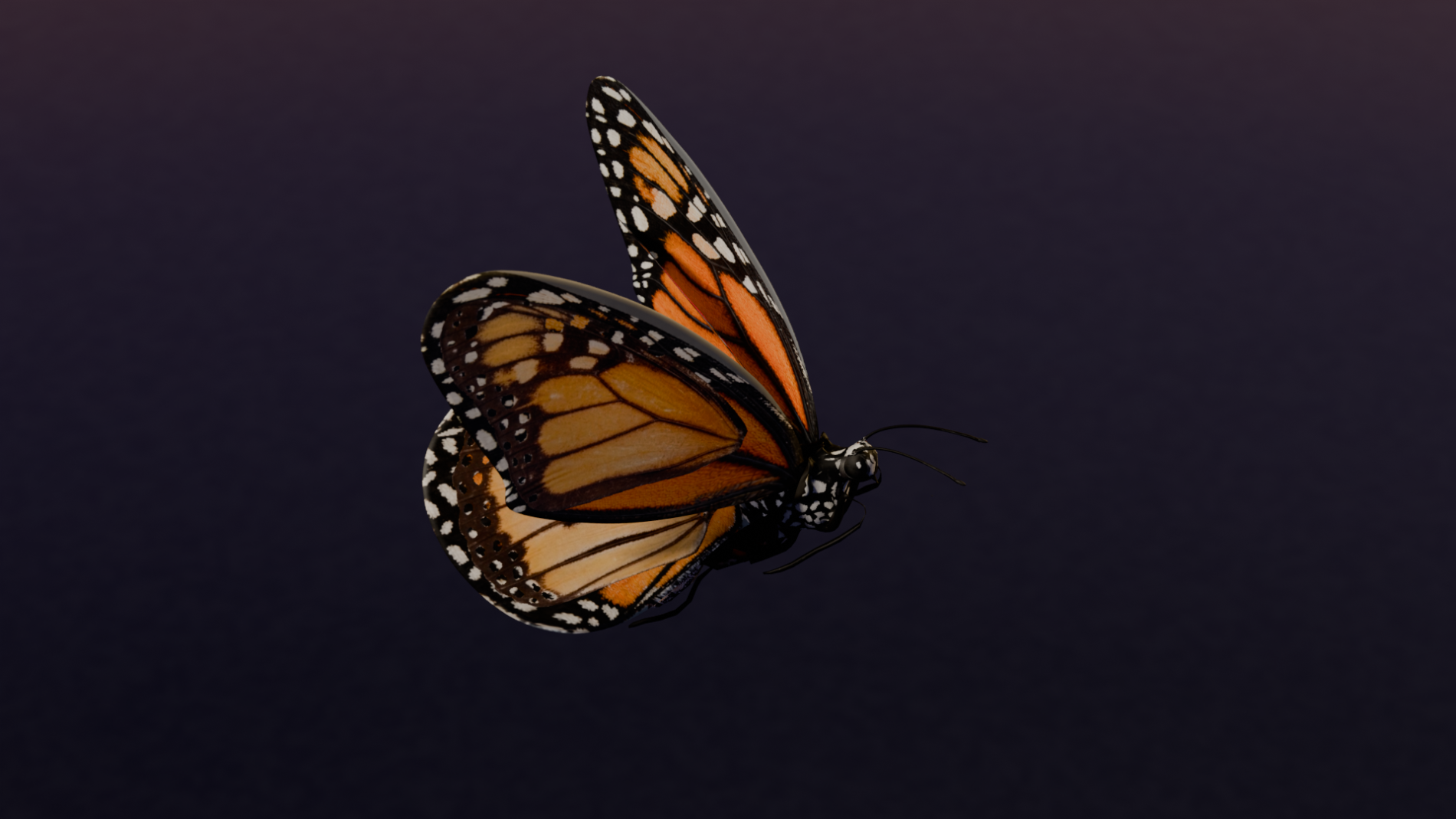
The Ultimate Monarch Butterfly References for 3D Animators
A free rigged monarch, a set of measured photo references, and the
wing kinematics behind every keyframe — each number traced back to a published paper.
No guessed poses.
Butterflies are the trap every creature animator falls into once. They look simple. Two
wings up, two wings down, a bit of float, done. Then you render it and the thing reads like
a paper napkin caught in a fan.
The reason is not your spline work. It is that a real butterfly wing is a stiff
spar with a compliant sheet hanging off it, it beats at a frequency most animators
guess wrong by a factor of two, and it does something during take-off that no standard
flight cycle contains. This page gives you the measurements, the anatomy, the behaviour, and
a rigged model you can open right now.
What you will find here
- The free rigged 3D model
- The animator’s spec sheet
- Anatomy that changes your rig
- Locomotion: the three gaits
- Senses, brain and behaviour
- Inside the 59-bone rig
- Weight painting, measured
- Animation recipes
- Colour, light and proportion
- What research found in 2026
- Why the reference matters
- The paper library
- FAQ
1. Start here: the free rigged monarch
Drag to turn the model, scroll to zoom in, and switch between the three
flight modes. The counter reads out the animal’s real milliseconds.
2. The animator’s spec sheet
Before the anatomy, the numbers you will actually type into a graph editor. Every value in
the right-hand column is sourced, and the sources are listed in full in
the paper library.
| Property | Value | Why an animator cares |
|---|---|---|
| Body length | ~35 mm | The scale anchor. Everything else derives from it. |
| Wingspan | 89–102 mm | Roughly three body lengths. Silhouette reads from this ratio. |
| Adult mass | ~0.5 g | Almost nothing. Air resistance dominates, gravity barely registers. |
| Cruise wingbeat | 10.0 Hz | At 24 fps that is 2.4 frames per full cycle. You will need a higher rate or motion blur. |
| Take-off wingbeat | 11.25 Hz | Faster than cruise, not slower. A common animation error runs it the other way. |
| Stroke amplitude | 115° | Huge compared with a bird. The wings nearly touch above the back. |
| Wing pitch sweep | 78° → 109° | Pronation and supination. Without it the wing is a flat board. |
| Hindwing lag | 4.5 % of cycle | The fore and hind pairs are not in lockstep. This offset is most of the “alive” read. |
| Body oscillation | 4.9 mm at 89° phase | The thorax bobs a quarter-cycle behind the wings. |
| Abdomen swing | ±16°, antiphase | It counter-rotates. Animate it in sympathy and the shot looks wrong. |
| Take-off climb | 225 mm in 533 ms | A real, timed launch you can match frame for frame. |
| Lift coefficient | 1.7 → 9.4 | Sea level versus 3,000 m. Thin air changes the whole flight envelope. |
3. Anatomy that changes your rig
Four anatomical facts have direct consequences for how you build the thing. The rest is
decoration.
It has four walking legs, not six
Monarchs are nymphalids, the brush-footed butterflies. In this family the front pair of
legs is reduced to a short brush and is not used for walking. It is held
folded against the thorax and is easy to miss entirely.
So when you rig a monarch, you build four functional legs and a vestigial pair. If you
build six walking legs you have animated a beetle wearing a butterfly costume. Reference
photos of a perched monarch make this obvious the moment you look for it.


de Toulouse. Put them side by side and the single most common butterfly texturing mistake
becomes visible — see the next section.
Photos: Didier Descouens, dorsal /
ventral,
CC BY-SA 4.0, via Wikimedia Commons.
The underside is not a copy of the top
This is the error that quietly ruins butterfly assets, and it is nearly always an
inherited one: the texture atlas holds a dorsal painting and the ventral half is a duplicate
of it. Nobody notices in the viewport, because the viewport shows the top.
Then the butterfly closes its wings, or banks, or lands — and suddenly the audience is
looking at a saturated orange underside that no monarch has ever had. On this asset the two
halves of the atlas differed by an average of only 0.011 on the forewing, which is the
numerical fingerprint of a copy. The ventral plate was reprojected; the dorsal was left
untouched.
One-minute check on your own asset
Open the wing atlas. Sample the same point on the dorsal and ventral halves. If the
values match to three decimals, you do not have a ventral texture — you have the
dorsal one twice.
Wing membranes are lit from behind
A butterfly wing is a single-layer sheet. Light passes through it. If you shade it as an
opaque surface, every wing that turns away from the key light goes dead black, which is why
so many butterfly renders look like cut vinyl.
The fix used here is deliberately cheap: a 16 % emission driven by the wing’s
own colour map. It approximates transillumination without a subsurface setup, and it
survives export to a GLB, which a real translucency shader will not. If you are working in
HDRP or Unreal, promote it to proper two-sided foliage shading — but the 16 % trick
is what makes the download look right out of the box.
Males carry a scent patch
Male monarchs have a black androconial spot on a vein of each hindwing,
and noticeably thinner black vein lines than females. It is a one-texture difference that
gives you two characters from one asset — worth doing if your shot has more than one
butterfly in frame.

the scent patch. Females lack it and carry heavier black veins.
Photo: Rhododendrites,
Wikimedia Commons,
CC BY-SA 4.0.
4. Locomotion: the three gaits
A monarch does not have one flight cycle. It has three distinct modes, and switching
between them on camera is most of what makes the animation convincing.
| Gait | Frequency | Duration | What is actually happening |
|---|---|---|---|
| Cruise | 10.0 Hz | 100 ms/cycle | Forward flight. Wings sweep 115° and twist through 31° of pitch. The body bobs; the abdomen counter-swings. |
| Glide / soar | 0 Hz | 1.5 s+ | Wings held flat and still, riding thermals. The migration gait, and the cheapest one to render. |
| Take-off | 11.25 Hz | 533 ms | Clap-and-fling. Climbs 225 mm. Faster and higher-amplitude than cruise. |
Clap-and-fling: the move most animators leave out
At the top of the upstroke the two wings slap together above the back,
rotating about their leading edges. That is the clap. Then they peel apart from the trailing
edge on the way down — the fling — and the opening gap sucks air in, generating
circulation before the wings have travelled anywhere.
It is not a stylistic flourish. It is a real, measured force-augmentation mechanism, and
butterflies use it most emphatically on the first few beats of every take-off.
Schlieren imaging work puts the speed gain at roughly 30 % following the clap event. Later
work showed the wings’ flexibility is what makes the clap efficient rather than merely
noisy — a rigid pair of wings clapping is a much worse pump.
Animation takeaway
Give your take-off two or three clap beats, then settle into cruise. The
contact at the top should be a real contact: wings touching, held for a frame, peeling from
the trailing edge. That single detail separates a butterfly launch from a generic flap.

the perch. Note that the launch is wing-driven, not a jump — the legs release, they do
not push.
Photo: Avenue,
Wikimedia Commons,
CC BY-SA 3.0.
The scales are aerodynamic, not just paint
Here is a result worth knowing before you decide the wing texture is “just a texture.”
Researchers filmed 11 butterflies across 236 climbing flights, then removed the wing scales
and filmed them again. Climbing efficiency dropped by 32.2 %. Flapping
amplitude fell about 7 %; frequency did not change.
The scales sit angled upward and form microscopic cavities that improve the boundary layer
over the wing. For an animator the practical consequence is modest but real: the wing surface
is not smooth, and at close range a flat specular response will read as
plastic. Break it up with anisotropic roughness along the scale direction.
Altitude changes everything
Monarchs migrate high — and their overwintering forests sit around 3,000 m in
central Mexico. When researchers flew monarchs inside a pressure chamber at reduced air
density, the lift coefficient they generated rose from 1.7 at sea level to 9.4 at
3,000 m. Thin air means less drag and greater range, and the butterfly
compensates with a far more aggressive lift regime.
If your shot is a mountain sequence, the flight should look different: longer
glides, bigger amplitude, less fluttering. That is not artistic licence. That is the data.
5. Senses, brain and behaviour
Believable creature animation is mostly about showing what the animal is paying attention
to. So here is what a monarch can actually perceive, and what each capability buys you on
screen.
| Sense | What the research shows | How to animate it |
|---|---|---|
| Compound eyes | Thousands of ommatidia per eye, giving near-360° coverage. Colour vision that extends into the ultraviolet, and monarchs can be trained to associate colours with reward. | It does not need to turn its head to see behind. Resist the mammal instinct to add a head-track for everything — a monarch’s alert cue is a body pivot, not a glance. |
| Polarised light | A specialised dorsal rim area at the top of the eye carries UV- and polarisation-sensitive receptors, far more polarisation-sensitive than the main retina. | It reads the sky, not the ground. On an overcast-to-clear cut, let the flight path straighten — it has just regained its compass. |
| Antennal clock | The circadian clock that time-compensates the sun compass sits in the antennae, not the brain (Merlin, Gegear & Reppert, Science, 2009). | Antennae are instruments, not decoration. Give them their own slow secondary motion and never parent them rigidly to the head. |
| Magnetic compass | A light-dependent inclination compass, active under UV-A/blue between 380 and 420 nm, with the magnetosensors again in the antennae (Guerra, Gegear & Reppert, Nature Communications, 2014). | Under cloud it keeps heading south. A migrating monarch is never lost, which means it should never look like it is searching. |
| Taste through the feet | Chemoreceptors on the tarsi detect dissolved sugar; contact triggers the proboscis to unroll. | The landing sequence is: touch down, then uncoil the proboscis. Getting that order right is a two-frame detail nobody consciously notices and everybody feels. |
The behaviour beat worth stealing
Land. Pause. Wings open and close once, slowly. Then the proboscis unrolls.
That sequence is anatomically correct and it buys you a full second of screen time in which
nothing happens and the audience stays completely engaged.

tarsi in contact with the flower head. Every element of this pose is triggered by a
different sense.
Photo: Thomas Bresson,
Wikimedia Commons,
CC BY 2.0.
The migration, in one paragraph
The autumn generation flies up to 4,000 km from as far north as Canada to a handful of
oyamel fir groves in Michoacán and the State of Mexico — a place none of them has
ever been. They navigate with a time-compensated sun compass, clocked from the antennae, with
a magnetic inclination compass as backup when the sky is closed. Then they cluster on the
trunks in their millions and wait out the winter.

sim, this is the reference: individuals hang wings-closed and overlapping, and the mass
moves as a single shivering surface, not as a flock.
Photo: Charles J. Sharp,
Wikimedia Commons,
CC BY-SA 4.0.

metamorphosis shot. The chrysalis is jade green with a line of metallic gold dots — an
actual structural colour, so light it as metal, not as paint.
Composite: Chiswick Chap,
Wikimedia Commons,
CC BY-SA 4.0.
6. Inside the 59-bone rig
59 bones, 53 of them deforming. The thing worth saying about this skeleton is negative:
no joint was placed by hand. Each one was solved from the mesh itself, which
is the only way to keep a rig honest when the subject is 35 mm long and your viewport
gizmo is bigger than its thorax.


thorax everything else: notum, head, four abdominal segments, four legs, four wing hinges.
The hinge convention
Each wing hinge uses local axes that match the three Euler angles used throughout the
insect flight literature. Adopt this convention and you can type published numbers straight
into your rig.
| Local axis | Meaning | Sign |
|---|---|---|
| X | Stroke — elevation and depression | + raises, same on both sides |
| Y | Pronation / supination (wing pitch) | + left, − right |
| Z | Fore-aft deviation | + left, − right |
The neutral flight pose, with offsets already solved: forewing X = −80.96°,
Z = ∓8.94°; hindwing X = −40.80°, Z = ∓22.08°.
Why the spanwise chain is off-centre
The three bones that run out along the span do not follow the middle of the
wing. They ride the radial vein, at the leading edge. That single placement decision is what
makes the wing twist about its stiff spar the way a real one does, instead of pivoting about
its own midline like a plank. Three further bones follow the trailing-edge fold line and carry
the camber.


coordinates the weights are built from: s along the span, c across the
local chord (0 at the costa, 1 at the trailing edge).
The notum is the real mechanism
A small detail that pays for itself: the notum, the dorsal plate of the thorax, rises and
falls 0.19 mm per wingbeat cycle. In a synchronous insect that plate
deforming is the flight motor — the wings are levers hung off it. Animating the
notum instead of only the wings gives you a body that looks powered rather than dragged.
7. Weight painting, measured
Every rigger has an opinion about automatic weights. Opinions are cheap, so here is the
same skeleton bound two ways and measured.
The vein-derived weights come from the two coordinates above. The transition width between
bones grows with c: tight and rigid over the veins, wide and docile
out in the membrane. That one rule does all the work.
| Measurement | Automatic weights | Vein-derived |
|---|---|---|
| Max edge stretch, hindwing, stroke limit | 1.372 | 1.017 |
| Same, under extreme twist | 1.731 | 1.167 |
| Costal spar length change | — | ≤ 1.03 % |
| Wing deforms when only the abdomen moves | yes (0.855–1.077) | no (1.000) |
| Bones per wing vertex (max) | 11 | 6 |
| Minimum weight sum per vertex | 0.839 | 1.000 |
| Mean dominant weight on the body | 0.000 (bone heat fails) | 0.799 |
Read that last row again
On this body, Blender’s bone heat returns a mean dominant weight of exactly
zero. It does not produce bad weights — it produces none at all. A thorax this
small, this smooth and this enclosed defeats the heat solver, and if you bind and move on
without checking, you will spend the afternoon debugging an animation problem that is
actually a binding problem.
The row above it matters just as much for shot work: under automatic weights, moving
only the abdomen deforms the wings by up to 8 %. Your abdominal follow-through
silently ripples through the wing membrane. With the vein weights that coupling is exactly
1.000 — which is to say, gone.


at the edges than it should be. The right one is 1.7 % off.

that separates one hypothesis from the other. Worth opening at full size.
If automatic weights are your normal workflow — and for most quadrupeds they
are perfectly fine — it is worth seeing where the line falls. We walked through the
automatic route in detail in
rigging a bird with Blender’s automatic tools
and in the
Rigify guide for animal rigs.
Both work. Neither survives a 35 mm thorax.
8. Animation recipes
The clips shipped in the GLB are written at 60 fps with a time scale of
6 — that is, at one sixth of real speed, so that 60 fps can resolve a
10 Hz wingbeat at all. Play them back at ×6 for real time. Build your own the same
way, or you will be trying to describe a full stroke cycle in six frames.
| Clip | Frames | Real duration | Loops |
|---|---|---|---|
| Monarca_Vuelo_Crucero | 0–36 | 100 ms · 10.0 Hz | Yes |
| Monarca_Planeo | 0–540 | 1.5 s | Yes |
| Monarca_Despegue | 0–192 | 533 ms · 11.25 Hz | No — climbs 225 mm |
| Monarca_Despegue_InSitu | 0–192 | 533 ms | No — root-motion free |
That last clip exists for a specific reason. If you are driving the butterfly from a game
engine’s locomotion system, you want the wingbeat without the baked translation, so the engine
owns the movement. It is the same in-place-versus-root-motion split we used for the quadruped
set in
the Unity Animator Controller walkthrough.
Five timings to copy
- Hindwing lag — 4.5 % of the cycle. Offset the hindwing curves
behind the forewing. Cheapest believability win on the whole rig. - Body bob — 4.9 mm at 89° phase. Almost exactly a quarter
cycle behind the wings. Not in phase. Never in phase. - Abdomen — ±16°, antiphase. It swings against the
body bob. This is the one animators reliably get backwards. - Twist gradient — 4° forewing, 6° hindwing from root to tip.
The wing is never a flat plane at any point in the cycle. - Take-off is faster than cruise. 11.25 Hz against 10. Launch hard,
then relax into the cruise, not the other way round.
Frame-rate warning
At 24 fps a 10 Hz wingbeat gets 2.4 frames per cycle. You are
below Nyquist. The wings will strobe, reverse, or freeze. Either render at 60 fps and
retime, or lean into heavy motion blur and accept that the audience will read a blur, not a
wing — which, incidentally, is exactly what they read in real life.
9. Colour, light and proportion
Proportion: do not trust the golden ratio
It is tempting to reach for φ when you set the forewing-to-hindwing ratio. Measured on
a real specimen, that ratio is 1.457 — noticeably short of the 1.618
canon. On this model’s mesh it comes out at 1.291. Neither is the “wrong” answer, but if you
scale to φ because it feels right, you have made a stylised butterfly and you should know
that you did.
Colour: the orange sits at 25°
The monarch’s orange lives around 25° of hue. That is a warm, slightly
red orange, and it is the one colour in the frame that must not drift. The background palette
was then built on its complement, in the violet-indigo range, so the wings separate without
any rim-light crutch.
orange · 25°
gold · 42°
violet · 258°
indigo · 249°
ground
Light: three points, and one of them is doing the real work
Warm key, high and to the left, to model form. A stronger warm backlight to rake the wing
membranes — this is the one that matters, because a single-layer wing lit from behind is
the whole reason the subject is beautiful. Then a cool violet fill, low, to keep the shadow
side from going to black without flattening it.


Compare the wing translucency across the three — the backlight is carrying the read in
all of them.
10. What research found in 2026
Animal locomotion had an unusually good year, and three results land close enough to this
subject to be worth an animator’s attention.
Most insects may be passively stable after all
In May 2026, a Cornell group led by Z. Jane Wang published
Stable flapping flight in morphological space in PNAS. They reduced the full
3D flight problem to five parameters — wing-to-body mass ratio, wing
loading, hinge position, wingbeat frequency and stroke amplitude — and found that far
more insect configurations are passively stable than anyone expected. The
prevailing assumption had been that most insects are unstable and fly only by constant neural
correction.
Why this matters at a desk: it means a well-proportioned flapping creature should look like
it settles, not like it is being caught. If your butterfly reads as permanently
saving itself from a fall, the proportions are probably fighting you, not the animation.
A 26-gram butterfly robot flew untethered
In February 2026, Gu and colleagues published AirPulse, a
26 g tailless butterfly-inspired flapping robot with everything on board
— wings, sensors, computer and battery. It stabilises itself with a scheme they call
Stroke Timing Asymmetry Rhythm: rather than changing how fast it beats, it changes
when in the stroke each wing turns around, keeping frequency constant.
That is a genuinely useful animation idea. Steering does not have to mean a
frequency change. Asymmetric timing within a constant-frequency beat is how a real
butterfly turns, and it looks far better than the usual “flap harder on one side.”
Two reviews worth bookmarking
January 2026 brought a comprehensive review of microinsect flight, covering animals
small enough to fly at single-digit Reynolds numbers where air behaves more like syrup than
like air. And a late-2025 preprint on
biologically constrained insect models showed that adding real anatomical
limits and passive biomechanics to a simulated insect measurably improves its locomotion
predictions — which is, in one sentence, the entire argument for solving a rig from the
mesh instead of posing it by eye.
11. Why this reference matters
There is a practical reason good monarch reference is getting harder to shoot, and it is
worth a paragraph.
In the 2025–26 overwintering season, monarchs occupied
2.93 hectares of Mexican forest, across nine colonies — three in
Michoacán and six in the State of Mexico. That is a 64 % increase
over the previous year’s 1.79 hectares, and the second consecutive rise. Genuinely good news.
It is also still a population down by more than 80 % from the 1990s. The US Fish and
Wildlife Service proposed listing the monarch as threatened under the Endangered
Species Act in December 2024; as of this writing the final rule has been reclassified as a
long-term action, pushing a decision to late 2026 at the earliest.
If you publish monarch work
Credit the science. Link a conservation organisation. It costs you one line and it is the
difference between using an animal as a texture and actually knowing what you rendered.
12. The paper library
Every number on this page traces to one of these. Open access where it exists.
| Paper | Where | What it gives you |
|---|---|---|
| Effects of flight altitude on the lift generation of monarch butterflies Sridhar, Kang et al. |
Bioinspir. Biomim. 16:036005, 2021 | Wingbeat frequency, and lift coefficient 1.7 at sea level rising to 9.4 at 3,000 m. |
| Butterflies fly using an efficient propulsive clap mechanism owing to flexible wings Johansson & Henningsson |
J. R. Soc. Interface 18:20200854, 2021 | Why the clap works: wing flexibility, not rigid slapping. |
| Butterfly clap–fling flight mechanisms observed by schlieren imaging | Biomimetics 11(3):184, 2026 | Roughly 30 % speed gain after the clap; clap concentrated in the first beats of take-off. |
| Unconventional lift-generating mechanisms in free-flying butterflies Srygley & Thomas |
Nature 420:660, 2002 | The classic: butterflies switch between several unsteady mechanisms within a single flight. |
| Beneficial aerodynamic effect of wing scales on the climbing flight of butterflies Slegers et al. |
Bioinspir. Biomim. 12:016013, 2017 | Remove the scales, lose 32.2 % of climbing efficiency. |
| Soaring flight of monarch butterflies Gibo & Pallett |
Can. J. Zool. 57:1393, 1979 | The glide: monarchs genuinely soar on thermals during migration. |
| Antennal circadian clocks coordinate sun compass orientation Merlin, Gegear & Reppert |
Science 325:1700, 2009 | The migration clock lives in the antennae, not the brain. |
| A magnetic compass aids monarch butterfly migration Guerra, Gegear & Reppert |
Nat. Commun. 5:4164, 2014 | Light-dependent inclination compass, UV-A/blue 380–420 nm. |
| Color vision and learning in the monarch butterfly Blackiston, Briscoe & Weiss |
J. Exp. Biol. 214:509, 2011 | Monarchs see colour and learn colour–reward associations. |
| The compound eye of the monarch, with focus on the dorsal rim area Stalleicken et al. |
J. Comp. Physiol. A, 2006 | Where polarised-light sensitivity actually sits in the eye. |
| Stable flapping flight in morphological space Wetherbee et al. (Wang lab) |
PNAS, May 2026 | Five parameters, and far more passive stability than expected. |
| AirPulse: a 26-gram tailless butterfly-inspired flapping-wing robot Gu et al. |
arXiv:2602.06811, Feb 2026 | Steering by stroke-timing asymmetry at constant frequency. |
For the living-animal side rather than the physics, two sources are worth having open while
you work:
Monarch Watch’s biology pages
and
the Monarch Joint Venture on butterfly senses.
Population figures come from
the annual WWF–CONANP survey,
and the listing status from
the US Fish and Wildlife Service.
13. The downloads
Everything on this page is free to use in your own work.
| File | Format | Contains |
|---|---|---|
| monarch-butterfly-3d-model-rigged-animated.glb | GLB · 6.2 MB | Mesh, 59-bone rig, textures, scene lighting, all four clips. Works in three.js, model-viewer, Blender, Unity, Unreal. |
| Monarca_Anatomico.fbx | FBX · 44 MB | All four takes, textures embedded. |
| Monarca_Anatomico_metros.fbx | FBX | Same, at metric scale, for engines that care. |
| Per-clip FBX | FBX | One file per clip, external textures, for engine import pipelines. |
14. Frequently asked questions
How fast does a monarch butterfly flap its wings?
About 10 Hz in cruising flight — ten full cycles per second, or
one cycle every 100 ms. During take-off it rises to roughly 11.25 Hz. Stroke
amplitude is around 115°, which is very large: the wings nearly meet above the back at the
top of the upstroke.
What is clap-and-fling, and do I need to animate it?
The wings meet above the back at the top of the upstroke (the clap), then peel apart from
the trailing edge on the way down (the fling), drawing air into the opening gap and generating
circulation early. Butterflies use it most strongly in the first beats of a take-off, where it
is worth roughly a 30 % speed gain. For a launch shot, yes — animate it. For a
distant cruising butterfly, no.
Why does my butterfly wing look like cloth?
Almost always the weights. A butterfly wing is stiff along its veins and compliant in
between, so the bone influence has to be narrow over the veins and wide in the membrane. Bind
it with uniform automatic weights and you get a uniform sheet, which is exactly what cloth is.
The measured difference is in section 7.
How many legs should a monarch butterfly model have?
Six in total, but only four that walk. Monarchs are brush-footed
nymphalids: the front pair is reduced, held folded against the thorax, and plays no part in
locomotion. Rig four functional legs and a vestigial pair.
Can I use this monarch 3D model commercially?
The model, rig and animation clips on this page are free to download and use in your own
projects. The photographs are separate: each is credited under its own Creative Commons
licence in its caption, and reuse must carry that attribution.
What frame rate should I animate a butterfly at?
Not 24. A 10 Hz wingbeat gets 2.4 frames per cycle at 24 fps, which is below the
sampling limit — the wings will strobe or appear to reverse. Work at 60 fps (these
clips are written at 60 fps with a ×6 time scale) and retime, or commit to heavy
motion blur.
Keep going
The ultimate octopus referenceThe other invertebrate problem: no skeleton at all.
The ultimate axolotl referenceMeasured rigging on another small, soft, awkward subject.
Baby martial eagle rigFeathered flight, and how a wing fold differs from a wing beat.
Blender vs Maya in 2026Which one you should be solving rigs in.
The full production pipelineFrom concept art to a game-ready asset, end to end.
Image credits
Renders, rig plates and the 3D model are original work by Animal
Animator. Photographs are used under Creative Commons licences from Wikimedia Commons:
dorsal and ventral specimen plates by Didier Descouens (CC BY-SA 4.0); overwintering cluster
at Piedra Herrada by Charles J. Sharp (CC BY-SA 4.0); male with scent patch by Rhododendrites
(CC BY-SA 4.0); butterfly about to take first flight by Avenue (CC BY-SA 3.0); nectaring
monarch by Thomas Bresson (CC BY 2.0); life-cycle composite by Chiswick Chap (CC BY-SA 4.0).
Each photograph links to its source file and licence in its caption.