
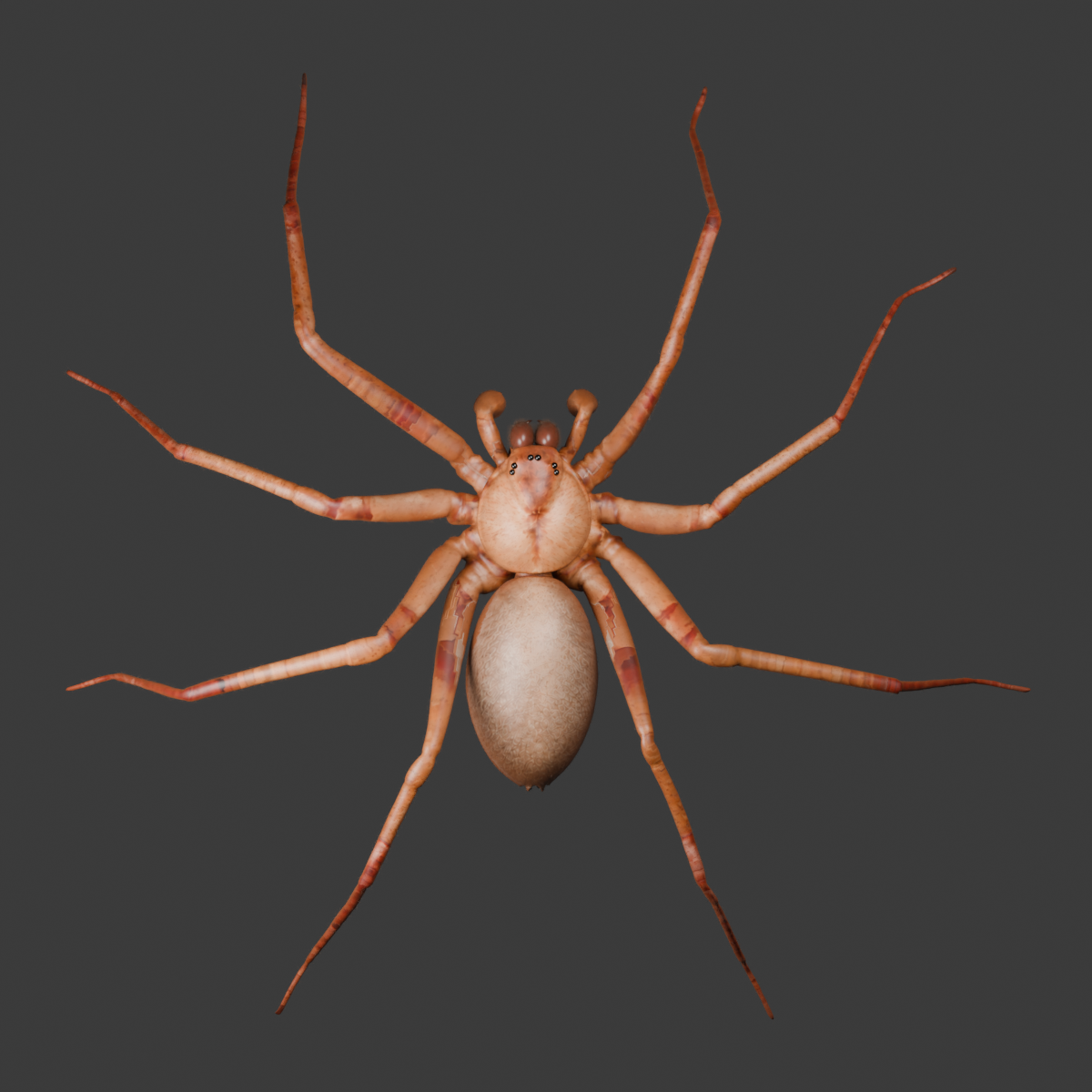
The Ultimate Valley of Mexico Recluse Spider References for 3D Animators
Measured anatomy, real gait mechanics, verified behaviour and a
12-clip animation list for Loxosceles tenochtitlan — the recluse spider
science only met in 2019, and the one that actually lives in Mexico City’s walls.
Body 6.7–10.4 mm
Leg span ~45 mm
Eyes 6, in 3 pairs
Still 85–90% of the night
Plates CC BY 4.0
Most spider rigs fail in the same three places. The legs bend like elbows instead of
folding like struts. The walk cycle is a mammal gait with four extra limbs bolted on. And
the idle never stops moving, because the animator could not believe a predator would sit
still for forty minutes.
All three mistakes are fixable. The fix is not taste, it is published measurement.
This page gathers what science actually knows about the Valley of Mexico recluse
spider: segment lengths in millimetres, the two leg joints that have no extensor
muscle at all, the share of the night the animal spends frozen, and what it really eats.
Then it turns each number into something you can key.
What you will find here
- The species file
- Reference plates
- The measured body
- Six eyes, and their limits
- Locomotion: hydraulics and gait
- 2025–2026 locomotion science
- Behaviour: where it hides
- What it eats
- The silk nobody expected
- The brown recluse comparison
- The 12 core animations
- Colour, scale and lighting
- Latest discoveries
- The paper library
- Image credits
- FAQ
1. The species file
The Valley of Mexico recluse spider, Loxosceles tenochtitlan,
was described in December 2019 by Alejandro Valdez-Mondragón and colleagues in
ZooKeys
892. It is named for Tenochtitlan, the Mexica city built on an island in Lake Texcoco
that Mexico City now sits on top of.
What makes it unusual is not the venom. It is the address. This is the first recluse
spider considered native to the Valley of Mexico, and its type locality
is a private house — Cruz Verde 132, Tlalpan, at 2,281 m elevation. For decades
these animals were collected and filed under Loxosceles misteca. Morphometrics
and DNA barcoding finally separated them.
Species card
- Binomial
- Loxosceles tenochtitlan Valdez-Mondragón & Navarro-Rodríguez, 2019
- Common names
- Valley of Mexico recluse spider; araña violinista del Valle de México; araña violinista Tenochtitlan
- Family
- Sicariidae (recluse and six-eyed sand spiders)
- Holotype
- Male, LATLAX-T001, Cruz Verde 132, Tlalpan, Mexico City, 10 Dec 2017
- Type coords
- 19.2921° N, −99.1742° W, 2,281 m
- Known range
- Mexico City (Tlalpan, Coyoacán), Estado de México (Cuautitlán Izcalli), Tlaxcala (Tepeyanco, Huamantla, Ixtacuixtla)
- Modelled range
- Trans-Mexican Volcanic Belt: Mexico City, northern Estado de México, western Puebla, most of Tlaxcala, parts of Hidalgo and Querétaro
- Habitat
- Synanthropic. Every known specimen came from inside a house or building — never from natural vegetation
- Medical status
- A Loxosceles, so treated as medically significant. Bites in the genus can cause cutaneous loxoscelism
Before you go hunting for live reference
Do not collect these animals yourself. Loxosceles venom contains
sphingomyelinase D, the enzyme behind the dermonecrotic wounds the genus is known for.
Use the published plates below, which exist precisely so nobody has to.
Also keep the fear proportionate. In the best-documented infestation on record,
a Kansas family collected 2,055 brown recluse spiders from their own
house over six months and nobody was bitten once
(Vetter
& Barger 2002). These are shy, slow-to-engage animals. Animate them that way.
2. Reference plates from Wikimedia Commons
The best free imagery of this species is the original description’s own figure set.
The authors released it under CC BY 4.0, so you can use it commercially
as long as you credit it. Full credit lines are in section 15.

(4–6) from Juárez Norte 214, Huamantla, Tlaxcala. This is the single most
useful plate for a modeller: live colour, live posture, and the sex difference in
abdomen volume in one frame. Photographs by Jared Lacayo-Ramírez, in
Valdez-Mondragón et al. 2019, CC BY 4.0.

female paratype (21–22), dorsal and ventral, with 1 mm scale bars.
Orthographic enough to use as blueprint planes. Note the ventral view: the sternum,
the coxal ring and the flat pedicel that hides between prosoma and abdomen.
Valdez-Mondragón et al. 2019, CC BY 4.0.

locality in Tlalpan. Red arrows mark exactly where in the house each one was
found. Set-dressing reference you cannot invent. CC BY 4.0.

the actual crevice environment they came out of. Photographs by José A.
Castilla-Vázquez and Alma R. Juárez-Sánchez. CC BY 4.0.

paratype, with the canal running along the embolus. If your spider is male, these
club-shaped palps read as “boxing gloves” in silhouette and are the fastest way an
audience tells the sexes apart. CC BY 4.0.
3. The measured body
Everything below comes from the type series in the 2019 description. Millimetres, not
vibes.
Overall proportions
| Measure | Male holotype | Female paratype | What it means for the rig |
|---|---|---|---|
| Total body length | 6.70 mm | 10.40 mm | Female is 1.55× the male |
| Carapace length | 3.20 mm | 3.75 mm | Only 1.17× — the head end barely changes |
| Carapace width | 2.90 mm | 3.25 mm | L/W 1.10 vs 1.15, near-circular both ways |
| Abdomen length (derived) | ~3.50 mm | ~6.65 mm | The entire sex difference lives here |
| Abdomen : carapace | 1.09 | 1.77 | Male reads leggy, female reads heavy |
| Longest leg (II) | 20.98 mm | 19.79 mm | Absolute leg length is nearly identical |
| Leg II : body length | 3.13× | 1.90× | The silhouette rule for the whole species |
| Leg span (derived) | ~44.9 mm | ~42.8 mm | 2 × leg II + carapace width |
The silhouette rule
Males and females of this species have the same leg length and different
bodies. A male is a small body slung inside a 45 mm span; a female is a heavy
abdomen inside the same span. If your two characters differ by scaling the whole rig,
you have got it backwards. Scale the abdomen, leave the legs.
Leg lengths, all four pairs
The leg formula is 2-1-4-3: leg II is longest, then I, then IV, then
III. This is the ordering you must respect when you place footfalls, because it makes the
footprint pattern a wide diamond rather than a rectangle.
| Leg | Male holotype | Female paratype | % of leg II (male) | Role |
|---|---|---|---|---|
| I | 18.55 mm | 18.73 mm | 88.4% | Forward reach, sweeps and probes |
| II | 20.98 mm | 19.79 mm | 100% | Longest. The primary feeler and the widest stride |
| III | 15.67 mm | 15.83 mm | 74.7% | Shortest. Tucked close, mostly stability |
| IV | 16.99 mm | 18.09 mm | 81.0% | Rearward brace and the main push-off |
Build to the mean, not to the holotype
Across the whole series the authors measured leg I at a mean of
18.10 mm in males (range 13.8–21.3, n = 16) and
22.36 mm in females (range 17.7–26.5, n = 24). The female
paratype in the table above, at 18.73 mm, is a small individual. For a hero asset use
the female mean and you land nearer a 50 mm leg span. A 20% size range
inside one sex is also your licence to build a crowd with real variation.
Inside one leg
A spider leg has seven segments: coxa, trochanter, femur, patella,
tibia, metatarsus, tarsus. Descriptions only measure femur through tarsus, so here is
the male’s longest leg broken down, with each segment as a share of what was measured.
| Segment | Length | Share | Animation note |
|---|---|---|---|
| Femur | 5.60 mm | 26.7% | Swings up and out from the body. Carries the lift |
| Patella | 1.12 mm | 5.3% | Tiny. It is a knuckle, not a knee segment |
| Tibia | 6.75 mm | 32.2% | Longest single segment. Sets the reach |
| Metatarsus | 6.20 mm | 29.6% | Angles down to the ground. The visible “shin” |
| Tarsus | 1.31 mm | 6.2% | The only part that flexes onto the surface |
Two numbers there do most of the work. The patella is 5.3% of the leg,
so the famous “spider knee” above the body is not a long segment — it is a sharp
angle change across a short one. And tibia plus metatarsus is 61.8% of
the leg, which is why a recluse silhouette is dominated by two long thin rods meeting at
a shallow angle near the ground.
A rig budget that matches the animal
| Region | Bones | Count | Notes |
|---|---|---|---|
| Legs | 7 per leg × 8 | 56 | Add an optional claw bone per leg if you need grip contact |
| Pedipalps | 6 per palp × 2 | 12 | No metatarsus. In males the tarsus carries the bulb |
| Chelicerae | base + fang × 2 | 4 | Fused basally in Loxosceles, so the bases move together |
| Core | prosoma, pedicel, opisthosoma | 3–5 | Give the abdomen 2–3 so it can squash and breathe |
| Spinnerets | three pairs | 6 | Only needed if you animate silk laying |
| Total | ~83 | Plus IK targets and pole vectors | |
If you have not rigged a multi-limbed creature before, the generation workflow in
our
Blender Rigify guide transfers directly — you are building eight short IK
chains instead of four long ones.
4. Six eyes, and what they cannot do

widely separated pairs, not the usual eight. Diagram by ThatSpiderByte,
CC BY-SA 4.0,
via Wikimedia Commons.
Get this arrangement right and arachnologists will forgive you a lot. Get it wrong and
you have modelled a different family. The six eyes sit as one central pair at the front
and one pair set back on each side, leaving conspicuous gaps between the groups.
The violin marking is the famous field mark, and L. tenochtitlan has a
notably well-defined one — the description calls it a “defined pale brown
violin-shaped pattern dorsally, darker toward the ocular region.” But violins vary,
fade, and appear on unrelated spiders. The eye arrangement is the reliable
character. Put your detail budget there.
What the animal actually senses
| Channel | Organ | Capability | How you animate it |
|---|---|---|---|
| Vision | Six simple eyes | Light, shadow and movement. No useful form vision | No head tracking. Ever. The prosoma cannot turn on a neck |
| Air movement | Trichobothria on tibia, metatarsus, tarsus | Filiform hairs that respond to air currents from an approaching hand or insect | The reaction starts in a leg, not in the eyes. Leg twitch first, body second |
| Substrate vibration | Slit sensilla and lyriform organs near the joints | Cuticle strain sensors; in studied spiders they fire at nanometre displacements up to about 1000 Hz | The spider responds to footsteps through the floor before anything is visible |
| Touch and chemistry | Tarsal hairs and palps | Contact chemoreception; recluses recognise and prefer refuges already lined with their own species’ silk | Legs I and II tap surfaces constantly while walking. The palps dab |
The single biggest realism win
Delete every head-turn in your spider animation. A spider’s sense organs are
distributed along the legs, so it orients by swinging the whole body, and it
investigates by sweeping legs I and II like antennae. A recluse “looking at” something
points two long forelegs at it and holds the body still. That one change does more for
believability than any amount of secondary motion.
5. Locomotion: hydraulics and gait
Spiders solved walking in a way no vertebrate does, and the difference is not
cosmetic. It changes your interpolation curves.
Two joints with no extensor muscle
The femur–patella and tibia–metatarsus
joints are the main flexion and extension joints of a spider leg, and neither has an
extensor muscle. The hinge axes sit at the dorsal rims of the segments, so muscles can
only pass the joint on the ventral side — geometrically, a muscle-driven extension
is impossible. Instead the spider extends those joints
hydraulically: dorsoventral muscles compress the prosoma, haemolymph
pressure rises, and the fluid pushes the segments apart.
Three consequences you can key
- Flexion is fast, extension is smooth. Pulling the leg in is
muscular and can snap. Pushing it out is a pressure ramp. Use ease-out on extension
and a tighter, punchier curve on flexion. Symmetrical ease on both sides is the
single most common tell of a hand-animated spider. - Body pressure and leg motion are coupled. The prosoma is the
pump. A tiny dorsoventral pulse on the cephalothorax, timed to the push-off, is free
realism — and it is mechanically true, not invented secondary motion. - The death curl is physics. When pressure fails, nothing extends
the legs, so they fold inward under the body. That is why dead spiders are always
found curled. It makes a beautiful, honest death pose.
One honest caveat, from
Weihmann
and colleagues (2012). In large, fast spiders during hard escape accelerations, the
ground reaction force vectors pass dorsally to the leg joints. The hydraulic
mechanism is therefore not doing most of the work at top speed. So use the pressure feel
for walks, stalks and pushes. In a flat-out sprint, the legs are thrown, not
inflated.
The gait: alternating tetrapod
Terrestrial eight-legged animals overwhelmingly use an alternating tetrapod:
the legs split into two sets of four, and the sets alternate. Number the legs L1–L4
on the left and R1–R4 on the right, front to back. Legs L1, R2, L3 and R4 move as
one set. Legs R1, L2, R3 and L4 move as the other. The two sets run half a cycle apart.
| Leg | 0% | 12% | 25% | 37% | 50% | 62% | 75% | 87% |
|---|---|---|---|---|---|---|---|---|
| L1 | stance | swing | ||||||
| R2 | stance | swing | ||||||
| L3 | stance | swing | ||||||
| R4 | stance | swing | ||||||
| R1 | swing | stance | ||||||
| L2 | swing | stance | ||||||
| R3 | swing | stance | ||||||
| L4 | swing | stance |
Set AL1 R2 L3 R4 Set BR1 L2 R3 L4 Duty factor 0.5 at a walk, falling as speed rises.
Four rules follow from that chart and from the leg measurements above.
- Every leg shares one cycle period. Leg III is 25% shorter than
leg II, but it does not step more often. It takes a shorter stride. Animators who give
short legs faster cycles produce a shimmering mess. - The footprint is a diamond. With a 2-1-4-3 formula, legs II plant
widest and furthest forward, leg III plants closest to the body. Lay your foot targets
out that way before you touch a curve. - The body barely bobs. Four legs are always down and the animal is
a crevice specialist. Vertical travel on the prosoma should be small — a fraction
of a millimetre at scale — and its rhythm is twice the stride frequency,
because both sets push. - Turning is stride-length asymmetry. Shorten the inside strides,
lengthen the outside ones. There is no pivot joint anywhere in the body to bend.
An honest gap in the literature
As of September 2026 there is no published kinematic study of
Loxosceles locomotion specifically. Nobody has put a recluse on a
treadmill with high-speed cameras. The gait framework above comes from tarantulas,
wandering spiders and general arachnid biomechanics, and it is the correct starting
point, but treat any recluse-specific stride number you find online as an
extrapolation. If a client asks for a citation, cite the arachnid literature and say
so.
6. What locomotion science found in 2025–2026
Three recent results change how a careful animator handles eight legs.
Spiders re-learn their gait in under a day
In June 2025, Suzanne Amador Kane and colleagues published the first application of
unsupervised machine learning to spider gait data in the
Journal of Experimental Biology. They filmed juvenile tarantulas running
intact, immediately after autotomising two legs, and again one day later.
The finding is striking: the spiders returned to their pre-autotomy speed and
stride frequency within a day, and again after the legs regrew. Path tortuosity
did not change. What did change was posture — autotomised spiders
widened the spread of the remaining legs to cover the missing footprint
and hold stability.
Direct production use
If your creature loses a leg in a shot, do not animate a permanent limp. Animate a
two-second stagger, then a wider stance and a normal-speed
walk. That is what the animal actually does, and it reads as competence rather than
damage — a much more frightening character beat.
The hydraulic story got more precise
Two 2025 papers refined the pressure picture. One, in the
Journal of Theoretical Biology, modelled semi-hydraulic actuation
and showed that moving haemolymph through the leg does not fight the muscle-driven
flexion — the two systems cooperate rather than compete. Another, in
Arthropod Structure & Development, extended hydraulic function to the
chelicerae, which matters directly here: the fang stroke of a recluse
is partly a pressure event, not purely a muscular snap. Give the bite a
load-and-release feel, with a beat of build-up before the strike.
Distribution is contracting
Not locomotion, but it belongs in any 2026 brief. A 2024 species-distribution study by
Valdez-Mondragón and Cortez-Roldán modelled four central Mexican
Loxosceles and projected that L. tenochtitlan‘s suitable range
shrinks 35–50% by 2050–2080, with only 20–30% of
currently occupied area persisting. Precipitation of the driest month alone contributed
41.8% of the model. A spider that already lives almost exclusively indoors is being
pushed further indoors.
7. Behaviour: where this spider actually hides
This is the section most spider animation gets wrong, because it is the section nobody
looks up. The behaviour of L. tenochtitlan is unusually well documented for a
species described so recently, because the describing team collected it in people’s
homes and wrote down exactly where.
Indoors, in Mexican cities
Every known specimen of this species came from inside a house or
building. The authors state plainly that it was never collected in natural
areas. The type locality is a street address. Here are the recorded hiding places, taken
straight from the description:
| Hiding place | Why it works | Set-dressing note |
|---|---|---|
| Wall cracks | Narrow, vertical, dark, undisturbed | The default. Everything else is a substitute for this |
| Behind decorative wall items | A permanent vertical gap nobody cleans | Picture frames, mirrors, hanging plates |
| Under beds and wardrobes | Dust, darkness, no traffic | Furniture that never moves is the key qualifier |
| Drawers and storage boxes | Layered cardboard makes crevices at every seam | Cardboard is the single best recluse prop |
| Doors and door frames | Gaps at hinges and jambs | Also the reason they end up walking across floors |
| Among wooden construction boards | Stacked timber is a crevice generator | Garages, patios, unfinished rooms |
| Under chairs and tables | Undersides are vertical-ish and never inspected | Good for a reveal shot |
| Between artificial plants | Fabric and plastic foliage, permanently still | A wonderfully specific, very real detail |
The geometry of a refuge
Recluse crevice preference has been measured, on the two best-studied species in the
genus, by Vetter
& Rust (2008). The numbers are unusually actionable for a layout artist:
Three things follow. Your crevice should be vertical. It should be
roughly a finger’s width, not a hairline. And it should look
used — a fresh clean gap is the one a recluse rejects. Dress the
inside with a thin, dusty, irregular silk lining and you have built the exact space these
animals compete for.
In nature
Honest answer: for this species, unknown. It has never been found outside a building.
The niche model puts its natural envelope in the Trans-Mexican Volcanic
Belt around 2,500 m, in temperate and pine-oak forest. Vegetation type alone
contributed 42% of that model. Ecologically, then, this is a highland
forest animal that happens to live in our walls. Elsewhere in the genus, recluses shelter
under rocks, under loose bark, in rodent burrows and in caves. If you need a natural set, build a rock-and-bark version of the same vertical,
finger-width, silk-lined crevice.
The activity budget, hour by hour
| Finding | Number | Source | Animation consequence |
|---|---|---|---|
| Time spent motionless while “active” at night | 85–90% | Cramer 2015 | Your idle is the primary animation. Budget for it |
| Daily activity spent near the retreat | >95% | cited in Cramer & Evers 2022 | Travel shots are the exception, not the rule |
| Activity rhythm | Unimodal, nocturnal | Solís et al. 2018 (L. laeta) | Mainly nocturnal, with some daytime movement |
| Dispersing individuals that were adult females | 0 of 23 | Cramer & Evers 2022 | Wanderers are juveniles and adult males |
| Ballooning on silk | None | haplogyne spiders are presumed not to balloon | Every journey happens on foot |
The behavioural thesis, in one line
This is a sit-and-wait animal that rarely leaves a small vertical crevice,
travels only on foot, and spends nearly nine tenths of its active night completely
still. A recluse crossing a bedroom floor is a rare event. Shoot it like a rare
event and the audience will feel it.
8. What it eats, according to the papers
No feeding study exists for L. tenochtitlan specifically. What we have is a
careful field diet study of a synanthropic Loxosceles reclusa population
(Cramer
2015), and it is far more interesting than the generic “eats insects” answer.
| Prey | Share | What it tells you |
|---|---|---|
| Other spiders | 25% | The commonest prey item is another spider. Recluses are serious araneophages |
| Beetles | 21% | Hard-shelled prey is handled fine |
| Woodlice | 15% | Slow, armoured, damp-loving. A crevice neighbour |
| Crickets | 13% | The classic lab prey, and a real one |
| Everything else | ~26% | Assorted small arthropods of the indoor fauna |
Sit-and-wait, not stalk-and-chase
The same study found that these spiders do not actively search for prey.
They sit on a small, irregular network of silk that works as a trip line, and they take
what walks into it. That is a completely different character from the roaming hunter most
spider animation depicts. The hunt is contact, seize, retreat, measured in a
handful of frames, bracketed by long stillness on both sides.
The scavenging argument
Here is a live scientific disagreement you can put in your shot notes.
| Study | Claim | Evidence |
|---|---|---|
| Sandidge 2003, Nature 426: 30 | Recluses prefer dead prey | In choice trials, roughly 85% took the dead item over an equally sized live one; observed scavenging in 25+ of 71 Kansas homes |
| Cramer 2008, J. Arachnol. 36: 140–144 | Recluses prefer live prey | Choice varied with satiation, prey size and carcass freshness; scavenging is opportunistic and behaviourally plastic, not a strategy |
| Cramer 2015, J. Arachnol. 43: 67–71 | Scavenging is rare in the field | More than 80% of experimentally offered dead prey was ignored |
The defensible position in 2026: a recluse is a sit-and-wait predator that
will scavenge when hungry enough and the carcass is fresh enough, but
does not go looking for corpses. If you want a narrative beat, the hungry-spider-accepts-a-dead-moth
shot is scientifically supportable. A spider preferring carrion is not.
9. The silk nobody expected
Recluse silk is genuinely strange, and it is a rendering opportunity almost nobody
takes.
In 2017 a team from William & Mary and Oxford found something new. Loxosceles
spins a flat ribbon about 50 nanometres thick, not the cylindrical
filament every other spider produces. No other arachnid does this. Along that ribbon the
spider lays down periodic sacrificial loops, anchored by silk-to-silk
bonds with no added adhesive. Under tension the loops pop open one after another. The
thread stretches and relaxes again and again instead of simply snapping, and it absorbs
many times more energy than a plain strand of the same strength.
How to render it
- Use ribbons, not tubes. A flat strip twists as it hangs, so it
flashes a specular highlight, goes dark as it turns edge-on, then flashes again. A
round filament cannot do that. It is the most recognisable thing about this silk and
it is free anisotropy. - No orb web. Ever. The retreat is an irregular, nondescript tangle
that thickens as new silk is added over weeks. It reads as dusty matted sheet, not
geometry. - Give the loops a purpose. If a thread has to hold in a shot, let
it stretch in small visible steps rather than a smooth elastic ramp. That staircase is
the loops opening, and it is real.
10. The brown recluse comparison
You will almost certainly be asked “is this the same as a brown recluse?” The answer
is: same genus, same body plan, same rig, different address and different genitalia.

the most-studied species in the genus. Nearly everything we know about recluse
behaviour was measured on this animal. CDC Public Health Image Library #1125, public
domain.

cosmopolitan and recorded in Mexico too. Note the identical leg architecture at a
different scale. Photo by Marino Linić, CC BY-SA 4.0.
| Species | Where it lives | Standing | What differs for you |
|---|---|---|---|
| L. tenochtitlan | Valley of Mexico: CDMX, Edomex, Tlaxcala | Described 2019. Native and strictly synanthropic | Unusually well-defined violin; asymmetric S-shaped seminal receptacles with accessory lobes |
| L. misteca | Guerrero, Morelos | Its closest relative; the two were confused for decades | Males have longer leg I — mean 23.75 mm vs 18.10 mm. Females lack accessory lobes |
| L. reclusa | Central and southern USA | The reference species of the genus | Same rig. Nearly all behavioural numbers on this page were measured on it |
| L. laeta | South America; widely introduced | The largest common recluse; most medically severe | Accepts narrower crevices (6.4 mm vs 9 mm). Bulkier read |
| L. rufescens | Mediterranean origin, now global | The invasive one; also recorded in Mexico | Slighter and paler. Good for a “wrong species in the wrong city” beat |
What all recluses share
- Six eyes in three separated pairs. The family signature.
- A flat body on long thin legs, with the 2-1-4-3 formula typical of
the genus. One rig genuinely serves all of them. - Chelicerae fused at the base, so the two fang bases move as a
unit — do not rig them as independent jaws. - Stridulatory lines on the lateral face of the chelicerae, recorded
in the 2019 description. That is the file half of a sound-making organ, which means
these animals have an acoustic channel in their behavioural repertoire. - Sphingomyelinase D in the venom, the enzyme behind loxoscelism.
A 2025 study in Int. J. Mol. Sci. split the enzyme into Class I and Class II
and showed Class I drives markedly stronger dermonecrosis.
Mexico is the world capital of this genus
Of roughly 149 described Loxosceles species worldwide, about
40 live in Mexico — close to 30% of the global total, the highest
diversity anywhere. The reclusa species group alone holds more than 50 species,
overwhelmingly North American. If you are building a Mexican environment, this genus is
the correct arachnid to put in it.
11. The 12 core animations
This is the clip list I would ship for a recluse used as a game creature, a
documentary insert or a horror beat. Frame counts assume 30 fps; halve
the swing timings for 60 fps rather than doubling the counts.
| # | Clip | Frames | Loop | Grounded in |
|---|---|---|---|---|
| 01 | Idle_Retreat_Hold | 240 | Yes | 85–90% of the active night is motionless |
| 02 | Idle_Alert_Sweep | 90 | Yes | Sense organs sit on the legs, so legs I and II probe |
| 03 | Walk_Cursorial | 20 | Yes | Alternating tetrapod, duty factor 0.5 |
| 04 | Scuttle_Burst | 10 | Yes | Escape run; duty factor falls below 0.5 |
| 05 | Freeze_Snap | 8 | No | Slit sensilla fire on substrate vibration; freezing is the first defence |
| 06 | Crevice_Squeeze | 45 | No | Vertical crevices, 6.4–9 mm, chosen 92% of the time |
| 07 | Wall_Climb | 24 | Yes | Wall cracks and door frames are the primary habitat |
| 08 | Strike_Bite | 14 | No | Cheliceral function is partly hydraulic: load, then release |
| 09 | Feed_Hold | 150 | Yes | Prey handled in place; 25% of the diet is other spiders |
| 10 | Silk_Dab | 60 | Yes | Retreat silk is added over weeks; refuges with silk are preferred |
| 11 | Groom_Leg_Draw | 80 | No | Sensory hairs need cleaning to keep working |
| 12 | Autotomy_Recover | 90 | No | Kane et al. 2025: stagger, widen stance, resume normal speed |
The five that carry the performance
01 · Idle_Retreat_Hold — the one you must not skip
Eight legs planted, body low, abdomen touching or nearly touching the substrate. Over
240 frames allow yourself: one slow pedipalp flex, one 1-pixel abdomen pulse every 60 or
so frames, and nothing else. No drifting, no breathing wave, no idle sway. The stillness
is the character. Then cut to clip 05 and the audience jumps.
03 · Walk_Cursorial — the 20-frame cycle
Frames 1–10, set A (L1 R2 L3 R4) is in stance while set B swings. Frames
11–20, they trade. Place foot targets in a diamond — legs II widest and
furthest forward, legs III tucked in. Keep the prosoma’s vertical travel tiny and give it
two bumps per cycle, one per push. Ease-out the extensions, snap the flexions.
That last rule is the hydraulic asymmetry from section 5 and it
is what separates a spider walk from a crab walk.
05 · Freeze_Snap — eight frames of total commitment
From any state, every leg stops within 2–3 frames, mid-stride if necessary. No
settle, no overshoot, no anticipation. Legs that were in the air simply stop in the air.
This is the hardest note to give a good animator, because everything in their training
says to cushion it. Do not cushion it.
06 · Crevice_Squeeze — the signature move
The body flattens and rotates so the widest dimension aligns with the gap, legs I and
II go in first and fold rearward along the body, and the abdomen is the last thing to
disappear. Because the preferred crevice is vertical, play it as a climb
into a slot, not a crawl under a lip. Forty-five frames, with the last ten being just an
abdomen sliding out of frame.
12 · Autotomy_Recover — the 2025 paper as a clip
Leg detaches. Two-second stagger with visible asymmetry. Then the remaining legs
spread wider and the walk resumes at full speed. Do not carry a limp
into the walk cycle — the measured animals did not. A creature that loses a limb
and keeps coming at the same speed is far more disturbing than one that hobbles.
The thirteenth clip, free
Death_Curl, 40 frames, no loop. All eight legs fold inward and
under the body, tarsi curling last. This is not stylisation: leg extension is
hydraulic, so when prosoma pressure fails there is nothing left to hold the legs open
and the flexor muscles win by default. It is the most scientifically honest death pose
in all of creature animation, and it costs you an afternoon.
Wiring these into a playable character is the same state-machine problem as any
quadruped. If you are building for a game, the setup in
idle,
walk and run locomotion in Unity maps onto this list directly, with Freeze_Snap as an
interrupt state rather than a blend.
12. Colour, scale and lighting
The palette
These swatches are approximations built from the published colour description plus the
live plates above. They are a starting point for a base colour map, not spectrophotometry.
Three details from the description worth building in. Femur I is darker than
the other femora in males. The violin mark deepens toward the eye
region rather than being flat. And the abdomen darkens
posteriorly, which gives you a free gradient that reads as volume under a single
light.
Scale, and the macro problem
A male is 6.70 mm long. In a scene authored at 1 unit = 1 metre, that
is 0.0067 units, which will fight your viewport clipping, your physics solver and your
subdivision tolerances. Model at 100× and scale down at the end, or
author the whole scene at 1 unit = 1 cm.
Then commit to the macro look, because there is no such thing as a wide-angle shot of
a 7 mm animal. At true macro magnification, depth of field is millimetres deep even at
f/16. Let the abdomen go soft while the eyes are sharp. Animators fight
this because it feels like a mistake. It is the single strongest cue that the audience is
looking at something genuinely tiny.
Lighting the cuticle
- Two speculars, not one. Arthropod cuticle is a thin, hard, slightly
translucent shell. A tight glossy lobe over a broad soft one sells it instantly. - Backlight the abdomen. The opisthosoma is soft and thin-walled, so
a rim from behind glows through it. The prosoma and legs do not. That contrast is the
quickest way to make a spider look alive rather than moulded. - Model the trichobothria individually. These long sensory hairs are
sparse, not a fur coat. A few dozen long ones on the dorsal faces of tibia, metatarsus
and tarsus, catching a rim light, do more than a million-strand groom. - Keep the key low and warm. Everything about this species is
crevices, floorboards and dusty corners. A hard low key with a long shadow reaching out
of a wall crack is the shot.
13. The latest discoveries, 2019 to 2026
| Year | Finding | Why it matters |
|---|---|---|
| 2019 | Loxosceles tenochtitlan described in ZooKeys 892 from Mexico City, Edomex and Tlaxcala | The first recluse considered native to the Valley of Mexico. Confirms Mexico as the world centre of the genus |
| 2019 | Four independent delimitation methods — neighbour-joining, ABGD, GMYC and bPTP — all recovered it as a distinct species | Not a judgement call. 49 mutations separate its COI haplotypes from L. misteca |
| 2019 | Geometric morphometrics of the male palpal tibia separated it from L. misteca statistically | A shape difference too subtle for the eye, proven with landmarks |
| 2024 | Zootaxa 5428: 192 specimens, 43 putative North American species analysed; 15 new putative species recognised | Mean intraspecific distance under 2%, mean interspecific 15.6%. Morphology has been undercounting this genus badly |
| 2024 | Distribution modelling projects a 35–50% range contraction by 2050–2080 | Driest-month precipitation alone explains 41.8% of the model |
| 2025 | Sphingomyelinase D split into Class I and Class II, with Class I far more dermonecrotic | Explains why severity varies so much between Loxosceles species |
| 2025 | Machine learning applied to spider gait for the first time; gait recovers within a day of leg loss | The best locomotion data the field has produced in years. See section 6 |
| 2026 | Still no Loxosceles-specific kinematic study | The open door. Whoever films a recluse at 1000 fps writes the reference everyone cites |

across ten Mexican Loxosceles. Red markers are L. tenochtitlan, which
forms its own well-supported cluster rather than nesting inside L. misteca.
Valdez-Mondragón et al. 2019, CC BY 4.0.
14. The paper library
Everything cited above, in the order you would want to read it.
The species itself
Valdez-Mondragón A, Navarro-Rodríguez CI, Solís-Catalán KP, Cortez-Roldán MR, Juárez-Sánchez AR (2019). ZooKeys 892: 93–133.
doi.org/10.3897/zookeys.892.39558 · open access · the source of every measurement on this page
Navarro-Rodríguez CI, Valdez-Mondragón A (2024). Zootaxa 5428(4): 527–548.
doi.org/10.11646/zootaxa.5428.4.4
Valdez-Mondragón A, Cortez-Roldán MR (2024). Revista Mexicana de Biodiversidad 95: e955376.
doi.org/10.22201/ib.20078706e.2024.95.5376 · open access
Behaviour, diet and refuge
Cramer KL (2015). The Journal of Arachnology 43(1): 67–71.
doi.org/10.1636/J14-44.1 · the 85–90% stillness figure and the prey breakdown
Vetter RS, Rust MK (2008). Journal of Medical Entomology 45(1): 36–41.
doi.org/10.1093/jmedent/45.1.36 · crevice width and the 92% vertical preference
Cramer KL, Evers DS (2022). The Journal of Arachnology 50(1): 23–26.
doi.org/10.1636/JoA-S-21-003 · who disperses, and why never by air
Solís R, Alfaro A, Segura B, Moreno L, Canals M (2018). The Journal of Arachnology 46(1): 21–25.
doi.org/10.1636/JoA-S-16-064.1 · unimodal nocturnal rhythm
Sandidge JS (2003). Nature 426: 30. · Cramer KL (2008). The Journal of Arachnology 36: 140–144.
doi.org/10.1038/426030a · read both; they disagree
Vetter RS, Barger DK (2002). Journal of Medical Entomology 39(6): 948–951.
PubMed 12495200 · the antidote to spider melodrama
Locomotion and materials
Kane SA, Quinn BL, Wu XK, Xi SY, Ochs MF, Hsieh ST (2025). Journal of Experimental Biology 228(12): jeb250243.
doi.org/10.1242/jeb.250243 · the newest hard gait data in the field
Weihmann T, Günther M, Blickhan R (2012). Journal of Experimental Biology 215(4): 578–583.
doi.org/10.1242/jeb.054585 · the nuance that stops you overdoing the hydraulics
Koebley SR, Vollrath F, Schniepp HC (2017). Materials Horizons 4(3): 377–382.
doi.org/10.1039/C6MH00473C · why recluse silk is a ribbon, not a thread
Pinto AFM, Lopes PH, Trufen CEM et al. (2025). International Journal of Molecular Sciences 26(7): 3012.
doi.org/10.3390/ijms26073012 · open access
15. Image credits
Every image on this page is free to reuse under the licence named. Attribution is a
condition of that licence, not a courtesy — keep these lines if you reuse the
images yourself.
- Plates 1–5, and the COI tree — Valdez-Mondragón A,
Navarro-Rodríguez CI, Solís-Catalán KP, Cortez-Roldán MR,
Juárez-Sánchez AR (2019), ZooKeys 892: 93–133,
doi:10.3897/zookeys.892.39558.
Live-specimen photographs by Jared Lacayo-Ramírez (Plate 1), Martín
Sánchez Vílchis (Plate 3), José A. Castilla-Vázquez and
Alma R. Juárez-Sánchez (Plate 4). Licensed
CC BY 4.0,
via Wikimedia Commons. - Six-eye diagram — ThatSpiderByte,
Loxosceles eye group,
CC BY-SA 4.0, via Wikimedia Commons. - Loxosceles reclusa — Centers for Disease Control and
Prevention, Public Health Image Library #1125. Public domain, via
Wikimedia Commons. - Loxosceles rufescens — Marino Linić, Rijeka, Croatia,
CC BY-SA 4.0, via
Wikimedia Commons.
16. Frequently asked questions
Is the Valley of Mexico recluse spider the same as a brown recluse?
No, but they are close cousins. Both are Loxosceles, they share the six-eye
arrangement, the flat body, the long thin legs and the 2-1-4-3 leg formula, so one 3D rig
serves both. L. tenochtitlan was described in 2019 from Mexico City and is
separated from its relatives by male palp shape, female seminal receptacles and about
13.8% divergence in the COI barcode.
How big is Loxosceles tenochtitlan?
The male holotype is 6.70 mm long in the body and the female paratype 10.40 mm. Legs
are far longer than the body: the longest leg, leg II, measures 20.98 mm in the male,
giving a leg span of roughly 45 mm. Across the full series, female leg I averages
22.36 mm, so an average female spans closer to 50 mm.
Where does this spider hide indoors?
In wall cracks first, then behind hanging wall decorations, under beds and wardrobes,
inside drawers and storage boxes, around door frames, among stacked timber, under chairs
and tables, and between artificial plants. It prefers vertical crevices of roughly
6–9 mm that already contain spider silk.
What does the Valley of Mexico recluse spider eat?
No study has examined this species directly. In the closely related brown recluse, the
measured field diet was 25% other spiders, 21% beetles, 15% woodlice and 13% crickets.
Recluses are sit-and-wait predators that take prey walking into a small silk trip line
rather than hunting it down, and they ignore more than 80% of dead prey offered to
them.
How do spiders extend their legs without extensor muscles?
Hydraulically. The femur–patella and tibia–metatarsus joints have hinge
axes on the dorsal rims, so muscles can only pass them ventrally and cannot extend them.
The spider compresses its prosoma with dorsoventral muscles, haemolymph pressure rises,
and the fluid pushes the segments open. For animators this means extension eases out
smoothly while flexion can snap — and it is why dead spiders curl their legs
inward.
What gait should a spider walk cycle use?
The alternating tetrapod. Legs L1, R2, L3 and R4 move as one set and R1, L2, R3 and L4
as the other. The sets run half a cycle out of phase, with a duty factor near 0.5 at
walking speed. All eight legs share one cycle period. Shorter legs take shorter strides
rather than stepping more often.
Is it dangerous?
It belongs to a medically significant genus whose venom contains sphingomyelinase D,
so treat any recluse with respect and never handle one. Keep the risk in proportion
though: a documented Kansas household collected 2,055 brown recluse spiders from their
own home over six months without a single bite. These animals avoid people.
Can I use these images in a commercial project?
Yes, with attribution. The plates from the 2019 description are CC BY 4.0, the CDC
brown recluse photograph is public domain, and the eye diagram and L. rufescens
photograph are CC BY-SA 4.0, which additionally requires that any adapted version of
those two images be shared under the same licence. Full credit lines are in
section 15.
Where to go next
Octopus referenceEight limbs again, but with no skeleton at all
Rigify for animalsThe rigging workflow behind the 83-bone budget
Locomotion in UnityTurning the 12 clips into a playable state machine
Jaguar referenceAnother Mexican predator, measured the same way
The production pipelineFrom reference plates to a game-ready asset
Written for animators, modellers and technical artists who would
rather cite a paper than guess. Corrections and better references are always welcome
— especially from anyone with a high-speed camera and access to a
Loxosceles.